Lang & Heyne Friedrich August I – A Pocket‑Watch‑Inspired Tribute in Gold and Platinum
Lang & Heyne is a boutique German house that has built its reputation on turning the elegance of historic timepieces…
By Vivir··Updated
In this review# Lang & Heyne Friedrich August I – A Pocket‑Watch‑Inspired Tribute in Gold and Platinum
Lang & Heyne is a boutique German house that has built its reputation on turning the elegance of historic timepieces into modern, hand‑crafted dress watches. The Friedrich August I is the brand’s homage to the Saxon monarch after whom it is named, and it arrives as a miniature celebration of early‑20th‑century pocket‑watch aesthetics rendered in precious metal. With a hand‑wound Caliber I movement, a double‑sunk enamel dial and a diamond‑crowned balance, the model aims to fuse historic romance with contemporary watchmaking precision. Below we unpack how the Friedrich August I fits into Lang & Heyne’s lineage, what it looks and feels like on the wrist, and whether its price of roughly US $56 300 is justified.
## Heritage — the model's place in the brand's line and its launch context
Lang & Heyne was founded in Dresden, a city that once housed the great workshops of the German Empire. The brand’s philosophy is to reinterpret the visual language of the late‑1800s and early‑1900s while employing today’s manufacturing standards. The Friedrich August I continues that narrative by directly referencing the pocket watches that would have graced a Saxon king’s vest pocket around 1900.
Although the exact launch year is not disclosed, the model appears alongside other historically inspired pieces in the brand’s catalogue, such as the Friedrich III, which is positioned as a top‑tier dress watch. The Friedrich August I shares this “dress” positioning, offering a formal silhouette that is unmistakably rooted in the past. Its reference number, FA‑I‑p‑w, signals a “pocket‑watch” inspiration (the “p”) and a water‑resistant case (“w”). By presenting the watch in both gold and platinum, Lang & Heyne underscores the regal theme, echoing the precious metals traditionally associated with royalty.
The model has been praised in multiple reviews for its “classy and noble” demeanor, a description that aligns with the brand’s goal of delivering pieces that feel like miniature works of art rather than mere time‑telling instruments. In that sense, the Friedrich August I is not just another entry in Lang & Heyne’s line; it is a statement of intent, a reminder that contemporary watchmaking can still be a vehicle for historical storytelling.
## Design & Case — case dimensions, materials, dial
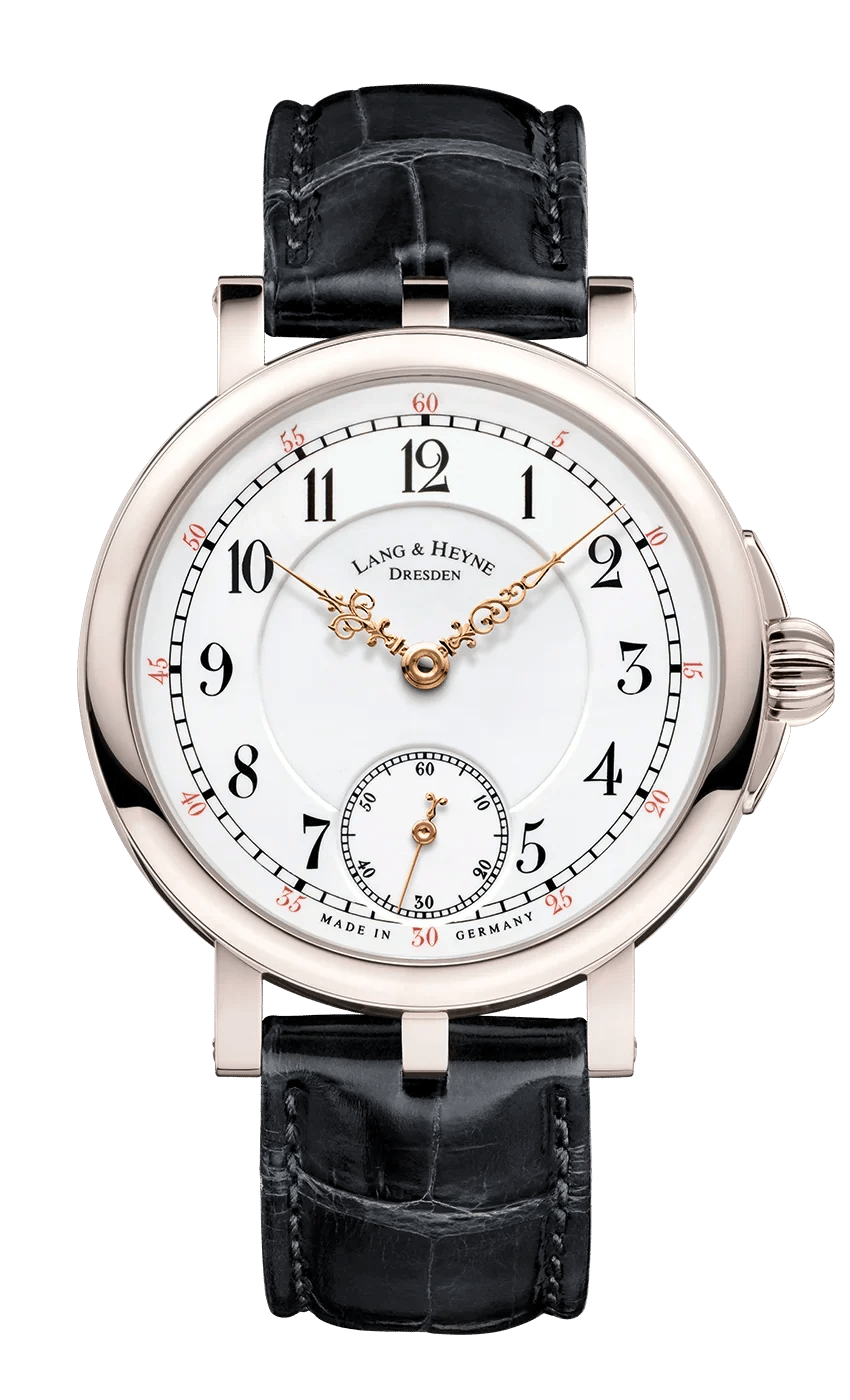
At first glance the Friedrich August I commands attention with a 43.5 mm case diameter—large enough to make a presence on the wrist but still restrained enough to retain a vintage pocket‑watch silhouette. The case is offered in either gold or platinum, each finished with a high polish that catches light in a manner reminiscent of aristocratic jewelry. A sapphire crystal backs the case, allowing the wearer to admire the hand‑finished movement while protecting it from scratches.
The dial is perhaps the watch’s most striking feature. Lang & Heyne employs a double‑sunk enamel technique, a labor‑intensive process that involves multiple firings to achieve a deep, luminous black surface. Arabic numerals are set in a classic, slightly raised style, providing clear readability while reinforcing the early‑1900s vibe. The hour markers are rendered as spade or Louis XV hands—both historically appropriate choices that add a sculptural quality to the face.
Crowning the balance is a single, brilliant‑cut diamond, a detail that reviewers have highlighted as “the ultimate in beauty.” This tiny gemstone not only adds sparkle but also serves as a visual anchor for the movement’s regulation system. Gold chatons hold the balance, a nod to the traditional construction methods of the era. The watch is water‑resistant to 30 meters, sufficient for everyday wear but not intended for swimming or diving.
Overall, the design balances opulence with restraint. The precious metal case, enamel dial, and diamond‑crowned balance work together to create a piece that feels both museum‑worthy and wearable—a rare achievement in the modern luxury market.
## Movement & Performance — caliber, power reserve, accuracy
Powering the Friedrich August I is Lang & Heyne’s in‑house Manual‑Winding Caliber I. The movement is built around a three‑quarter plate architecture, a historic layout that provides robustness while keeping the overall thickness modest. Gold chatons secure the balance, and the hand‑engraved balance cock is highlighted by the aforementioned diamond.
The Caliber I offers a 46‑hour power reserve, meaning the watch can run for nearly two full days after a single wind. For a manual‑wind dress watch, this is a respectable figure, allowing the wearer to take the watch off for an evening event without worrying about immediate rewinding. A noteworthy functional addition is the second‑hand stop mechanism, which lets the wearer halt the sweep hand for precise time setting—a feature rarely found in contemporary manual watches.
Specific accuracy data (e.g., seconds per day) has not been disclosed by the brand, so we cannot comment on the movement’s chronometric performance relative to Swiss standards. However, the combination of a hand‑finished balance, gold chatons, and a diamond‑crowned regulator suggests a high level of craftsmanship aimed at minimizing friction and ensuring stable oscillation.
The movement is visible through the sapphire caseback, offering a glimpse of the hand‑finished components and reinforcing the watch’s status as a collector’s piece as much as a timekeeper.
## On the Wrist — wearability, lug‑to‑lug, comfort notes
The Friedrich August I sits on the wrist with a presence that is both dignified and approachable. At 43.5 mm, the case is larger than many classic dress watches, yet the double‑sunk enamel dial and refined case proportions keep the silhouette from feeling bulky. The thickness is not explicitly stated, but the three‑quarter plate construction typically results in a modest profile that sits comfortably under a shirt cuff.
Gold and platinum, while luxurious, add a perceptible weight to the watch. Wearers accustomed to lighter titanium or stainless‑steel pieces may notice the heft, which, in the context of a dress watch, often translates into a feeling of solidity and quality. The 30‑meter water resistance means the watch should be protected from rain and brief splashes, but it is not suited for swimming or prolonged exposure to moisture.
Because the watch is manual‑wound, the wearer must remember to wind it daily (or at least every other day) to maintain power reserve. This ritual can be a pleasant reminder of the watch’s mechanical nature, but it does add a small maintenance consideration for those accustomed to automatic movements.
Overall, the Friedrich August I feels like a piece of jewelry that tells time. Its size and weight convey gravitas, while the polished case and enamel dial ensure it remains comfortable for extended wear at formal events.
## When to Wear — occasion, setting and dress‑code fit
Given its noble aesthetic and precious‑metal case, the Friedrich August I is unmistakably a dress watch. Its design language—Arabic numerals, spade or Louis XV hands, and a double‑sunk enamel dial—evokes the elegance of early‑20th‑century aristocracy, making it a perfect companion for black‑tie affairs, state dinners, and high‑end cocktail events.
In a business setting, the watch can serve as a conversation starter, especially among clients or colleagues who appreciate horological history. Its understated yet lavish details allow it to complement a tailored suit without overwhelming the overall look.
For more relaxed occasions—such as a gallery opening or a fine‑dining experience—the Friedrich August I still shines, as its gold or platinum case adds a touch of luxury without appearing ostentatious. However, it would feel out of place in casual environments like a weekend hike, a sports event, or any activity that could expose it to water beyond the modest 30‑meter rating.
In short, the watch excels wherever a refined, formal dress code is expected, and it can elevate any ensemble that calls for a touch of historic grandeur.
## Value & Verdict — price‑positioning + final take
Lang & Heyne lists the Friedrich August I at roughly US $56 300. At this price point, the watch competes with high‑end Swiss dress pieces that often feature automatic movements, sapphire crystals, and comparable case sizes. The Friedrich August I distinguishes itself through its unique blend of historic design cues, a hand‑finished manual‑wind Caliber I, and the rarity of a double‑sunk enamel dial—processes that are labor‑intensive and rarely seen in contemporary production.
From a value perspective, the watch offers:
* **Historical authenticity** – A design that directly references pocket watches from the early 1900s, something few modern brands attempt.
* **Craftsmanship** – Hand‑engraved balance, gold chatons, diamond‑crowned regulator, and enamel dial work that require specialized artisans.
* **Exclusivity** – Limited production runs typical of boutique manufacturers, meaning the piece is not mass‑produced.
The drawbacks are equally clear:
* **Manual winding** – While appealing to purists, it adds a daily ritual that some owners may find inconvenient.
* **Modest water resistance** – 30 meters limits use in wet conditions.
* **Size** – At 43.5 mm, the watch may be too large for those with smaller wrists, and the lack of an official lug‑to‑lug measurement makes precise fit assessment difficult.
* **Price** – The $56 k tag places it in a niche market; buyers must be convinced that the historical design and hand‑finished details justify the premium over more technically advanced (e.g., automatic) alternatives.
**Verdict:** The Friedrich August I is a masterclass in marrying historic aesthetics with modern horological execution. For collectors who value artistry, hand‑finished enamel, and a tangible connection to the past, the watch delivers an experience that far outweighs its functional limitations. Its price reflects not just the materials but the rarity of the craftsmanship involved. If you seek a watch that serves as both a statement of refined taste and a conversation piece steeped in Saxon royal heritage, the Friedrich August I stands as a compelling, albeit expensive, choice. For those who prioritize practicality—automatic winding, higher water resistance, or a more modest price—other options may serve better. Nonetheless, within its niche, Lang & Heyne’s Friedrich August I succeeds admirably, offering a timeless elegance that feels as appropriate on a 1900s pocket as on a 21st‑century wrist.