Lang & Heyne Friedrich II: The Serious Collector's Review
Lang & Heyne does not build watches for people who need a spec sheet to feel something. The Friedrich II is a dress watch from Dresden with a hand-wound, hand-finished movement, a restrained dial, and a production volume that makes Rolex look mass-market. That is the context you need before you look at the price. This is not a value play in the usual sense. It is a craft purchase, a low-volume independent, and a watch that asks you to care about anglage, bridge shapes, and the quiet confidence of a small maker.
The Serious label fits the Friedrich II because it refuses to chase sports-watch fashion. There is no bezel action, no lume, no oversized case, and no marketing narrative about exploration. It is a formal watch with a serious movement. For a young collector building a collection around actual watchmaking rather than resale screenshots, that is exactly the appeal. For a flipper, it is a warning label.
This review covers the Friedrich II as a collector's object: what the brand is, how the movement is finished, how it wears, what to expect for accuracy, and how to think about hold versus sell in a market where public data is thin. The short version: buy it for the craft, hold it with patience, and do not expect Submariner liquidity.
Manufacture history: Dresden, small series, high craft
Lang & Heyne was founded in Dresden in 2001, and the brand's identity is tied to the Saxon watchmaking tradition rather than to a large industrial group. The company works in small series, with an emphasis on hand-finished mechanical movements and classical watch design. That matters for the Friedrich II because the watch is not just a dial and a case; it is a statement about how a small manufacture can still make a movement worth turning over.
The name Friedrich II places the watch in a line of historical references that Lang & Heyne uses across its collection. The brand is not trying to be A. Lange & Söhne with a different logo. It is smaller, more artisanal, and more dependent on the collector's willingness to know what they are looking at. That is also why the secondary market is opaque. There is no global retail network pushing volume, no endless waitlist content cycle, and no huge auction record to anchor expectations. You have to evaluate the watch on the movement and the maker.
The movement: the reason to pay attention
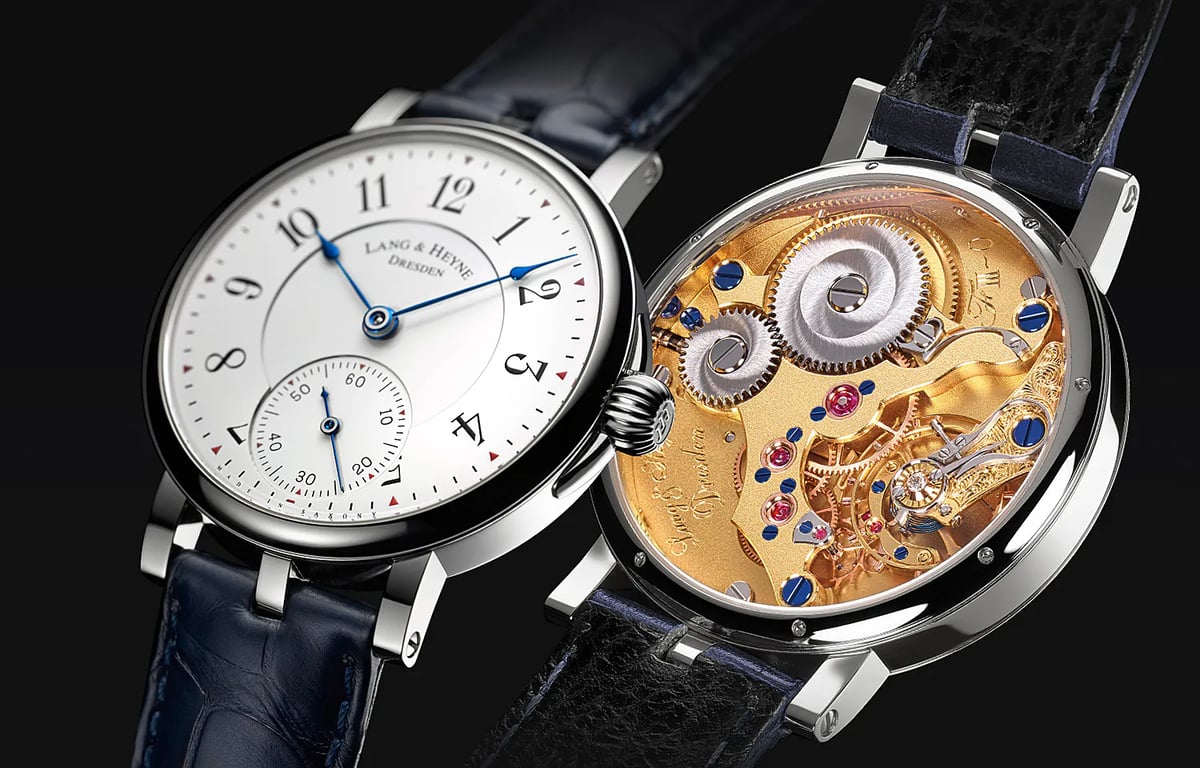
The Friedrich II is a manual-wind watch with an in-house Lang & Heyne calibre. The exact numeric designation of the calibre is less important than the architecture and finishing, because this is where the brand earns its keep. The movement is built in the Saxon tradition: hand-finished bridges, polished steel components, and the kind of details that are usually hidden in a closed caseback. The point is not chronometric certification or a high-frequency beat. The point is that a watchmaker spent time on the surfaces you will see when you turn the watch over.
Lang & Heyne movements are known for hand-engraved balance cocks, gold chatons, and a warm, traditional look. The Friedrich II fits that profile. It is a connoisseur's movement rather than a techno-flex. If your idea of value is a silicon escapement and a 70-hour power reserve, you are looking at the wrong watch. If your idea of value is a movement that looks like it was made by people rather than programmed by a machine, the Friedrich II is speaking your language.
The watch is not COSC-certified. That is not a flaw in this context; it is a different product philosophy. Independent makers often regulate by hand and deliver excellent real-world performance without paying for a certification that matters more in mass-market sports watches. The lack of certification does not mean the watch is inaccurate. It means the marketing story is about finishing and craft, not lab standards.
Case, dial, and the serious dress-watch formula
The Friedrich II is a formal watch. The case is designed to slip under a cuff rather than dominate a room. The dial is restrained, with a classical layout and a small seconds display that keeps the design from feeling like a generic three-hander. The overall effect is sober, legible, and deliberately unflashy. This is the kind of watch that looks better in person than in a thumbnail, because the quality is in the proportions, the printing, the hands, and the way the light moves across the dial.
Lang & Heyne does not use lume on a watch like this. There is no pretense of being a sports watch. The crystal is sapphire, the strap is leather, and the case is gold in the editions that matter to collectors. The Friedrich II is not a beach watch, a gym watch, or a travel beater. It is a dress watch with a manual movement, and it should be treated that way. If you need one watch for everything, this is not the one. If you need a watch for the moments when a suit or a jacket is the point, it is very much the one.
The Serious edition angle is appropriate because the watch does not rely on novelty. There is no skeleton dial screaming for attention, no oversized date, no tourbillon as a party trick. The Friedrich II is serious in the way a good suit is serious: the details are quiet, but they are not accidental. That is also why it ages well. Trend-driven watches tend to look dated when the trend passes. A well-proportioned dress watch with a hand-finished movement tends to look more valuable as the rest of the market gets louder.
On the wrist: comfort, balance, and presence
On the wrist, the Friedrich II behaves like a proper dress watch. It sits close to the wrist, the lugs and strap work together without awkward gaps, and the case does not feel top-heavy. The manual movement helps here because there is no rotor adding thickness or mass. The watch feels balanced rather than dense, and it disappears under a cuff in the way a formal watch should. Comfort is excellent for long days at a desk, dinners, and any occasion where you are wearing something with a collar.
This is not a watch with wrist presence in the modern sense. It does not announce itself from across the room. Its presence is for the person sitting next to you at dinner who knows what they are looking at. I would rate it four out of five for connoisseur presence: discreet, confident, and clearly expensive to the right eyes, but not a status object for the wrong ones. If you want a watch that gets comments from strangers, buy a steel sports watch. If you want a watch that gets comments from watchmakers, buy this.
Accuracy and daily expectations
Real-world accuracy for an independent hand-wound watch should be judged piece by piece. The Friedrich II is not a quartz watch, and it is not certified by a chronometer body. Expect a well-regulated mechanical movement with daily variance in the low single digits to a few seconds, depending on how it is worn and regulated. The exact number matters less than consistency. A watch that runs plus three seconds per day every day is easier to live with than one that swings wildly from day to day.
Because this is a manual-wind watch, you will interact with it. You will wind it, set it, and notice how it feels. That is part of the ownership experience. If you want a watch you can put on and forget for a month, a manual dress watch is the wrong format. If you want a ritual, the Friedrich II delivers. The movement is the point, and the winding experience is part of the point.
Market context: resale data, demand, and hold versus sell
Here is the honest market view. Lang & Heyne is an independent brand with low production and a narrow collector base. Public resale data for the Friedrich II is thin. That means you should not underwrite a purchase like this with a spreadsheet that assumes liquidity. The watch is not a Rolex Submariner, a Patek Philippe Nautilus, or an A. Lange & Söhne Odysseus. It does not have a deep, transparent, daily-traded market. It has a small group of buyers who understand the brand and a larger group who have never heard of it.
That cuts both ways. On the positive side, scarcity supports the idea that well-preserved examples will find buyers when they appear. On the negative side, finding that buyer can take time. If you need to sell quickly, you will likely take a haircut. If you can wait, the right collector will pay for condition, full set, and service history. The trend is best described as stable rather than appreciating. There is no evidence of a speculative bubble in Lang & Heyne, and that is probably healthy. The brand is not being pumped by hype cycles, which means the collectors who own it tend to be serious.
My hold recommendation is straightforward: hold if you bought for the craft. Sell only if you need liquidity, if the size or format no longer suits your collection, or if you have a genuine opportunity to upgrade within the independent space. Do not buy the Friedrich II as a short-term flip. Do not expect it to fund your next purchase in six months. Buy it because you want a hand-finished Saxon dress watch from a small maker, and because you are comfortable with a narrow resale market.
Auction history for this specific edition is not meaningful. Independent-brand results are sporadic, and you should not use a one-off auction price as a benchmark without context. If you are buying pre-owned, insist on the full set, ask for service records, and have the movement inspected by someone who knows independent watchmaking. The cost of a bad purchase is higher than the cost of a good inspection.
Variants and alternatives
Lang & Heyne editions can vary by dial finish, case metal, and strap configuration. The Friedrich II is the core reference point, and The Serious label is best understood as an edition or collector descriptor rather than a mass-market model line. If you are hunting one, confirm the exact configuration with the manufacturer or a reputable dealer. Do not assume that every Friedrich II has the same dial or case metal. Independent brands often build to order, and that is part of the charm and the complications of buying one.
Within the brand, the Friedrich August is the obvious sibling for collectors who like the classical Lang & Heyne language. Other Lang & Heyne models such as the Moritz and Georg are worth knowing if you are building a small collection around the brand. They are not substitutes for the Friedrich II; they are different expressions of the same philosophy. The Friedrich II is the serious dress watch in the lineup, and that is its job.
If you are comparing alternatives, the A. Lange & Söhne Saxonia Thin is the obvious German dress-watch benchmark. It has broader market recognition and a deeper service network, but it is also a much larger brand with a different ownership experience. The D. Dornblüth & Sohn 99.1 is an independent German hand-finished dress watch at a lower price point, though it does not have the same level of movement decoration. The Vacheron Constantin Traditionnelle Manual-Winding is a classical hand-wound dress watch with a broader network and more liquidity. The Patek Philippe Calatrava is the blue-chip default. The Nomos Lambda is a German dress watch with an in-house calibre, but its finishing is more industrial than Lang & Heyne. None of these watches is a direct substitute. They are different answers to the same question.
There is no meaningful homage market for the Friedrich II. The brand is too niche, the movement is too expensive to copy, and the design is not famous enough to inspire a wave of lookalikes. That is a good thing. You will not see a cheap clone on every wrist, and that supports the watch's identity as a collector's object.
Service and ownership
Service should be arranged through Lang & Heyne or an authorized partner. This is not a watch you hand to the local mall kiosk. The movement has hand-finished components and traditional Saxon details, and it deserves a watchmaker who understands independent construction. Service intervals depend on wear, but a mechanical watch like this should be inspected every few years and serviced when performance or condition demands it. The exact cost will depend on the work required. Budget for proper care, and keep the paperwork.
Ownership is part of the value proposition. You are not buying a watch that every jeweler can service. You are buying into a small maker with a specific philosophy. That means you need to be comfortable with a more personal relationship with the brand or its partners. For some collectors, that is a feature. For others, it is a hassle. Be honest with yourself about which collector you are.
Pros and cons
The pros are obvious to anyone who values watchmaking. The hand-finishing is exceptional for the price point. The design is classical and versatile. The low production gives it a sense of scarcity that is not manufactured by a marketing department. The movement is the star, and the watch is the kind of object that rewards ownership over time.
The cons are equally clear. Resale liquidity is thin. The service network is limited. It is not a sports watch and it is not a daily beater. If you need one watch for everything, this is not it. If you need a watch that will hold value like a steel sports Rolex, this is not it. The Friedrich II is a connoisseur's purchase, and connoisseur purchases come with connoisseur problems.
Final verdict
The Lang & Heyne Friedrich II is a serious collector's dress watch. It has a hand-finished Saxon movement, a restrained design, and a level of craft that is increasingly rare in a market dominated by hype cycles. It is not the easiest watch to flip, and that is the point. Buy it for the craft, hold it with patience, and enjoy the fact that you are wearing something that most people will never understand.
If you are a young collector building a collection with intention, the Friedrich II is worth considering alongside the usual blue-chip dress watches. It offers a different kind of value: not liquidity, not mass recognition, but the daily pleasure of a movement made by people who care. That is a serious proposition.