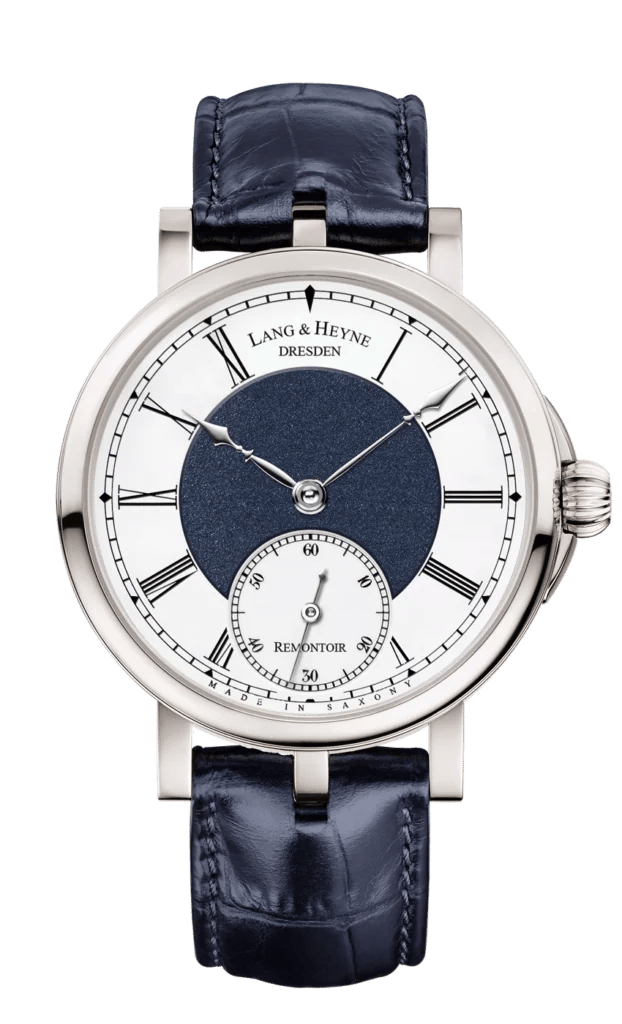
Reference FD3L11M12H1003 — a rectangular hand-wound dress watch with a constant-force remontoir from one of Germany's smallest ateliers.
The short version
Lang & Heyne does not chase the market. The Dresden house, founded in 2001 by Marco Lang and Mirko Heyne, builds a few dozen watches a year, most of them to order, and finishes them by hand to a standard that makes a lot of Swiss haute horlogerie look like it came off a conveyor. So when the atelier drops a remontoir d'égalité into the Friedrich III — its rectangular dress watch — it is not chasing a trend. It is making an argument about what a small German workshop can still do.
The Friedrich III Remontoir, reference FD3L11M12H1003, is the sort of watch that does not photograph well and does not need to. It is quiet on the dial and loud under the sapphire caseback, where the constant-force mechanism and the Saxon finishing do the talking. It is also the kind of piece that rewards a buyer who cares more about how a movement is made than about what the spec sheet says — which is convenient, because Lang & Heyne publishes very little of the latter.
Dresden, not Glashütte
Glashütte gets the headlines. Dresden, twenty minutes up the Elbe, is where Marco Lang's father Rolf spent years restoring instruments at the Mathematisch-Physikalischer Salon — the royal cabinet of clocks and scientific instruments that still sits inside the Zwinger. Marco grew up around that. When he and Mirko Heyne founded Lang & Heyne in 2001, they set up in Dresden rather than in the valley where Lange, Glashütte Original and Nomos cluster, and the decision still defines the brand. Heyne left a year later; Lang has run the atelier ever since.
Output is tiny. A few dozen watches a year, most of them built to order, which is why you almost never see one in a boutique and why the secondary market is so thin. What you do see, when you handle one, is finishing that leans hard on Saxon tradition: frosted plates, gold chatons, hand-engraved balance cocks, anglage cut by hand on every bridge. This is the context for the Friedrich III Remontoir. It is not a mass-market statement; it is a calling card.
What a remontoir actually does
Every mechanical watch has a torque problem. A mainspring delivers its most force when fully wound and its least when nearly unwound, so the escapement receives a slightly different push at the start of the day than at the end of the week. Most watches simply absorb that variation and get regulated to an average. A remontoir d'égalité refuses to accept it.
The mechanism inserts a secondary spring between the mainspring and the escapement. Energy from the mainspring is stored in that small spring and then released to the going train in even, metered packets — classically once per second. The balance therefore sees a consistent supply of torque whether the watch was wound five minutes ago or thirty hours ago. The result is not necessarily a spectacular instantaneous rate; it is a rate that stays put.
This is why the remontoir matters more to an owner than to a spec sheet. On a watch without constant force, you learn to live with a piece that runs a touch fast on Monday and settles by Thursday. On a remontoir watch, that drift flattens out. It is one of the few complications that improves the experience of wearing the watch rather than the experience of showing it to someone else — and it is a mechanism that very few houses bother to engineer, because it is expensive, delicate and invisible from the front.
The watch itself
The Friedrich III is Lang & Heyne's rectangular dress watch, and the Remontoir version is the same idea taken to its logical conclusion. The case is rectangular, in precious metal, with the kind of softly curved profile that photographs as flat and reads as sculptural in person. Lang & Heyne builds to order, so case metal, dial finishing and engraving can be specified by the buyer; the family has been offered in gold and platinum, and individual commissions vary.
Crystal is sapphire, front and back. The dial is hand-finished and classical in layout — this is not a watch with a busy face. There is no luminous material anywhere, which is correct for a piece like this; a dress watch that glows in the dark is a dress watch that has misunderstood itself. The strap is leather, closed with a pin buckle, which keeps the profile slim under a cuff and keeps the visual weight on the case where it belongs.
One thing worth saying plainly: Lang & Heyne does not publish a full dimensional or technical specification for this reference, and we are not going to invent one. Case diameter, thickness, lug-to-lug, water resistance and the movement's jewel count and frequency are not figures we can verify for FD3L11M12H1003, so we have left them out rather than fill them with numbers borrowed from a different watch. If those figures decide the purchase for you, ask the atelier directly — they will tell you, because they are building the watch for you anyway.
The movement
What we can say is that the movement is in-house, hand-wound, and built around the remontoir. Lang & Heyne's finishing vocabulary is unmistakably Saxon: frosted surfaces on the plates, gold chatons set into the bridges, and a balance cock engraved by hand, which means no two are quite the same. Under a loupe, the interior angles on the bridges are cut and polished by a person, not a machine, and the screw heads are polished and blued in the traditional manner.
The remontoir itself sits in the going train as a secondary spring and release mechanism. It is the kind of engineering that only makes sense at this scale — a large manufacturer would look at the cost, the assembly time and the service complexity and quietly shelve it. A workshop producing dozens of watches a year can justify it, because the whole point of the workshop is that it can.
Because the movement is hand-wound, there is a daily ritual attached to ownership. You wind it in the morning. You feel the mainspring load up. On a remontoir watch, that ritual has a small extra reward: you know that the energy you are feeding in is being metered out evenly rather than dumped at the escapement. It is a small thing. It is also the difference between a watch and a mechanism.
On the wrist
Rectangular watches live or die on proportion rather than on millimeter counts, and the Friedrich III gets the proportions right. It sits flat against the wrist, the lugs curve away cleanly, and there is no crown digging into the back of your hand. It disappears under a shirt cuff the way a proper dress watch should, which is the entire point of the genre and something a surprising number of modern dress watches fail at.
The balance between case, strap and movement is what stands out. Nothing feels specified by committee. The leather strap is soft enough from day one that there is no break-in period worth mentioning, and the pin buckle keeps the whole assembly low-profile. Because the atelier works to order and does not publish a dimensional sheet for this reference, the honest advice is to handle one before you commit if you possibly can — not because the watch is awkward, but because rectangular cases are personal in a way round ones are not, and the only reliable test is your own wrist.
Accuracy and living with it
There is no chronometer certification here, and Lang & Heyne does not publish a rate specification for this reference. What the remontoir buys you is not a spectacular number on day one; it is a more stable number across the whole run of the mainspring. Watches without constant force tend to run slightly fast when freshly wound and drift as torque falls off. A remontoir flattens that curve.
In practice, expect a well-regulated hand-wound movement to keep time within a few seconds a day, and expect the remontoir to hold that figure more consistently over the course of a week. Time it over seven days rather than seven hours, and let the atelier regulate it at service if you want it tighter. This is a watch that rewards a patient owner, and the mechanism inside it is designed for exactly that kind of patience.
The market
Lang & Heyne does not publish list prices widely, and this reference is built to order, so pricing is a conversation with the atelier rather than a number on a website. Expect a high-five-figure to six-figure USD proposition depending on case metal, dial specification and any bespoke engraving — and treat any figure you see quoted secondhand with caution, because there simply are not many of these watches trading publicly.
That thinness cuts both ways. On the one hand, production in the dozens means scarcity is structural; the brand cannot flood its own market, and the collector base for independent German watchmaking is only growing. On the other hand, liquidity is limited. If you need to sell quickly, you are selling into a small pool of buyers who already know what the watch is. The right way to think about the Friedrich III Remontoir is as a long-term hold: buy the object, enjoy the object, and let the market do whatever it does in the background.
What else to look at
If you want a German rectangular dress watch and you want it easier to service, the A. Lange & Söhne Cabaret is the obvious comparison — discontinued, beautifully made, and far more liquid. If you want a blue-chip name in the same silhouette, the Patek Philippe Gondolo is the default answer. If what actually attracts you is the constant-force mechanism, the F.P. Journe Tourbillon Souverain is the most famous modern remontoir d'égalité, and the Romain Gauthier Logical One solves the same torque problem with a totally different chain-and-fusee architecture.
None of those watches are the same proposition. The Cabaret and the Gondolo are rectangles; the Journe and the Gauthier are constant-force machines. The Friedrich III Remontoir is the rare piece that is both, from a house small enough that owning one still means something.
Verdict
The Friedrich III Remontoir is not a watch you buy with a spreadsheet. It is a watch you buy because you want a rectangular dress piece with a mechanism most of the industry does not bother to build, finished by hand in a city that has been doing this work for three centuries. Against a Cabaret or a Gondolo it asks more patience and offers less liquidity — and in return it gives you something almost nobody else at the table will be wearing.
If you are the kind of collector who reads the movement before the dial, this is your watch. If you need a published spec sheet before you commit, it is not — and that is fine, because Lang & Heyne is not building it for you anyway.