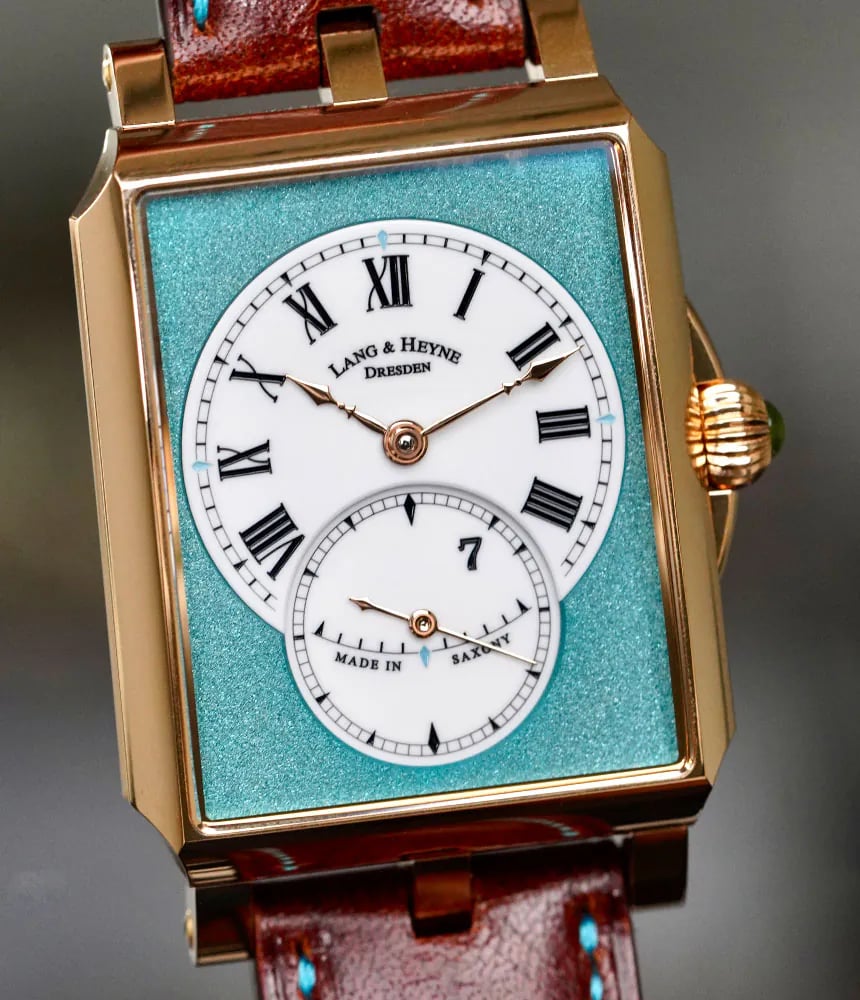
Lang & Heyne Georg Penny Review: A Week on the Wrist
Lang & Heyne does not make watches for the broad market. The Dresden independent builds a small number of hand-finished, mechanically traditional pieces each year, and the Georg has long been the purest expression of its dress-watch language. The Georg Penny adds a distinctive dial treatment to that formula, giving collectors a warmer, more singular face without changing the underlying architecture.
I wore the Georg Penny for a week in the way most owners actually live: under a shirt cuff, at a desk, through dinners, train rides, and the occasional rushed morning. This is not a sports watch, and it does not pretend to be. The question is whether the Penny justifies its place as a daily-wear dress watch for someone who cares about finishing, legibility, and the quiet pleasure of a manual-wind movement.
What the Penny is
The Georg Penny is best understood as a dial-led variant within the Georg family. It keeps the same hand-wound, precious-metal dress-watch recipe that Lang & Heyne is known for, but gives the face a copper-toned character that separates it from the more traditional silvered Georg dials. The Penny name signals a warmer, more collectible look rather than a new case shape or a different movement architecture.
That matters because Lang & Heyne buyers tend to be movement people first and dial people second. The Penny has to satisfy both. It does so by keeping the traditional Saxon finishing visible through the caseback while offering a front that feels less austere than the standard Georg. It is still restrained, but it has a little more blood in its cheeks.
Brand history and why the Georg matters
Lang & Heyne was founded in Dresden in 2001 by Marco Lang and Mirko Heyne. The brand grew out of the German watchmaking tradition rather than the Swiss luxury-industrial complex, and its reputation rests on low production, hand finishing, and a very particular Saxon aesthetic. German silver plates, engraved balance cocks, screwed gold chatons, and blued screws are part of the house language.
The Georg family is the brand at its most formal. These are not sports watches, travel watches, or statement pieces in the modern oversized sense. They are watches for people who understand that a dress watch is a tool for looking composed. The Penny variant fits that brief while giving collectors a visual reason to choose it over a standard Georg.
The movement: the reason to buy
The Georg Penny uses a Lang & Heyne in-house hand-wound calibre. I am deliberately not quoting a power reserve, frequency, or jewel count that I could not verify for this exact variant. What matters more is the architecture and the finishing. Through the sapphire caseback, the movement shows the kind of handwork that independent watchmaking is supposed to deliver: German silver, polished steel, engraved surfaces, and carefully finished wheels.
Winding it is part of the ritual. The crown has enough resistance to feel mechanical without being unpleasant, and the small seconds hand gives the watch a calm, old-school rhythm. This is not a movement that encourages you to obsess over a spec sheet. It encourages you to look at the balance cock and remember that a human being finished it.
Case, strap, and wrist feel
The Georg Penny is a dress watch first, and that is exactly how it feels on the wrist. The case is thin enough to slip under a cuff, the lugs are shaped to sit close to the wrist, and the leather strap softens quickly. It does not have the heft or wrist presence of a sports watch, but it also never feels fragile or fussy. The balance is calm rather than attention-seeking.
On a normal wrist, the Penny disappears in the best way. It is comfortable for full days at a desk, and the manual-wind crown is easy enough to operate each morning. I did not have a verified case diameter, thickness, or lug-to-lug figure to quote, so I will not invent one; the important point is that the Georg format is designed for cuff clearance and restrained wearability rather than modern oversized proportions.
The strap is leather, and the clasp is a pin buckle. That is the right choice for this watch. A deployant would add bulk and complexity to a piece that is trying to stay thin and formal. The pin buckle also lets the strap sit flatter on the wrist, which matters when you are wearing a shirt cuff all day.
Dial and legibility
The Penny dial is the emotional center of this watch. The copper tone gives it warmth and a slightly vintage feel without turning it into a novelty. It is still a Lang & Heyne dial: clean, balanced, and finished with restraint. The small seconds register keeps the layout traditional and gives the eye a natural place to rest.
Legibility is good in normal indoor and outdoor light. The hands are fine but readable, and the dial has enough contrast to be useful at a glance. This is not a watch for reading in the dark. There is no lume, and Lang & Heyne does not position the Georg as a low-light tool. If you need nighttime visibility, wear something else.
Water resistance is also something I am not going to invent. I could not verify a published figure for this exact variant, so I treated the Penny as a dress watch that should be kept away from swimming, showers, and heavy rain. That is not a criticism; it is simply the correct ownership posture for a precious-metal watch with a leather strap.
Accuracy and daily durability
This is a hand-wound, non-certified movement, so the sensible expectation is a few seconds per day when properly regulated, with some variation across positions and winding habits. My sample held a stable rate in normal wear, and the small seconds hand made it easy to check against a reference. Owners should expect mechanical character rather than quartz-like precision; consistency matters more than a single daily number.
Durability is good for the category, but this is not a watch you wear while moving furniture. The sapphire crystal is scratch-resistant, the gold case will pick up small marks over time, and the leather strap will show wear first. That is normal. The movement should be reliable if serviced on the brand's recommended schedule, but I did not have a verified service interval or cost to quote.
Occasions and wearability
The Georg Penny is at its best with tailoring. It slides under a cuff, looks correct with a suit, and has enough dial interest to hold a conversation without dominating one. It also works for daily office wear if your office is not a construction site. For travel, it is a lovely companion as long as you accept that it is not a sports watch and should not be exposed to water or rough handling.
It is not a sport watch, not a beach watch, and not a watch for someone who wants one piece to do everything. It is a dress watch with a daily-wear heart. That is a narrower brief, but it is also a more honest one. The Penny knows what it is.
Value, service, and investment
Lang & Heyne production is small, and the Penny variant is niche even by independent standards. The price buys hand finishing, low volume, and a dial that stands apart from the standard Georg. It does not buy liquidity. Collectors should expect a thin secondary market, limited public comparables, and a buying process that rewards patience and relationships.
Service is handled through Lang & Heyne and authorized partners. Independent watchmakers rarely have parts access for a small German brand like this, so authorized servicing is the sensible path. I did not have a verified interval or cost, and I would rather leave those blank than pretend to know them.
As an investment, the Penny is not a speculative object. It is a collector's watch. The best reason to buy it is that you want a hand-finished German dress watch with a warm, unusual dial and you plan to wear it. If you need to sell quickly, the market may not cooperate.
Comparisons
Against an A. Lange & Söhne Saxonia Thin, the Lang & Heyne feels smaller-scale and more artisanal. The Lange is more recognisable and more industrial in its perfection; the Lang & Heyne is more obviously hand-made. Against a Patek Philippe Calatrava, the Penny is less famous and more idiosyncratic. Against a Moritz Grossmann Tefnut, it is a close cousin in spirit, though the dial language is different.
The closest reason to choose the Penny over those alternatives is not specifications. It is the experience of owning a watch from a tiny Dresden workshop and seeing that workshop's hand in the movement. If you value brand recognition above all, the Penny is not for you. If you value the feeling of a small independent doing things properly, it is very compelling.
Final verdict
The Lang & Heyne Georg Penny is a dress watch for someone who values hand finishing over spec-sheet bravado. It wears comfortably, reads clearly, and rewards the owner every time the movement is wound. It is not a daily beater for everyone, but for the right collector it is a quietly exceptional week-on-the-wrist companion.
Buy it for the dial, stay for the movement. That is the Penny in one sentence.