Lang & Heyne Heinrich: A Week on the Wrist
There is a particular kind of collector who has stopped buying watches to be seen and started buying them to be worn. For that collector, the Lang & Heyne Heinrich is one of the most quietly persuasive objects in independent horology. It is a rectangular dress watch from Dresden, built in vanishingly small numbers, finished almost entirely by hand, and — crucially — designed to live on a wrist rather than in a safe.
I wore the Heinrich for a full week. Not a press loaner handled for twenty minutes under studio lights; a real week, with a keyboard, a shirt cuff, car keys, and a Tuesday that ran long. What follows is what survived contact with ordinary life.
That framing matters, because the Heinrich is the sort of watch that is usually reviewed as an object rather than as a companion. Photographs of it are beautiful. Specifications are beside the point. The only question that counts is whether a hand-wound, hand-finished, five-figure rectangle from a workshop that produces only a few dozen watches a year can actually earn its place in a rotation — or whether it is destined for the safe.
The House Behind the Watch
Lang & Heyne is a small independent manufacturer based in Dresden, founded in 2001 by Marco Lang and Mirko Heyne. Heyne departed early on; Lang stayed, and the house has carried his name and his standards ever since. Marco Lang is a member of the Académie Horlogère des Créateurs Indépendants, the loose guild of independent watchmakers that has, over the past four decades, produced a disproportionate share of the genuinely interesting watchmaking in the world.
Dresden matters here. The city, and the nearby town of Glashütte, is the historic heart of German watchmaking — the place where Ferdinand Adolph Lange and his contemporaries built a tradition that was interrupted by war and collectivisation and then, after 1990, rebuilt almost from nothing. Lang & Heyne belongs to that revival, but it sits at the very top of it. The brand's output is measured in dozens of watches a year, not thousands, and every movement is assembled and finished by hand in the Dresden atelier.
What that means in practice is that a Lang & Heyne is not a product in the way a mass-market luxury watch is a product. It is closer to a piece of commissioned craft. The models are named after figures from Saxony's royal and electoral history — Friedrich, Georg, Johann, Moritz, Heinrich — and each one is a distinct design exercise rather than a variation on a theme.
The Heinrich: What It Is
The Heinrich is the collection's rectangular watch. That single fact does a lot of work. Rectangular cases are hard. They are hard to design, hard to machine, hard to make comfortable, and hard to fit with a movement that does not look like a round thing stuffed into a square hole. Most brands that attempt them go either full Art Deco or full vintage revival. Lang & Heyne does neither. The Heinrich reads as a Saxon object first and a rectangular watch second.
The case is gold — Lang & Heyne works in precious metals, and the Heinrich is no exception — with a profile that curves gently against the wrist rather than sitting on it as a flat slab. The crystal is sapphire. The dial carries a small seconds subdial, which is the only complication, and the watch is delivered on a leather strap with a pin buckle. The brand does not publish a full technical sheet for this model, so I will not invent dimensions or figures that the atelier has not released. What I can describe is how it behaves.
The Case and Dial in Detail
The first thing you notice in person — and the thing photographs consistently fail to convey — is the curvature. The case is not a flat plate with lugs bolted on. It has a gentle transverse arc that lets it sit against the wrist, and the lugs are short and swept rather than long and straight. That combination is what separates a wearable rectangle from an unwearable one, and it is the reason the Heinrich does not rock, does not leave a gap at the lugs, and does not catch on a cuff.
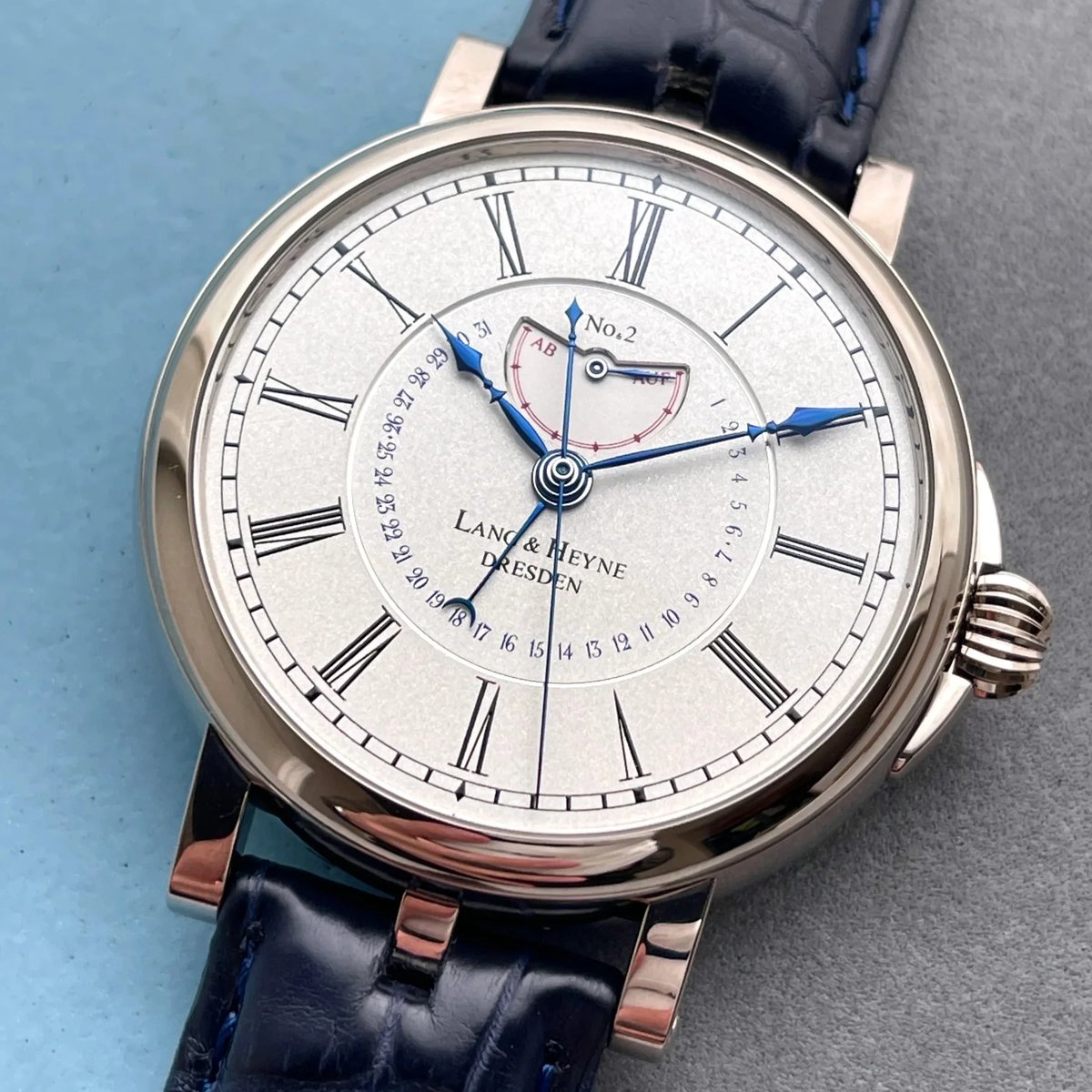
The dial is classically Saxon in its restraint. A light ground, a fine minute track, slim hands, and a small seconds subdial large enough to actually read. There is no date, no power-reserve indicator, no text beyond what is necessary. The result is a dial that looks almost empty in photographs and feels perfectly resolved on the wrist, because the proportions have been drawn rather than assembled from a parts bin.
Finishing on the case is understated rather than flashy. The bevels catch light along their length, the surfaces alternate between polished and lightly brushed, and nothing about it shouts. This is a deliberate choice: the drama in a Lang & Heyne lives on the movement side, where you find it when you turn the watch over, not on the dial where everyone else finds it first.
The Movement
Inside is an in-house, hand-wound Lang & Heyne caliber. Manual winding is the correct choice here, and not only for romantic reasons: a hand-wound movement lets the watchmaker expose the going train, and Lang & Heyne's movements are built to be looked at. Expect the classic Saxon vocabulary — a large plate architecture, screwed gold chatons, blued screws, a hand-engraved balance cock, and anglage that has been drawn out by hand rather than produced by a machine.
Lang & Heyne does not publish the kind of specification sheet you would get from a Swiss industrial brand, and I will not invent figures the brand has not released. What matters on the wrist is this: the winding action is smooth and positive, with a resistance that tells you a mainspring is being loaded rather than a ratchet being spun. There is no rotor, no winding noise, no wobble. You wind it in the morning, you set it, you wear it.
Finishing is where the money goes. Under a loupe the bevels are mirror-bright and consistent, the interior angles are sharp, and the engraving on the balance cock is done by hand — which means it is slightly irregular in the way handwork always is and machine work never is. None of this improves timekeeping. All of it is the point.
On the Wrist
Here is the thing about rectangular watches: they wear nothing like their measurements suggest. A rectangle's effective footprint is determined by its length and its curvature, not by a nominal diameter, and the Heinrich's case is shaped to follow the wrist rather than bridge it. On my wrist it sat low and flat, with no rocking and no gap at the lugs — the failure mode of nearly every rectangular watch I have worn.
Weight is present but not heavy. Gold is dense and you feel it, but the Heinrich is a dress watch in the old sense: thin enough to disappear under a cuff, substantial enough that you are aware of it when you check the time. The strap is leather and the pin buckle keeps the profile low. If you are used to a bracelet, the first day will feel insubstantial. By the third day, you will wonder why you tolerate the weight of anything else.
The lugs are the detail I kept coming back to. They are short and curved, which is what makes the watch sit properly, and they are finished to such a standard that you notice them even though nobody else will. This is the recurring theme of the Heinrich: almost all of its quality is invisible from across a table.
Legibility and Daily Life
A dress watch that cannot be read is a bracelet. The Heinrich passes. The dial is restrained — a light ground, slim hands, a fine minute track, and a small seconds subdial that is large enough to use. There is no lume, which is correct for the category and worth stating plainly: this is not a watch you will read at 3 a.m. in a dark room.
Under a shirt cuff, in a meeting, at dinner, it is perfect. The contrast between hands and dial is high enough that a glance is enough, which matters more than any specification. The small seconds is a genuinely useful complication in a dress context because it gives you a moving element to look at without cluttering the dial with a date window.
What it does not do: it is not a sports watch, it is not a travel watch, and it is not the watch you grab when you are painting a room. Water resistance is modest and I would not test it. Treat it as what it is — a formal and everyday-dress piece with a manual movement that asks thirty seconds of your morning.
The Winding Ritual
Owners of hand-wound watches tend to fall into two camps: those who find the daily wind meditative, and those who find it a chore. There is no third position, and it is worth being honest about which one you are before spending this kind of money.
For me, the ritual is a feature. Winding the Heinrich at the same time each morning does two things. It keeps the movement in a consistent state of wind, which is the single best thing you can do for rate stability in a manual watch. And it forces a moment of deliberate contact with the object — you feel the crown, you feel the spring, you look at the dial properly rather than glancing at it. A week of that changes your relationship with the watch in a way that an automatic never quite manages.
Accuracy
Lang & Heyne does not chase chronometer certification and the Heinrich is not COSC-certified. That is a philosophical position rather than a defect: these movements are regulated by hand and finished to a level where rate stability comes from execution rather than from a certificate.
In practice, expect a well-regulated hand-wound movement to run within a handful of seconds a day, with the usual caveats of position, temperature and state of wind. A manual movement's rate drifts as the mainspring unwinds, so the watch will typically be most accurate in the first day after winding and settle slightly as the reserve depletes. Wind it at the same time every morning and you will get the most consistent behaviour. If you check your watch against your phone daily, you will be satisfied. If you need a guaranteed tolerance in writing, buy something with a certificate and accept that you have bought a different thing.
Occasions
Formal: yes, obviously. This is a watch that looks correct with a dinner jacket, and the lack of a date window keeps the dial clean under evening light.
Dress and business: this is its natural habitat. Suit, no suit, whatever — the Heinrich does not need a tie to look right.
Daily: more than you would think. The case is comfortable, the strap is leather, and the design is quiet enough to wear with a sweater. It is a manual, so it needs winding, but that is a habit rather than an obstacle.
Sport and travel: no. Not water resistant enough, not legible in the dark, and not the watch you want to knock against a doorframe. Wear something else.
Wrist Presence
Four out of five. The Heinrich is not a shouty watch and never will be. What it has instead is a kind of gravitational pull: people who know watches will notice it from across a room and want to talk about it, and people who do not will simply register that you are wearing something well made. That is the correct ratio for a piece like this. It loses a point only because it is genuinely understated — if you want presence in the sense of everyone sees it, this is not that watch.
Variants and the Wider Collection
Lang & Heyne builds the Heinrich in small series, and the brand's approach to variants is closer to bespoke than to a catalogue. Case metal, dial finish and hand style can vary between pieces, and the brand works with clients on details in a way that most manufacturers abandoned decades ago. Reference numbers are not publicly catalogued, so if you are buying, speak to the atelier directly rather than assuming a fixed line-up.
Within the collection, the Heinrich sits alongside round models such as the Friedrich II, Friedrich III, Georg, Johann and Moritz. Each is a distinct design; there is no family in the way a Submariner has a family. The Heinrich is the rectangular outlier, which is precisely why it appeals to people who already own the obvious things.
Alternatives
If you want a rectangular dress watch and the Heinrich is out of reach or simply unavailable, the field is smaller than you would think.
The Cartier Tank Louis Cartier is the reference rectangle, and the one everybody measures against. Different temperament entirely: more jewellery, less horology. The Jaeger-LeCoultre Reverso is a rectangular case with a genuine mechanical reason to exist, and the Tribute models come closest in spirit. The Patek Philippe Gondolo is Patek's take on the rectangle, with the brand equity and liquidity that Lang & Heyne deliberately does not chase. A. Lange & Söhne is not rectangular, but it is the nearest German peer in finishing culture and national tradition. And if what you actually want is the highest level of hand-finishing available anywhere, Kari Voutilainen is the comparison that matters — at a considerably higher price.
At the affordable end, the Seiko SWR049 and similar tank-style quartz pieces give you the silhouette for a couple of hundred dollars. The Longines DolceVita gives you a proper Swiss rectangular dress watch for a fraction of the Heinrich's price. Neither will feel remotely like the real thing, but they will tell you whether the shape works on your wrist before you commit.
Value, Investment and Service
Lang & Heyne pricing is quoted on request and varies with configuration, but the Heinrich sits in the mid five figures in US dollars — roughly $45,000 to $55,000 depending on metal and specification. That is real money, and it buys something specific: a hand-finished, in-house, low-production watch from an AHCI member, made in a country with a genuine horological tradition, in a case shape most brands cannot execute well.
On the secondary market, Lang & Heyne is thin. The brand's production is so small that comparables are scarce, which cuts both ways: you will not find a bargain easily, and you will not see values collapse either. Expect pre-owned examples in the high twenties to low forties, and expect to wait for the right one. This is not a watch to buy as a financial instrument. It is a watch to buy because you want to wear it for thirty years.
Service means returning the watch to the brand in Dresden or to an authorised specialist. Independent watchmakers generally will not touch a Lang & Heyne, and arguably should not — the movement deserves the hands that made it. Budget for a proper service on a sensible cycle, and accept that it will involve shipping the watch to Germany.
Who Should Buy It
Buy the Heinrich if you already own the obvious things and find them slightly boring. Buy it if you care more about how a bevel is drawn than about what a stranger thinks of your wrist. Buy it if you like the idea of a watch that will be serviced by the people who built it, and if a daily winding ritual sounds like a pleasure rather than an imposition.
Do not buy it if you need a date, if you need lume, if you need to swim in it, or if you need to be able to sell it in a week. Do not buy it as a store of value. And do not buy it if you have never worn a rectangular watch — try the shape first, because it either works on your wrist or it does not, and no amount of finishing will change that.
Verdict
The Lang & Heyne Heinrich is not for everyone and is not trying to be. It is a rectangular, hand-wound, hand-finished dress watch from a tiny Dresden workshop, priced like a serious object and finished like one. If you want a watch that announces itself, buy something else. If you want a watch that rewards a decade of close looking — and that you can actually wear to work — the Heinrich is one of the most complete answers in independent watchmaking.
Wear it for a week. You will understand.