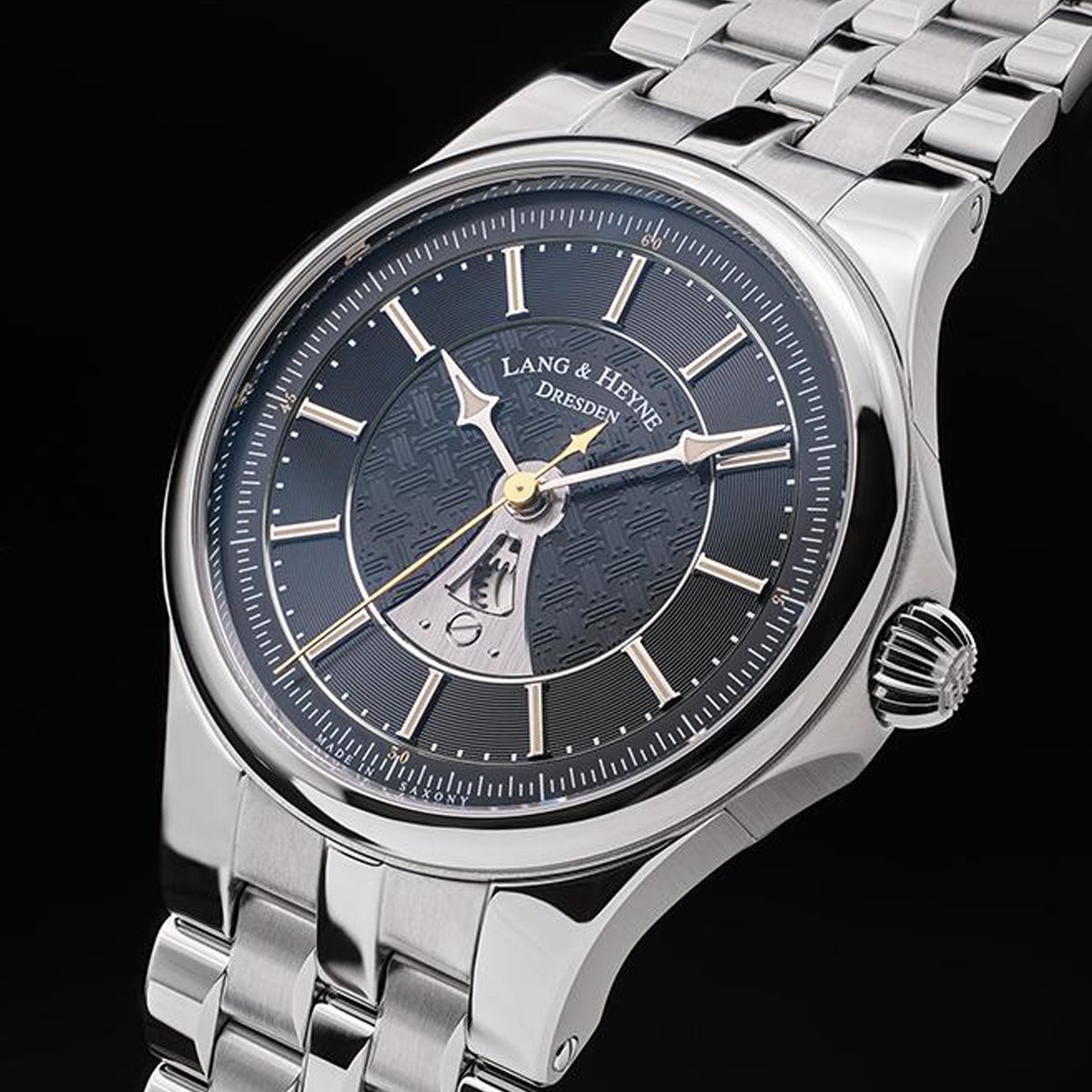
Lang & Heyne Hektor Edition II Review
There are watches that announce themselves and watches that require a second look. The Lang & Heyne Hektor Edition II belongs to the second category. It is a rectangular dress watch from a small Dresden manufacture, built around a manually wound in-house calibre and finished in an idiom that owes more to Saxon craft than to marketing departments.
The Hektor is not a sports watch, not a travel tool and not a liquidity play. It is a collector’s object in the old sense: low-volume, hand-finished and deliberately restrained. Edition II sharpens that character rather than changing it, with a dial and case execution that ask you to look closely at proportion, surface and the movement beneath. This review focuses on what matters in a watch of this type: architecture, finishing, wearability and ownership. Where Lang & Heyne does not publish a figure for this exact edition, we leave it open rather than inventing a spec-sheet number.
Dresden, not Glashütte
Lang & Heyne was founded in Dresden in 2001 by Marco Lang and Mirko Heyne. That date and that city matter. Dresden is not Glashütte, though the two are close enough to share a broader Saxon watchmaking culture. Lang & Heyne has built its reputation on small-series production, in-house calibres and finishing that is meant to be inspected rather than merely admired from a distance. The brand does not behave like a mass-market maison. It behaves like a workshop with a very particular standard.
The Hektor is the brand’s rectangular dress watch, and Edition II is best understood as a discreet evolution of that idea rather than a radical departure. It sits alongside round models such as the Friedrich and Georg families, but its shape gives it a different role in the collection. A rectangular watch is not simply a round watch with corners. The case, dial and movement all have to justify the geometry. The Hektor Edition II is interesting because it treats the rectangle as an architectural problem, not a styling exercise.
Case and dial
The first thing to understand about the Hektor Edition II is that it is a dress watch in the literal sense. The case is rectangular, the crystal is sapphire and the strap is leather. There is no luminous treatment, no date window and no suggestion that the watch wants to go swimming. That restraint is the point. The case is made in gold, and the overall effect is one of quiet precision rather than showroom shine.
The dial is deliberately quiet. Hours and minutes are presented without fuss, and the small seconds display gives the face a traditional rhythm without crowding it. The Edition II dial is the focal point of this version, and its success depends on surface and proportion rather than colour alone. A rectangular dial has to balance a lot of empty space. If the markers are too heavy, the watch becomes rigid. If they are too light, it loses authority. The Hektor manages that balance by keeping the elements narrow and the minute track disciplined.
This is not a watch that photographs as loudly as a sports chronograph. It is a watch that rewards the angle of the wrist and the quality of light. The case profile matters here. A rectangular dress watch must sit flat and avoid feeling like a slab. The Hektor’s shape is intended to follow the wrist rather than sit above it, and the leather strap does much of the final work. The result is a watch that looks formal without looking fragile.
Movement and finishing
The Hektor Edition II is powered by an in-house manual-winding calibre. That is the correct answer for a watch of this type. A hand-wound movement in a rectangular dress watch is not a romantic affectation; it is an architectural choice. It keeps the watch close to the wrist, gives the owner a daily ritual and allows the movement to be finished as an object in its own right.
Lang & Heyne’s finishing language is the reason many collectors pay attention to the brand. The movement uses German-silver platework, screwed gold chatons, a hand-engraved balance cock and polished steel components. These are not decorative bullet points. They change the way the watch looks through a sapphire back. German silver has a warmer tone than brass and takes anglage and polishing differently. Gold chatons add a visual anchor around the jewels. The hand-engraved balance cock is a signature of human decision-making: no two are identical, and the engraving sits somewhere between ornament and signature.
The movement is not presented as a complication-heavy showpiece. There is no tourbillon, no perpetual calendar and no chronograph. The Hektor Edition II relies on small seconds and the quality of execution. That is a mature approach. At this level, the movement should be judged by architecture and finishing before it is judged by a list of functions. The calibre is built to be seen, but it is also built to be wound and worn. The pleasure is in the consistency of the finish rather than in a single headline feature.
Lang & Heyne does not publish every figure for this edition in the same way as a large brand. Power reserve and frequency are not stated here because they are not confirmed for this exact reference in the material available. That may frustrate spec-sheet readers, but it is also a reminder that this watch is not sold on spreadsheet superiority. It is sold on craft, rarity and the judgement of a small manufacture.
On the wrist
The Hektor Edition II wears like a proper rectangular dress watch: compact in presence, flat against the wrist and reliant on the strap for its final fit. It does not try to wrap the wrist like a sports watch. Instead it sits centred and calm, which is exactly what a watch of this shape should do under a cuff. The rectangular case gives it a different silhouette from a round dress watch, but the intention is the same: to stay out of the way until you choose to look at it.
Comfort will depend heavily on strap choice. A thin leather strap with a pin buckle keeps the watch light and formal; a heavier strap would fight the case. Because these are small-series watches, buyers should expect to fine-tune the strap rather than rely on micro-adjustments. Done well, the result is a watch that disappears for hours and then reminds you why you bought it when you turn the wrist. The Hektor is not a watch that dominates a room. It is a watch that rewards the person wearing it.
Wrist presence is therefore not about size. It is about shape, surface and the quality of the dial. The Hektor Edition II has enough character to be noticed by people who know watches and enough restraint to remain polite in a formal setting. That is a difficult balance to strike. Many rectangular watches lean too far into jewellery; others become austere. The Hektor sits between those poles, with a seriousness that feels German and a softness that keeps it wearable.
Accuracy and ownership
The movement is not COSC-certified and does not pretend to be. A well-regulated hand-wound independent of this type should run within a handful of seconds per day in normal wear. Consistency matters more than a single timing-machine result: wind it regularly, avoid treating it as a sports watch and expect the rate to settle with use. This is a watch that rewards routine. It is not a set-and-forget quartz piece, and it is not designed to absorb shocks in the way a dive watch would.
Ownership should be approached with the same discipline. Service should be arranged through Lang & Heyne or an authorized specialist. Independent access to parts and finishing expertise is limited, and that is the trade-off of buying from a small manufacture. The upside is a relationship with a workshop rather than a call centre. The downside is that ownership requires patience. Collectors who understand that trade-off will be comfortable with the Hektor. Collectors who want a watch they can wear hard and service anywhere should look elsewhere.
Alternatives and value
The obvious alternatives are the classic rectangular dress watches. The Cartier Tank Louis Cartier is the reference point, but it is a different kind of object: more jewellery-led, with a broader market and a very different movement philosophy. The Jaeger-LeCoultre Reverso Tribute Monoface offers a rectangular art-deco alternative with a swivelling case and a wider service network. The Patek Philippe Gondolo brings a more conventional luxury-house aura and stronger secondary-market liquidity. The A. Lange & Söhne Cabaret is the closest German cousin in spirit, with a similar Saxon finishing language, though it is discontinued.
None of those watches makes the Hektor redundant. The Lang & Heyne is for the collector who wants the Dresden workshop experience, not the boutique experience. It is for someone who values the hand-engraved balance cock, the German-silver platework and the fact that production is tiny. The Hektor Edition II is not a value proposition in the ordinary sense. It is a craft proposition. The price buys a hand-finished, low-volume rectangular calibre and the access that comes with a small independent. Value is in craft and scarcity rather than liquidity.
That also means the secondary market should be treated with caution. Small-series independents can trade narrowly around retail, but public sales data is thin and condition matters enormously. Buyers should expect to hold rather than flip. The Hektor Edition II is not a watch to buy because you think it will appreciate. It is a watch to buy because you want to wear it and because you want to support the kind of watchmaking it represents.
Verdict
The Hektor Edition II is not the logical choice for a one-watch collection, and it is not meant to be. It is a dress watch for collectors who value the rectangular case, the Dresden finishing idiom and the rarity of a small independent operating at this level. Buy it for the craft, wear it with discipline, and it will feel less like a possession than a private standard.
It is also a reminder that not every great watch needs to be a tool. Some watches are made to be looked at, wound and understood. The Hektor Edition II belongs in that quieter category. It does not shout. It does not chase trends. It simply asks for the right wrist and a little patience.