Lang & Heyne Markgraf Heinrich Moritz of Saxony – A Detailed Review
By Vivir··Updated
In this review# Lang & Heyne Markgraf Heinrich Moritz of Saxony – A Detailed Review
The Lang & Heyne Moritz, officially titled *Markgraf Heinrich Moritz of Saxony*, arrives as a bold statement from a boutique that has spent more than a decade perfecting the art of Saxon horology. Encased in 18‑karat white gold, the 44 mm piece houses a hand‑wound Caliber III that drives a full‑calendar module, a moon‑phase, and an Earth‑declination sub‑dial. Priced at USD 56 000, it sits at the intersection of historic homage, technical ambition, and dress‑watch sensibility. Below we break down every facet that matters to a collector or an enthusiast deciding whether this timepiece belongs on the wrist—or in the safe.
## Heritage — the model's place in the brand's line and its launch context
Lang & Heyne, a Saxon watchmaker founded in the early 2000s, has built its identity around naming watches after notable German historical figures. The *Markgraf Heinrich Moritz* follows that tradition, drawing its moniker from a 17th‑century Saxon noble. The model was introduced “over a decade ago during Marco Lang’s tenure,” positioning it as one of the brand’s more established pieces while still retaining the limited‑production ethos that defines Lang & Heyne’s output.
Within the brand’s catalogue, the Moritz occupies the high‑end dress segment (tier 1, category “dress”) and is listed alongside other manually‑wound creations. Its focus on a complete calendar and an additional declination indicator differentiates it from the more minimalist dress offerings, yet it remains true to the label’s core values: meticulous hand‑finishing, a dedication to mechanical purity, and a reverence for Saxon watch‑making heritage.
## Design & Case — case dimensions, materials, dial
The Moritz makes an immediate visual impact. Its 44 mm white‑gold case (18 k) measures 12.5 mm in thickness, a proportion that many reviewers describe as “commanding.” While the size may feel large for a traditional dress watch, Lang & Heyne pairs it with a supple leather strap that, according to hands‑on testing, settles comfortably on an average‑sized wrist.
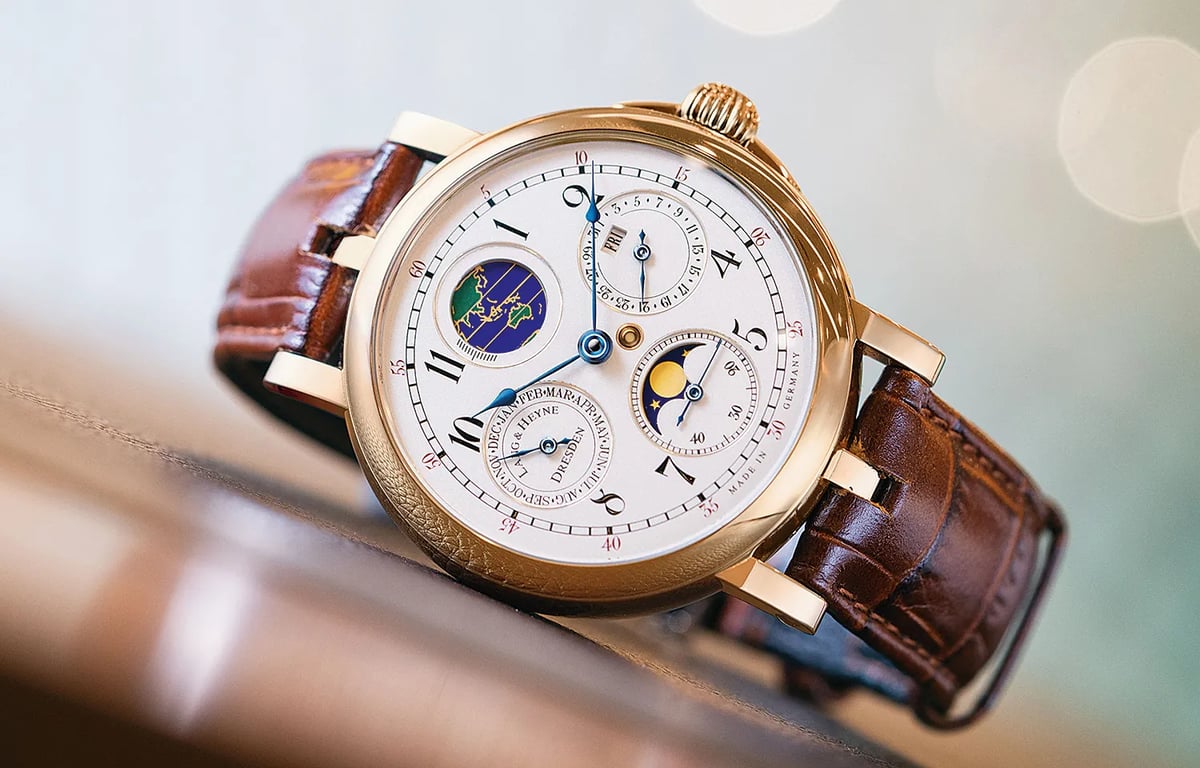
The case is polished to a high shine, with clean, straight lines that echo classic Germanic design. The bezel is unadorned, allowing the dial to command attention. The dial itself is a solid silver base, a choice that offers a subtle contrast to the gold case and enhances legibility. Multiple sub‑dials are arranged with disciplined symmetry: a date window, day and month indicators, a moon‑phase disc, and the Earth‑declination sub‑dial.
The declination sub‑dial is particularly noteworthy. It features a gold disc enamelled to depict an Earth view from the Asian and Australian perspectives. While the complication is not described as rare in the source material, its presence adds a layer of astronomical intrigue that is uncommon in most dress watches. The enamel work is crisp, and the gold accents tie the sub‑dial visually to the case’s metal.
The hands are finished in a classic blued steel, and the hour markers are applied indices coated in a subtle luminescent material, ensuring readability in low light without detracting from the dial’s elegance. The overall aesthetic balances opulence and restraint—a hallmark of Lang & Heyne’s design language.
## Movement & Performance — caliber, power reserve, accuracy
At the heart of the Moritz lies Lang & Heyne’s in‑house Caliber III, a hand‑wound mechanical movement. The caliber continues the brand’s tradition of employing a three‑quarter plate—a structural element that adds rigidity and stability to the movement’s architecture. The finishing is described as “traditional Saxon,” which includes bevelled edges, polished bridges, and C‑finishing on the balance wheel.
One of the Caliber III’s functional highlights is the stop‑second system, inherited from the earlier Caliber I and also present in Caliber IV. This system uses a lever that applies pressure against the balance wheel with a spring, halting its oscillation. The result is a precise hand‑positioning capability that benefits both time‑setting and chronometer‑level accuracy, though the exact seconds‑per‑day deviation is not disclosed in the source data.
The movement drives a complete calendar—date, day, and month—plus a moon‑phase and the Earth‑declination indicator. All complications are mechanically linked, meaning the wearer benefits from a fully integrated, hand‑wound operation without the need for additional batteries or electronic assistance.
Water resistance is modest at 30 m (3 atm), sufficient for everyday exposure to rain or brief hand washing but not intended for swimming or diving. The power reserve is not specified in the provided facts, so we cannot comment on endurance between windings. Nonetheless, the positive reviews emphasize the movement’s reliability and the “intelligent engineering” that makes the watch “quite wearable and even practical.”
## On the Wrist — wearability, lug‑to‑lug, comfort notes
Despite its 44 mm diameter—a dimension that borders on the larger side for a dress watch—the Moritz is surprisingly approachable on the wrist. The case’s 12.5 mm thickness keeps the profile relatively sleek, avoiding the bulk that can accompany larger timepieces. The lug‑to‑lug spread is not explicitly measured, but the overall case geometry suggests a balanced proportion that aligns well with a standard leather strap.
When paired with the supplied leather strap, the watch sits comfortably, with the strap’s flexibility compensating for the case’s width. Reviewers note that the watch “sits comfortably on the average‑sized wrist,” indicating that the ergonomics have been thoughtfully considered.
The hand‑wound nature of the movement means the wearer must wind the watch regularly—ideally daily—to maintain power. This ritual can be a point of connection for enthusiasts but may be a minor inconvenience for those accustomed to automatic watches. The 30 m water resistance also imposes practical limits; the wearer should avoid submersion beyond splashes.
A minor criticism noted in the negative feedback is the suggestion that a “slightly smaller case” might appeal to a broader audience. This reflects a subjective preference rather than a functional flaw, and those who appreciate a more pronounced wrist presence will likely view the size as an asset.
## When to Wear — occasion, setting and dress‑code fit
The Moritz straddles the line between formal dress and statement piece. Its white‑gold case and refined dial make it suitable for black‑tie events, high‑end business meetings, and ceremonial occasions where a traditional dress watch is expected. The inclusion of multiple complications—particularly the moon‑phase and declination sub‑dial—adds a conversational element that can spark interest in more inquisitive settings, such as private gatherings or collector shows.
Because of its size, the watch may feel assertive on a slim‑sleeved tuxedo shirt, but the leather strap’s softness helps integrate it into formal attire without appearing out of place. For daytime wear, the Moritz can complement a tailored suit or a smart‑casual ensemble, especially when the wearer wishes to showcase horological craftsmanship.
The modest water resistance and hand‑wound nature mean the watch is best reserved for occasions where it can remain on the wrist for extended periods without exposure to water or vigorous activity. It is not a sports or travel companion, but rather a piece to be admired in settings that value elegance and mechanical artistry.
## Value & Verdict — price‑positioning + final take
At an asking price of USD 56 000, the Moritz occupies a premium tier within the boutique watch market. Lang & Heyne offers a range of customization options—including hand‑engraving and gem‑setting—that can further personalize the piece, potentially influencing final cost. The price reflects the combination of a full‑calendar mechanism, the Earth‑declination sub‑dial, hand‑finishing of the Caliber III, and the use of 18 k white gold for the case.
From a value perspective, the watch delivers a high level of mechanical sophistication in a single, manually‑wound movement. The three‑quarter plate, stop‑second system, and Saxon finishing demonstrate the brand’s commitment to engineering excellence. The dial’s enamel work and the overall aesthetic quality are also indicative of a watch that has been crafted with considerable attention to detail.
Potential buyers should weigh the following:
* **Pros** – Robust mechanical architecture, full‑calendar with additional astronomical complication, striking white‑gold case, high‑quality finishing, limited‑production exclusivity, and a design that bridges classic dress‑watch elegance with a modern, conversation‑starting complication.
* **Cons** – A case size that may be too large for some wrist dimensions, modest 30 m water resistance, the necessity of daily winding, and the lack of an officially stated power reserve.
In conclusion, the Lang & Heyne *Markgraf Heinrich Moritz of Saxony* stands as a compelling choice for collectors who value a blend of historical homage, mechanical depth, and dress‑watch refinement. Its unique combination of a complete calendar, moon‑phase, and Earth‑declination sub‑dial—executed in a meticulously finished hand‑wound movement—offers a distinctive experience that justifies its price point within the boutique segment. While its size and manual winding may limit its appeal to a niche audience, for those who appreciate the art of Saxon watchmaking, the Moritz is a worthy addition to any serious horological library.