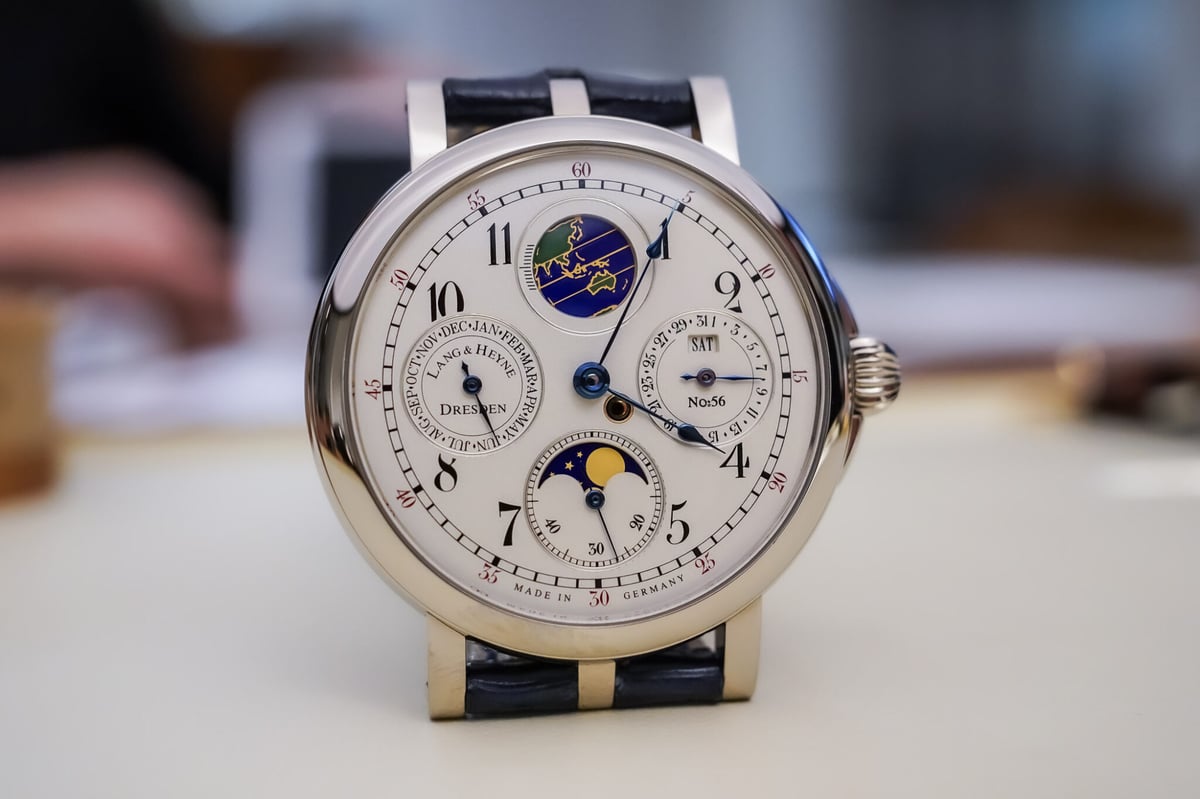
There is a moment in every collector's arc when the goal stops being recognized and starts being correct. The Lang & Heyne Moritz is built for that person — the one who has already done the steel sports watch, already done the chronograph, and now wants something that only four people in the room will identify, and only one of them will be right.
The Moritz is a rectangular dress watch from Dresden. It is hand-wound, made in vanishingly small numbers, and finished to a standard that most Swiss maisons abandoned somewhere around the quartz crisis. It is not a watch you buy because it photographs well. It is a watch you buy because you have started reading the underside of balance cocks.
This is not a starter watch, and Lang & Heyne is not a starter brand. What follows is a straight look at what the Moritz is, who it's for, what it costs, and whether the rectangle earns its place in a collection that already has three round watches fighting for wrist time.
The Short Version
The Moritz is Lang & Heyne's rectangular statement piece, reference 15, built around the in-house Caliber VI — a hand-wound movement that is itself rectangular, which is the whole point. Rectangular movements are hard. Round movements let you arrange a going train in a tidy circle; a rectangle forces every wheel, bridge, and pivot decision to be re-solved along a long, narrow plate. Very few houses bother. Lang & Heyne bothered.
What you get for the money is not a certificate, not a complication, and not a story about a race car. You get finishing, scarcity, and a shape that reads as deliberate rather than default.
Where It Comes From
Dresden, not Glashütte. That distinction matters more than it sounds.
Lang & Heyne was founded in 2001 by Marco Lang and Mirko Heyne, and the atelier was deliberately set up in Dresden rather than in the Glashütte valley that every German watch conversation defaults to. Marco Lang came out of a Glashütte watchmaking family and trained in the trade; the house he built with Heyne took the technical seriousness of Saxony and pointed it at a different aesthetic — Dresden baroque, courtly, architectural, more interested in proportion than in sport.
Production is tiny. You can count a year's output without needing a spreadsheet, and that scarcity is not a marketing position — it is a structural fact of how the watches are made. Every movement is assembled and finished by hand, and hand-finishing does not scale. This is the reason Lang & Heyne watches are hard to find, hard to service quickly, and hard to flip. It is also the reason they look the way they do.
The Moritz is named after Moritz of Saxony, the 16th-century Duke and later Elector who turned Dresden into a Renaissance capital. Naming a rectangular watch after a ruler who built a city on geometry is not subtle, and it is not supposed to be.
The Case: A Rectangle With Manners
Rectangular cases are unforgiving. There is no bezel to hide behind, no lugs to soften a bad line, no dial-to-case ratio you can fudge. A rectangle is either proportioned correctly or it is a rectangle that looks wrong, and you will feel it every time you put it on.
The Moritz gets it right. The case is offered in gold, with platinum configurations available through the atelier for buyers who want the extra density and the cooler tone. The geometry is confident without being severe — the kind of rectangle that reads as classical rather than as a design exercise. Polished surfaces carry the light, and the transitions between planes are crisp enough that you can tell a human finished them.
Because this is a dress watch in the old sense of the term, there is no luminous treatment anywhere. No lume plots, no luminous hands, no concession to the idea that you might need to read it in the dark. That is not an oversight. It is a statement about what kind of watch this is.
The crystal is sapphire, which is the correct and unremarkable choice. Water resistance is not something Lang & Heyne positions this watch around, and you should treat the Moritz accordingly: it is a desk watch, a dinner watch, a boardroom watch. It is not a beach watch, and it is not a watch you wear to wash the car.
The Dial
Lang & Heyne's dial work is where the Dresden sensibility shows up most clearly. The house vocabulary runs on engine-turned and guilloché fields, applied markers, and heat-blued hands — traditional techniques executed with a level of care that only makes sense when you are producing a few dozen dials rather than a few thousand.
The Moritz carries a small seconds display, which is the right call for a rectangular dress watch and the right call for a hand-wound movement. A sweeping central seconds hand would fight the geometry. A subdial at six gives the rectangle a focal point and gives the eye somewhere to rest, and it lets the dial breathe around it.
Dial variants run across silver-toned, dark, and warm tones, and because Lang & Heyne works at this scale, configuration is closer to a conversation than a catalogue. That matters: on a watch like this, the dial is half the purchase.
Caliber VI: The Reason It Exists
Here is the part that separates the Moritz from every rectangular dress watch you have ever considered.
The Caliber VI is a rectangular hand-wound movement, made in-house. That shape is not cosmetic. When you stretch a movement into a rectangle, the mainplate becomes a long plate, the bridges become long bridges, and the entire going train has to be re-laid along an axis rather than around a center. Barrel placement, wheel spacing, and pivot support all become harder. You do it because the case demands it, and you do it well because you are Lang & Heyne and you have no interest in doing it badly.
The finishing is the Dresden house style at full volume. Frosted German silver surfaces rather than the high-gloss striping you see from most Swiss manufacturers. Broad, polished bevels along every bridge edge. Gold chatons. And a balance cock that has been hand-engraved rather than stamped out of a press — a detail that costs hours and buys nothing except the thing that actually matters here, which is that the movement looks like it was made by a person.
There is no chronometer certification, and Lang & Heyne does not publish a rate specification to hang a marketing campaign on. That will bother some buyers and reassure others. If you need a printed number, this is not your watch. If you want a movement your watchmaker will genuinely enjoy opening, it is.
On The Wrist
A rectangular case wears nothing like its measurements suggest, which is exactly why the Moritz is so difficult to compare on paper. The shape sits flat and wide across the wrist rather than tall and domed, so it reads as a piece of architecture resting on the arm instead of a puck balanced on top of it. In gold, the weight is present but not fatiguing — you can wear it through a full day of meetings without thinking about it, then notice it again when you take it off.
The strap is where the fit is actually decided. Lang & Heyne ships the Moritz on leather with a pin buckle, and because rectangular cases run a long, straight line from lug to lug, the strap needs the right thickness and taper to keep the case seated. Get that right and the watch disappears into the wrist in the best possible way. Get it wrong and the case will rock. Budget for a proper fitting and treat the strap as part of the watch rather than an afterthought.
Timekeeping
No chronometer certificate. No published rate window. What you get instead is a hand-finished, hand-adjusted movement that, in real-world use, should hold within a few seconds a day once it has settled into your wearing pattern.
Expect the rate to differ slightly on the wrist versus on a winder, and expect it to shift if the watch sits for a week. Hand-wound movements reward consistency — wind it at the same time each day and it will behave better than if you treat it casually. The honest framing is this: the Moritz is built for finishing and stability, not for a certificate on the dial.
When To Wear It
Formal and dress are the obvious answers, and the Moritz is superb at both. It slides under a cuff without a fight, and on a suited wrist it changes the entire register of an outfit — not by shouting, but by being visibly better made than everything around it.
Daily wear is more viable than you would expect. The flat profile and the leather strap make it a genuinely comfortable all-day watch, and the lack of lume is only a problem if you spend your evenings in the dark reading your wrist. What it is not is a travel watch in the modern sense: no second time zone, no quick-release anything, no water resistance story. Take it on the trip, not to the pool.
Variants And Configuration
Lang & Heyne does not run a variant matrix the way a Swiss brand does. Reference 15 is the Moritz, and the differences you will encounter are dial and case-metal configurations ordered through the atelier rather than distinct catalogue references.
The silver-toned dial is the classic and the one that best shows off the engine-turning. A dark dial pushes the watch toward evening and makes the polished case edges read harder against the wrist. A warm-toned dial — salmon or similar — is the collector's pick, because warm dials on rectangular cases are the fastest route to a watch that looks like it came out of a 1930s Dresden drawing office.
Case metal matters too. Gold gives you warmth and presence; platinum gives you density, a cooler tone, and a level of discretion that borders on invisibility. Neither is wrong. Both are expensive.
What It's Up Against
The obvious comparison is the Jaeger-LeCoultre Reverso Tribute. Both are rectangular dress watches with serious mechanical credibility, but the Reverso has a flipping case and a ninety-year production history, and it is a design icon in a way the Moritz will never be. If you want the rectangle that everyone understands, the Reverso wins.
Cartier's Tank Louis Cartier is the other reference point. The Tank is the most recognizable rectangle in watchmaking and it is a genuinely beautiful object, but it competes on design rather than on movement obsession. Nobody buys a Tank because of what is under the caseback.
Patek Philippe's Gondolo occupies similar territory with far more auction liquidity and a cushion-adjacent geometry that reads differently on the wrist. And A. Lange & Söhne's discontinued Cabaret is the German rectangle from the big Saxon house — a watch that now trades on exactly the same scarcity logic that makes the Moritz interesting.
None of these watches is trying to be the Moritz, and the Moritz is not trying to be any of them. The difference is that the Moritz is competing on the quality of the object rather than on recognition, and that is a fight most of these watches stopped entering decades ago.
Money
Pricing sits in the mid five figures, with current retail in the low-to-mid seventy-thousand-dollar range depending on metal and dial configuration, and pre-owned examples typically trading meaningfully below that. The secondary market is thin — not because the watches are undesirable, but because so few exist and the people who own them tend to keep them.
That thinness is the whole investment story. Lang & Heyne is a buy-and-hold brand, not a flip. There is no auction history of note for the Moritz, and there is no realistic scenario in which it becomes a liquidity play. What it is instead is a defensible twenty-year hold: a watch made in numbers so small that the supply can never catch up with even modest demand, from a house whose finishing standard is not going to get cheaper to produce.
For a buyer with a genuine interest in watchmaking, that is a reasonable trade. For a buyer looking for an exit, it is not.
Service
Servicing goes back to the atelier or an authorized partner. An independent watchmaker can work on the movement, but parts availability and the hand-finished surfaces argue strongly for keeping the Moritz in the official channel. Expect the process to be slower than a Swiss brand's, because the infrastructure is smaller and the watchmakers are fewer. That is the cost of buying from a house like this, and it is worth knowing before you commit rather than after.
The Verdict
The Lang & Heyne Moritz is not competing with the Reverso or the Tank on recognition. It is competing on the thing those watches stopped competing on decades ago — the quality of the object in your hand.
If you want a rectangle that people will nod at across a room, buy a Cartier. If you want a rectangle that a watchmaker will ask to see, buy this. It is a slow watch for a collector who has stopped rushing, and it rewards exactly the kind of attention that got you into watches in the first place.
Pros
- A genuinely rectangular in-house hand-wound movement — a shape very few houses attempt
- Hand-finishing at a level that embarrasses watches costing twice as much
- Tiny production means you will almost never see another on a wrist
- Rectangular case wears flatter and more comfortably than its proportions imply
Cons
- No chronometer certification and no published rate specification
- Tiny production cuts both ways — parts, servicing, and resale are all slow
- Not a water watch; treat it as a desk and dinner piece
- Secondary market is thin, so exit liquidity is genuinely poor