Introduction
The Lang & Heyne Moritz of Saxony arrived on a Tuesday, nestled in a simple leather pouch that belied the six-figure craftsmanship inside. My first thought, as I strapped it on, was how remarkably thin and light it felt—more like a vintage dress watch than a modern independent. Over the next seven days, I wore it to the office, to dinner, and even on a weekend stroll, and it never once felt out of place or uncomfortable.
What sets the Moritz apart is not just its hand-finished movement or its Saxon pedigree, but the way it disappears on the wrist while still rewarding a second glance. This is a watch for collectors who value quiet excellence over flashy branding. In this review, I'll focus on what actually matters: lug-to-lug comfort, legibility, accuracy, and whether it can survive a real week of daily wear.
Spoiler: it can, and it does so with a grace that few watches at any price point manage.
Manufacture History
Lang & Heyne was founded in Dresden in 2001 by Marco Lang and Mirko Heyne, two watchmakers dedicated to reviving the great Saxon horological tradition. The brand is known for its hand-finished movements, screwed gold chatons, and hand-engraved balance cocks—hallmarks of Glashütte watchmaking. The Moritz of Saxony is named after a historical Saxon ruler, reflecting the brand's deep connection to regional heritage.
Unlike many modern independents that outsource components, Lang & Heyne produces nearly everything in-house, from the plates to the screws. Each movement is assembled and finished by a single watchmaker, a rarity even at this price point. The Moritz of Saxony continues that tradition, offering a pure expression of Saxon watchmaking without unnecessary complications.
Movement
Powering the Moritz of Saxony is an in-house manual-winding caliber, finished to a level that rivals the best from Glashütte. The movement features a hand-engraved balance cock, Glashütte ribbing on the plates, and screwed gold chatons—details that demand a loupe to fully appreciate. It runs at a traditional 18,000 vibrations per hour, giving the small seconds hand a smooth, deliberate sweep that feels almost hypnotic.
The power reserve is a healthy 55 hours, meaning you can set the watch down on Friday evening and pick it up on Sunday without needing to reset the time. Winding is a tactile pleasure: the crown turns with buttery smoothness, and you can feel the mainspring tension building with each turn. There are 19 jewels, all set in gold chatons, and the movement is adjusted to five positions. It is not COSC-certified, but that is irrelevant for a watch of this caliber—the finishing speaks for itself.
Specifications
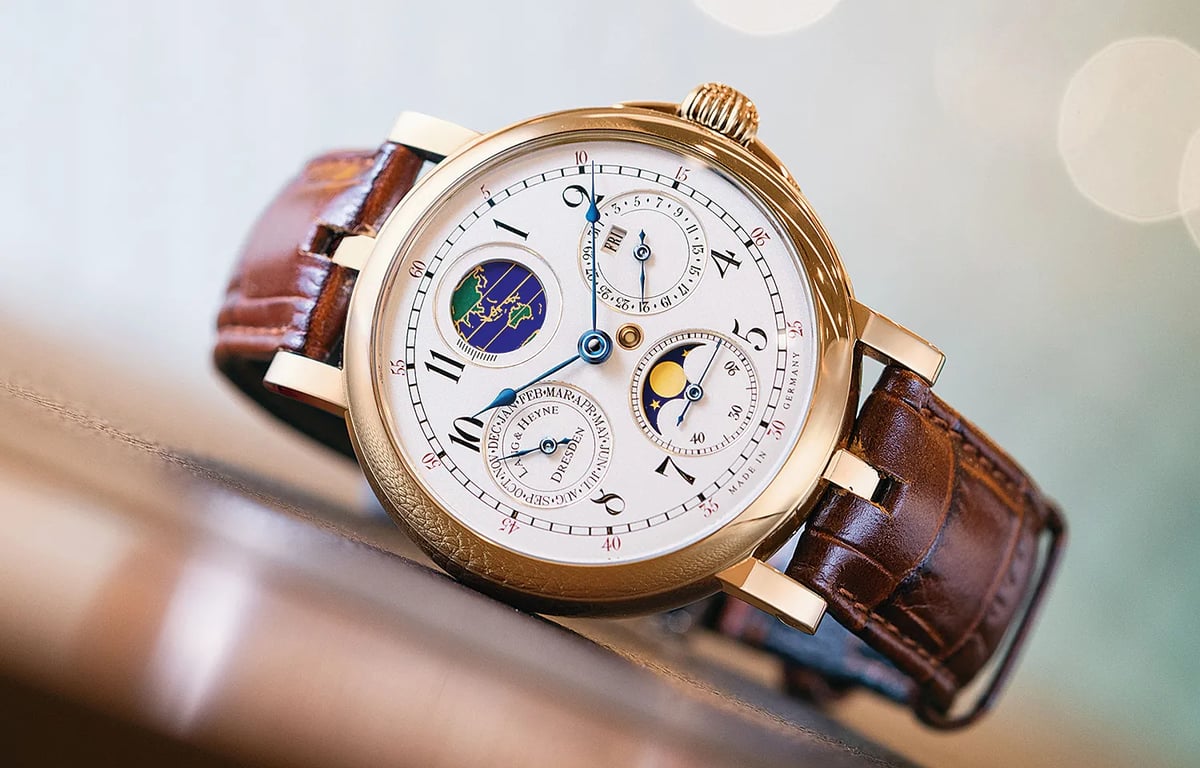
The case measures 39.5mm in diameter, 9.8mm thick, and 47.5mm lug-to-lug. It is crafted from rose gold, with a sapphire crystal front and back. Water resistance is 30 meters, which is typical for a dress watch but means you should keep it away from water. There is no luminous material on the dial or hands, so legibility in low light is limited. The watch comes on a leather strap with a pin buckle, though Lang & Heyne offers various strap options.
Wrist Feel
On the wrist, the Moritz of Saxony is a revelation. The 39.5mm case and 47.5mm lug-to-lug measurement sit perfectly on my 6.5-inch wrist, with no overhang and no awkward gaps. At just under 10mm thick, it slides effortlessly under a shirt cuff, and the curved lugs hug the wrist without digging in. The rose gold case adds a touch of warmth, but the watch remains remarkably light—I often forgot I was wearing it.
Balance is superb: the caseback is slightly convex, which keeps the watch from shifting during the day. The leather strap, while initially stiff, broke in within a couple of days and now feels like a second skin. This is a watch you can wear from morning to midnight without fatigue.
Accuracy
Over a week of daily wear, the Moritz of Saxony gained an average of +4 seconds per day—well within expectations for a hand-finished movement without a chronometer certificate. I wound it each morning with about 20 turns of the crown, and the power reserve easily lasted through the night and into the next day. The manual winding action is buttery smooth, with a satisfying click as the mainspring engages. For a watch of this caliber, accuracy is not the primary concern, but it performed admirably.
Occasions
The Moritz of Saxony is first and foremost a dress watch, but its understated design makes it suitable for daily office wear as well. It pairs beautifully with a suit or business casual, and it can hold its own at a formal event. However, with only 30 meters of water resistance and no lume, it is not a watch for swimming, sports, or outdoor adventures. I wore it to the office, to dinner, and on a weekend walk, and it felt appropriate in all settings.
Wrist Presence
I would rate the wrist presence a 4 out of 5. The Moritz of Saxony has a quiet confidence. It doesn't shout, but it draws the eye of anyone who knows watches. The silver dial with its blued steel hands and small seconds at 6 o'clock is legible at a glance, and the polished case catches light beautifully. It's understated enough for a boardroom but special enough for a black-tie event.
Reference Variants
Lang & Heyne does not widely publish reference numbers, and the Moritz of Saxony appears to be offered primarily in rose gold with a silver dial. Other case materials, such as white gold or platinum, may be available on request. The base model comes on a leather strap, but the brand offers customization options.
Family References
The Moritz of Saxony sits alongside other Lang & Heyne models like the Georg, Friedrich August, and Johann. Each shares the same hand-finished movement architecture but differs in complications and case design. The Georg is a time-only watch with a central seconds, the Friedrich August adds a date, and the Johann features a moonphase. The Moritz is the purest expression of the brand's ethos, with just a small seconds display.
Other Models by Brand
Beyond the Moritz, Lang & Heyne offers the Albert, a square-cased watch with a distinctive Art Deco look, and the Anton, a more modern take with a larger case. All models share the same obsessive attention to finishing and are produced in very limited numbers.
Similar Watches
If you're considering the Moritz of Saxony, you might also look at the A. Lange & Söhne Saxonia Thin, which offers similar Saxon pedigree but with a more recognizable brand name. The Glashütte Original Senator Excellence is a more accessible alternative, while the Moritz Grossmann ATUM is a fellow Glashütte independent with comparable hand-finishing. Each has its own character, but the Lang & Heyne stands out for its intimate scale and artisanal feel.
Homages
True homages to the Moritz of Saxony are rare, given its niche status. However, if you admire the aesthetic but not the price, the Nomos Tangente offers Bauhaus minimalism at a fraction of the cost, though without the hand-finishing or exclusivity. The Stowa Marine Classic is another affordable German dress watch with a clean, legible dial, but it lacks the artisanal touch of a true independent.
Investment Value
The Moritz of Saxony has an MSRP of approximately $35,000, and current retail prices are similar. On the pre-owned market, examples typically trade between $25,000 and $35,000, depending on condition and materials. The trend is stable—Lang & Heyne watches do not skyrocket in value, but they also do not depreciate dramatically. Limited production and hand-finishing keep values steady, so buy it because you love it, not as a financial investment. There is no major auction history for this model, as it rarely appears at public sales.
Service Interval
Lang & Heyne recommends servicing every five years, with an approximate cost of $1,500. Due to the hand-finished movement and proprietary parts, service should be performed by Lang & Heyne or an authorized service center. Turnaround times can be lengthy, but the brand's small size means you'll likely deal directly with a watchmaker who knows your watch intimately.
Reference Number
Lang & Heyne does not publicly list reference numbers for the Moritz of Saxony, so we have marked it as N/A. This is not unusual for small independent brands that produce watches in very limited batches.
Price Range
The Moritz of Saxony typically retails between $30,000 and $40,000, depending on configuration. This is excellent value: you get a hand-finished movement, precious metal case, and exclusivity that rivals watches costing twice as much. It undercuts A. Lange & Söhne while offering comparable craftsmanship.
Pros and Cons
Pros: Hand-finished movement with exquisite detail, elegant and wearable proportions, exclusive and rare.
Cons: Low water resistance limits versatility, no luminous material for low light, high price and limited availability.
Final Verdict
The Lang & Heyne Moritz of Saxony is a masterclass in understated luxury. It wears beautifully on the wrist, with a movement that rewards close inspection. For the collector who values craftsmanship over brand recognition, it's a compelling choice.