Introduction: The Anti-Hype Dress Watch
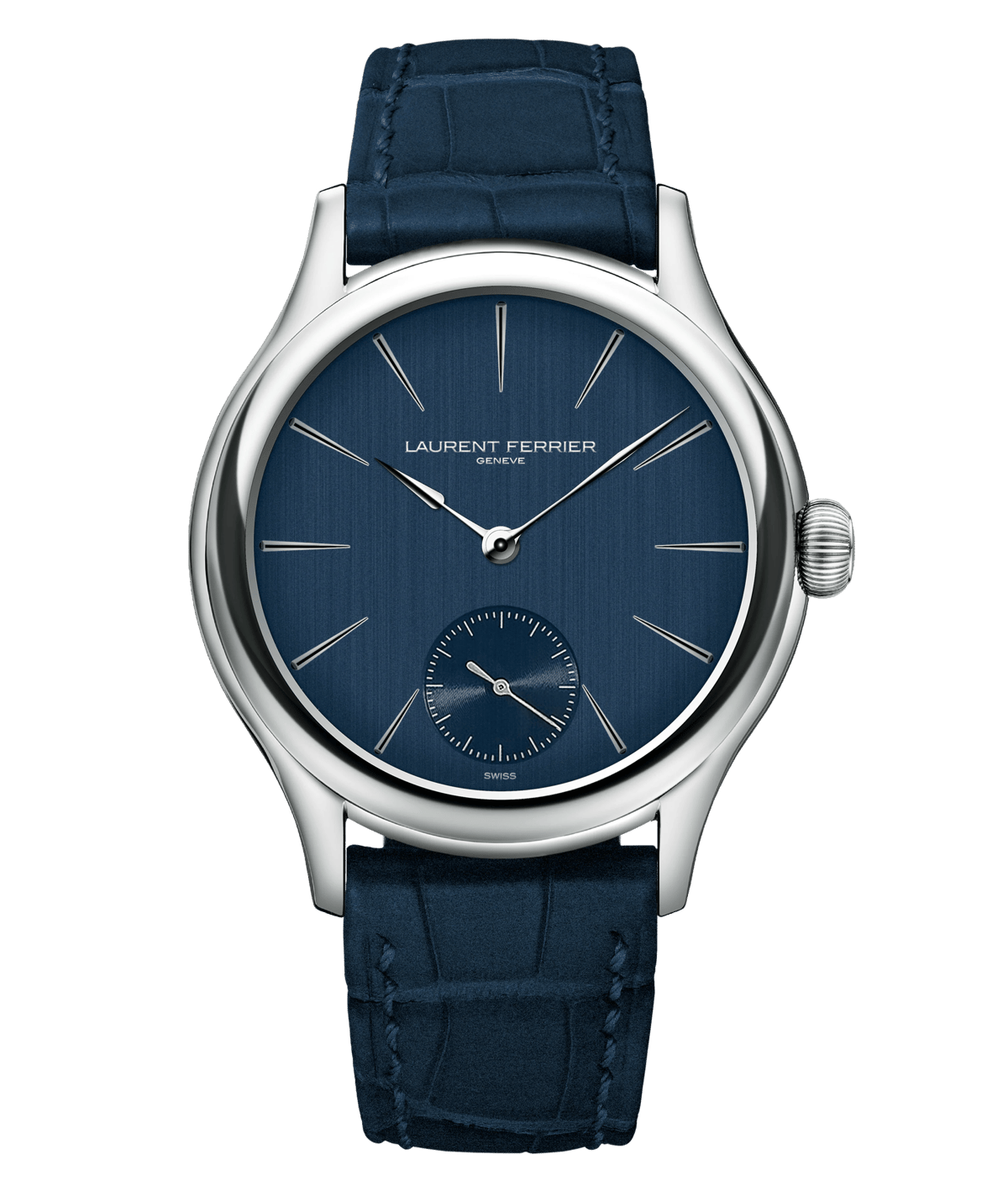
There is a particular kind of collector who, somewhere around their third or fourth serious purchase, stops buying watches that other people recognise. The Laurent Ferrier Classic Micro-Rotor Blue, reference LCF004.G1.CG2, exists almost entirely for that person. It is a dress watch of near-aggressive restraint: a blue dial, a small seconds hand, a case that curves like a river stone, and underneath it an automatic micro-rotor movement finished to a standard most of the industry abandoned decades ago.
Laurent Ferrier is not a brand that markets. It does not run celebrity ambassadors, it does not engineer limited-edition hype cycles, and it has largely refused to chase the sports-watch money that has dominated the last decade of the auction market. What it does is build a small number of watches a year for people who care about the difference between a bevel polished by hand and one polished by a machine. The Classic Micro-Rotor is the entry point to that world, and the blue dial is the most contemporary face it wears.
This review treats the reference the way a buyer should: what it is, how it actually wears, what it costs, what it is likely to be worth in five years, and whether you should be writing a cheque or waiting for the next one to surface on the secondary market.
The House of Laurent Ferrier
Laurent Ferrier spent 37 years at Patek Philippe, ending his tenure as head of creation — effectively the man responsible for the look of some of the most recognisable watches of the late twentieth century. In 2009 he founded his own manufacture in Geneva with his friend and business partner François Servanin. The brand's first watch, the Galet Classic Tourbillon Double Spiral, was presented in 2010 and won the Men's Watch Prize at the Grand Prix d'Horlogerie de Genève that same year.
That debut set the template the house has followed ever since: classical proportions, a pebble-shaped case (galet is French for pebble), and movements that are as interesting from the back as the dial is from the front. The Classic Micro-Rotor — originally sold as the Galet Micro-Rotor — arrived shortly afterwards as the more accessible, everyday expression of the same philosophy.
Production is small. Laurent Ferrier is not a brand you will see on every wrist in a boardroom, and that scarcity is a large part of the appeal. It also has practical consequences for the secondary market, which we will get to.
Movement: Calibre FBN 229.01
The heart of the reference is Laurent Ferrier's in-house automatic calibre FBN 229.01. It is a micro-rotor design, which is to say the winding mass is not a large semicircular weight bolted on top of the movement but a small, off-centre rotor recessed into the mainplate. The practical consequences are twofold. First, the movement stays slim, which is what allows the watch to sit as flat as it does. Second, and more importantly for anyone who takes the caseback off, the micro-rotor leaves the entire movement architecture visible — the bridges, the gear train, the balance — instead of hiding half of it under a slab of metal.
The calibre runs at 21,600 vibrations per hour (3 Hz) and carries a power reserve of around 72 hours, which is generous for a micro-rotor automatic and means you can take it off on Friday and put it back on Monday without resetting it. It is not COSC-certified, and Laurent Ferrier has never pretended otherwise; the brand's position is that its own finishing and regulation standards exceed what a certificate would add.
Finishing is where the money goes. Geneva stripes across the bridges, circular graining on the mainplate, anglage — hand-bevelling — on every visible edge, and mirror-polished screw heads. The architecture is designed to be looked at, and the sapphire caseback exists for exactly that reason. In a category where many brands charge six figures for a decorated ébauche, this is a movement that earns its price on the back of the watch alone.
Case, Dial and Design Language
The Classic Micro-Rotor is built around a stainless steel case with the brand's signature pebble profile: a domed bezel that flows into the caseband without a hard edge, and lugs that curve downward rather than sticking out. It is the sort of case that photographs badly and wears beautifully, because the appeal lives in the transitions rather than in any single line.
The blue dial is the reason this particular reference exists. Laurent Ferrier dials are usually quiet — silvered opaline, slate grey, the occasional green — and the blue version is the brand allowing itself one small piece of theatre. The finish is a deep, slightly desaturated blue with a fine graining that catches light across the surface rather than reflecting it in a single hotspot. Applied indices are faceted and polished. The small seconds sub-dial at six o'clock is recessed and snailed, which gives the dial a sense of depth that flat-printed alternatives lack.
The hands are the brand's signature Assegai shape — long, tapering, with a subtle curve — polished to a mirror finish that reads black against the blue in most lighting conditions. There is no date, no lume, and no text beyond the brand name and the word Automatic. It is a dial that has been edited down to what matters, and that editing is the hardest thing in watch design to get right.
On the Wrist
The first thing you notice is the weight, or the lack of it. A stainless steel dress watch with a micro-rotor movement and an alligator strap is a genuinely light object, and combined with the case's low, domed profile it disappears under a cuff exactly the way a proper dress watch should. This is not a watch you feel all day; it is a watch you forget you are wearing until you glance down at it.
Balance is excellent. The lugs curve downward rather than projecting outward, so the watch sits close to the wrist instead of perching on top of it, and the hand-stitched alligator strap is soft enough from day one that there is no break-in period. The crown is small and slightly recessed, which is aesthetically correct but does mean winding and setting require a little more dexterity than a sports watch. That is a fair trade for a case profile this clean.
On smaller wrists the watch wears larger than its numbers suggest, because the dial is almost entirely open and the bezel is thin. On larger wrists it reads elegant rather than prominent. If you are used to sports watches, the first hour will feel like you have forgotten to put on a watch. By the end of the day you will understand why people who own both reach for this one.
Accuracy and Daily Ownership
Laurent Ferrier regulates its movements to a standard that in practice lands comfortably inside a handful of seconds per day in either direction. Owners typically report figures in the region of -2 to +4 seconds per day, which is chronometer-grade performance without the certificate. As with any mechanical watch, real-world rates depend on position, temperature and activity; a micro-rotor automatic left on a desk for three days will not perform like one worn daily.
The absence of a date means there is nothing to set beyond the time, which makes it an unusually easy watch to live with if you rotate through several pieces. The 72-hour power reserve is the practical enabler: pick it up on a Monday morning after a weekend in the box and it will still be running.
The Market: Pricing, Resale and the Hold Question
Laurent Ferrier sits in an awkward but interesting place in the secondary market. It is not a hyped brand — there are no waitlists of the kind that generate social-media content — but it is a respected one, and the Classic Micro-Rotor is the model that most often changes hands. Retail for the reference sits in the low-to-mid forty-thousand-dollar range, and pre-owned examples have generally traded in the mid-thirties to low-forties depending on condition, completeness and dial colour.
That spread tells you something important: this is a watch that depreciates modestly from new and then flattens out. It is not a value trap, but it is also not a flip. The blue dial is the most commercially appealing of the Classic Micro-Rotor dials, which means it is both easier to sell and less likely to be discounted heavily — expect a blue-dial example to command a small premium over a silvered one on the secondary market.
Where the brand does appreciate is at the top of the range. Laurent Ferrier's tourbillons and rarer complications have a genuine collector following, and pieces with unusual dials or small production runs have shown real strength through the 2022 peak and the subsequent correction. The Classic Micro-Rotor is not that watch. It is the gateway, and gateways rarely outperform.
The hold recommendation is straightforward. If you are buying this as a daily wearer and you intend to keep it, buy it pre-owned at a fair price and stop thinking about it. If you are buying it as an investment, you are buying the wrong Laurent Ferrier — put the money into a tourbillon or a Voutilainen instead. If you are buying it new, accept that the first owner takes the depreciation hit and negotiate accordingly.
Auction history for the reference is thin rather than non-existent. Laurent Ferrier does cross the block at Phillips and Christie's, and Classic Micro-Rotor examples have sold, but the model is not a headline-generating lot. That is not a bad thing: it means pricing is driven by private sales and dealer inventory rather than by auction theatre, which keeps the market orderly.
Alternatives Worth Considering
The most direct competitor is the Parmigiani Fleurier Tonda PF Micro-Rotor, which offers a similar technical proposition — a slim, micro-rotor automatic in a restrained case — with an integrated bracelet and a slightly more modern silhouette. It is a different aesthetic, but the same buyer.
At the top of the market, the F.P. Journe Chronomètre Bleu is the obvious comparison: a blue dial, a tantalum case, and a level of finishing genuinely in the same conversation. It costs considerably more, and the waiting list is real.
For collectors who want the same philosophy in a different accent, the Kari Voutilainen Vingt-8 and the H. Moser & Cie. Endeavour Centre Seconds both occupy the same territory of quiet, hand-finished excellence. The A. Lange & Söhne Saxonia Thin is the more conventional choice, and the Vacheron Constantin Patrimony the more accessible one.
If you want the look without the price, the Baltic MR01 uses a Chinese micro-rotor movement and delivers a surprisingly convincing dress-watch silhouette for a few hundred dollars. It is not the same object — the finishing is industrial rather than hand-applied and the movement architecture is simpler — but it is a legitimate way to test whether the micro-rotor dress watch is a format you actually enjoy wearing before committing five figures.
Service and Long-Term Ownership
Laurent Ferrier is a small manufacture, and service runs through the brand or through a small number of highly capable independents. Turnaround is measured in weeks rather than days, and costs are in line with other independent Swiss brands — a four-figure sum for a full service, more if parts are required. The good news is that the movement is robust and the design is straightforward; there is no exotic complication to fail.
The alligator strap is the wear item. Plan on replacing it every couple of years if you wear the watch regularly, and budget for a genuine replacement rather than an aftermarket one if you care about resale. Keep the original buckle and any paperwork; on a watch like this, completeness is worth real money at trade-in.
Verdict
The Laurent Ferrier Classic Micro-Rotor Blue is not a watch for people who need their purchases validated by a market. It is a watch for people who have decided they would rather own something made by a handful of people in Geneva than something made by a machine and marketed by a department. On those terms it is close to perfect: beautifully proportioned, beautifully finished, and quiet enough to wear every day without ever feeling like a statement.
Buy it used, buy it to keep, and do not expect it to make you money. Expect it to be the watch you reach for when nothing else feels right.