First impressions: green, but not loud
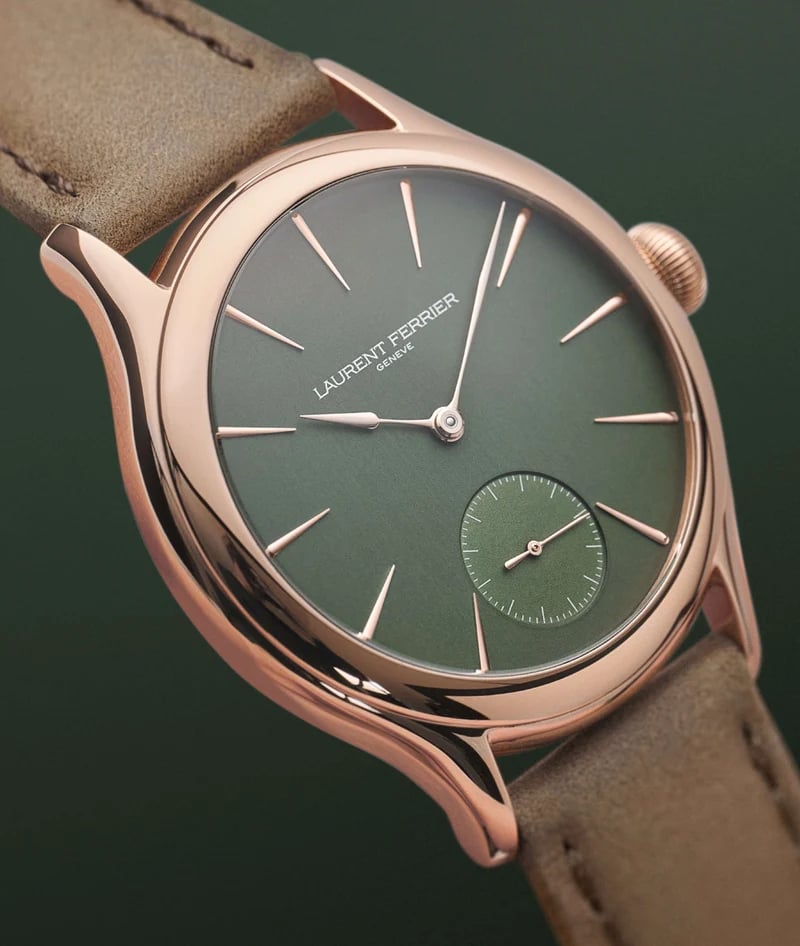
There is a particular kind of watch that only reveals itself after a week on the wrist. In a press image, the Laurent Ferrier Classic Micro-Rotor Evergreen reads as a very expensive green dress watch: pleasant, restrained, slightly severe. On the wrist — in a shirt cuff, on a train, at a long dinner — it becomes something else entirely: a quiet, almost frictionless object that you stop noticing and start missing the moment you take it off. That gap between the photograph and the lived experience is what this review is about.
Laurent Ferrier is not a brand that shouts. Founded in 2009 by a man who spent the better part of four decades at Patek Philippe, the Geneva house has built a small, deliberately slow catalogue around a handful of calibres and a case shape that has barely changed in fifteen years. The Classic Micro-Rotor is its most approachable line — 'approachable' being a relative term in this corner of the market — and the Evergreen is the version with the deep green dial that has quietly become the collection's most wanted variant.
I wore it for a week: to the office, on a train, through a long dinner, in the rain, and on a Sunday morning with no particular plan. Here is what survived.
Laurent Ferrier in two minutes
Laurent Ferrier founded his eponymous brand in Geneva in 2009 with his friend François Servanin, after a long career at Patek Philippe where he worked on some of the most recognisable designs of the late twentieth century. The house's debut piece, the Galet Classic Tourbillon Double Spiral, won the Best Men's Watch prize at the Geneva Grand Prix in 2010 and immediately established the brand's reputation for classical proportions married to genuinely original movement engineering.
What matters for this review is the micro-rotor line. Originally sold as the Galet Micro-Rotor, it was renamed the Classic Micro-Rotor as the collection was reorganised around 2020. It has always been the brand's core dress watch: a small-seconds, three-hand piece built around an in-house self-winding calibre with a micro-rotor and Laurent Ferrier's signature natural escapement. The Evergreen is a dial variant of that same watch, and the fact that the brand has resisted the temptation to turn it into a limited-edition circus is very much in keeping with how Laurent Ferrier operates.
What the Evergreen actually is
Strip away the marketing and you have a stainless steel dress watch with a deep green dial, a small seconds subdial, and a leather strap. That is it. There is no date, no luminous material, no screw-down crown, no bracelet option. The dial is the headline: a rich, saturated green that reads almost black in low light and opens up into something much livelier in daylight, with a finish that shifts as you move your wrist. It is not a novelty green. It is the kind of green you would find on a well-worn leather club chair, and it works with navy, charcoal, brown and — slightly surprisingly — denim.
The rest of the dial is deliberately quiet. Applied indices, slim hands, a small seconds at six o'clock. There is no text beyond the brand name, no 'automatic' script, no depth rating cluttering the surface. Laurent Ferrier understands that a dress dial lives or dies on restraint, and this one is beautifully judged.
The movement: FBN 229.01
The calibre inside is the FBN 229.01, an in-house automatic with a micro-rotor and a 72-hour power reserve, running at 21,600 vibrations per hour. The headline technical feature is the natural escapement — a double direct-impulse design that Laurent Ferrier has been developing and refining since the brand's earliest days. In plain terms, it transmits energy to the balance more efficiently than a conventional Swiss lever escapement, which is partly why the movement can run for three days on a single winding and still keep good time.
The micro-rotor is the other half of the story. By sinking the winding weight into the movement rather than sitting it on top, the calibre stays thin and the caseback view stays unobstructed. And what a view it is: hand-bevelled bridges, Côtes de Genève, circular graining, polished screw heads, and a rotor that occupies the centre of the display like a piece of jewellery. This is finishing done by people, not machines, and it shows under a loupe.
Laurent Ferrier does not submit this watch for COSC certification. That is a deliberate choice rather than an oversight — the brand regulates by hand in its own atelier, and the certificate would tell you less than a week on the wrist will.
On the wrist: the case is the point
Here is where the Classic Micro-Rotor separates itself from almost everything else in the category. The case is the soft, rounded 'pebble' shape that Laurent Ferrier has been refining since the Galet era, with lugs that curve down and away from the case rather than projecting straight out. That geometry is the entire story of how it wears.
There is no flat slab of caseback pressing into the wrist bone. There are no lug tips hovering over the edge of the arm. It settles. On a wrist that normally makes dress watches feel perched rather than worn, this one simply sits down and stays there. I noticed it within the first hour and then stopped noticing it entirely, which is exactly the point.
In steel, the watch is light enough that it disappears by mid-morning, and the weight distribution is dominated by the strap rather than the head — a subtle but important detail, because it means the watch does not rotate around the wrist when you move your arm. The leather strap is supple straight out of the box, with none of the two-week break-in period that stiffer alligator often demands, and the pin buckle keeps the profile low enough that it never catches on a shirt cuff.
The one ergonomic compromise is the crown. It is small, discreet and slightly fiddly to grip if you have large fingers. That is the price you pay for a case flank with no protrusions, and after a week I decided it was a fair trade. Over seven days I never once caught the watch on a sleeve, a doorframe or a bag strap, which is more than I can say for most watches in this bracket.
Legibility: excellent by day, nonexistent by night
In daylight, the Evergreen is a pleasure to read. The contrast between the hands and the green dial is strong, the applied indices catch light at useful angles, and the small seconds is easy to locate at a glance without dominating the dial. The sapphire crystal is clear and, in the examples I have handled, well managed for reflections — you get some glare outdoors, but nothing that stops you reading the time.
At night, the watch is effectively blind. There is no luminous material anywhere on the dial or hands. For a formal dress watch that is a defensible choice — lume would compromise the dial's purity — but if you are the kind of person who checks the time at 3 a.m. without turning on a light, this is not the watch for that job.
Accuracy in the real world
The natural escapement is capable of running comfortably within a few seconds a day, and the example I wore was consistent enough that I stopped checking it against a reference clock after day three. That consistency matters more than raw precision: a watch that gains four seconds every day is far easier to live with than one that wanders unpredictably.
The 72-hour power reserve is genuinely useful rather than a spec-sheet flourish. Take the watch off on Friday evening, leave it on a bedside table, and it will still be running and roughly on time on Monday morning. That alone makes it a far more practical daily wearer than its dress-watch styling might suggest.
A week of real wear
Monday. Office day, shirt and jacket. The watch slid under the cuff without a fight and stayed there. No crown dig, no case edge pressing into the back of the hand. By lunchtime I had forgotten I was reviewing it, which is the highest praise I can give.
Tuesday. Train journey, laptop bag, a lot of typing. The pin buckle never caught on the desk edge, and the strap showed no creasing after a full day of wrist movement. The green dial looked almost black under train lighting — a nice reminder that this is a watch that changes character with its environment.
Wednesday. Rain. I did not panic, but I also did not stand in it. This is a dress watch and should be treated like one. Wipe it down and move on.
Thursday. A long dinner, low light, white tablecloth. This is where the Evergreen earns its money. Under warm restaurant lighting the dial picks up a depth that photographs never capture, and the small seconds gives the face just enough movement to be interesting without being busy. Two people asked about it. Neither had heard of Laurent Ferrier, which I found oddly satisfying.
Friday. Took it off at 7 p.m. and left it on the dresser.
Saturday. Wore something else.
Sunday. Picked it up at noon. Still running, still roughly correct. The 72-hour reserve is not a marketing number.
Monday. Back on the wrist. No irritation, no strap smell, no caseback grime to clean off — the smooth caseback and soft strap make this an unusually low-maintenance watch.
Occasions: where it belongs
The Classic Micro-Rotor Evergreen is a formal and dress watch first, a daily wearer second, and a travel watch third. It is at its best with tailoring: suits, jackets, knitwear, a good coat. It works surprisingly well as an everyday office watch because it is so comfortable and so discreet. It is not a sports watch, not a beach watch, and not something you would take hiking. There is no luminous material, and the case is not designed for swimming. Treat it as a beautifully made object for civilised occasions and it will never let you down.
Variants and family
The Classic Micro-Rotor family shares a single case design and a single calibre, with dial colour as the main variable. The Evergreen is the green-dialled execution on a leather strap. Other executions in the same family have been offered with silver-white, blue and sector-style dials, and gold-cased versions sit above the steel references on price. Laurent Ferrier does not publish a single consolidated variant list, so if a specific dial code matters to you, confirm it with an authorised dealer rather than relying on a forum thread.
The wider family is worth understanding too. The Classic Origin and Classic Auto sit alongside the Micro-Rotor in the catalogue, and the Galet Classic Tourbillon Double Spiral remains the brand's flagship. The micro-rotor line's direct ancestor is the Galet Micro-Rotor, which is effectively the same watch under its pre-2020 name.
Alternatives worth trying on
If you are shopping in this bracket, the obvious comparisons are the Patek Philippe Calatrava 6119, the A. Lange & Söhne Saxonia, the F.P. Journe Chronomètre Souverain, the Vacheron Constantin Traditionnelle and the H. Moser & Cie. Endeavour Small Seconds. Each has a different personality: the Patek has the network, the Lange has the finishing, the Journe has the cult, the Vacheron has the heritage, and the Moser has the minimalism. None of them wears quite like the Laurent Ferrier, because none of them has that pebble case.
If the budget is tighter, the Baltic MR01 is the only genuinely affordable micro-rotor dress watch worth considering, and the Nomos Orion and Frederique Constant Slimline Small Seconds both deliver the small-seconds dress-watch mood for a fraction of the money. They are not the same object — not remotely — but they scratch a similar itch.
Value and ownership
Pricing on the Classic Micro-Rotor Evergreen sits in the region of fifty thousand US dollars at retail, depending on market and taxes. On the secondary market, steel micro-rotors typically trade below retail, in the high thirties to high forties, and the trend is best described as stable rather than exciting. This is not a watch you buy to flip.
What you are paying for is craft: a hand-finished in-house movement with a natural escapement, a case that has been thought about rather than merely drawn, and a dial that was finished by someone who cared. Against a comparable Patek or Lange, the Laurent Ferrier gives you more hand-work per dollar and considerably less brand recognition. That is either the whole appeal or a dealbreaker, depending on what you want from a watch.
Servicing runs through the brand's Geneva atelier and a small authorised network. It is not fast and it is not cheap, but it is done properly, and the movement deserves nothing less. Budget for it the way you would budget for a good tailor.
The verdict
The Classic Micro-Rotor Evergreen is the rare dress watch that gets better the longer you leave it on. It is not the loudest independent in the room, and it will never be an auction trophy, but as a thing to actually wear — to a meeting, to dinner, to a wedding, to a Tuesday — it is close to faultless. The case disappears, the movement rewards a second look, and the green dial does something that photographs simply cannot convey.
If you have been circling a small-seconds dress watch and want something that nobody else at the table is wearing, this is the one to try on before you sign anything. Just do not expect to take it off afterwards.