The quiet flex: why the steel Laurent Ferrier matters
There is a specific moment in a collector's life when the conversation shifts. You stop buying the watch that gets recognised and start buying the watch that gets asked about. The Laurent Ferrier Classic Micro-Rotor Silver lives entirely in that second category. It is a steel dress watch from a Geneva independent that produces a few hundred pieces a year, and almost nobody outside the hobby will know what it is. That is precisely the point.
Laurent Ferrier spent decades as a designer inside Patek Philippe, and when he finally put his own name on a dial in 2009, he did it with a tourbillon that took the Grand Prix d'Horlogerie de Geneve the following year. Since then the brand has built its reputation on two things: movement architecture that punches above its price class, and case finishing that feels like a river stone. The Classic Micro-Rotor is the watch that made that reputation reachable without going gold.
This reference, LCF004.R5.GR1, is the silver-dial steel version. It carries the same FBN229.01 automatic micro-rotor calibre as its precious-metal siblings, including the double direct-impulse escapement Laurent Ferrier helped bring to series production in a wristwatch. What follows is everything worth knowing before you wire the money: the movement, the way it sits on the wrist, what it costs, and whether it is the kind of watch you keep.
Laurent Ferrier, in brief
The brand was founded in 2009 by Laurent Ferrier and his friend Francois Servanin, and it arrived with a statement rather than a whisper. The Galet Classic Tourbillon Double Spiral, with its twin balance springs and its pebble-smooth case, won Best Men's Watch at the 2010 Grand Prix d'Horlogerie de Geneve. That win did two things: it told the industry that a small independent could still out-engineer the big houses, and it set the template for everything the brand has done since.
What makes Laurent Ferrier interesting in 2020s horology is the restraint. There is no aggressive marketing, no celebrity ambassador programme, no constant stream of limited editions designed to create artificial scarcity. The catalogue is small. The output is small. The watches are sold through a handful of retailers and directly to collectors who have usually already owned the obvious names. When a brand like this survives and grows, it is because the product does the talking.
The Classic Micro-Rotor sits in the middle of that catalogue. It is not the tourbillon, and it is not the sports watch. It is the everyday dress piece, the one that a collector wears to the office, to dinner, and to the kind of auction preview where everyone else is wearing something louder.
The case and the dial
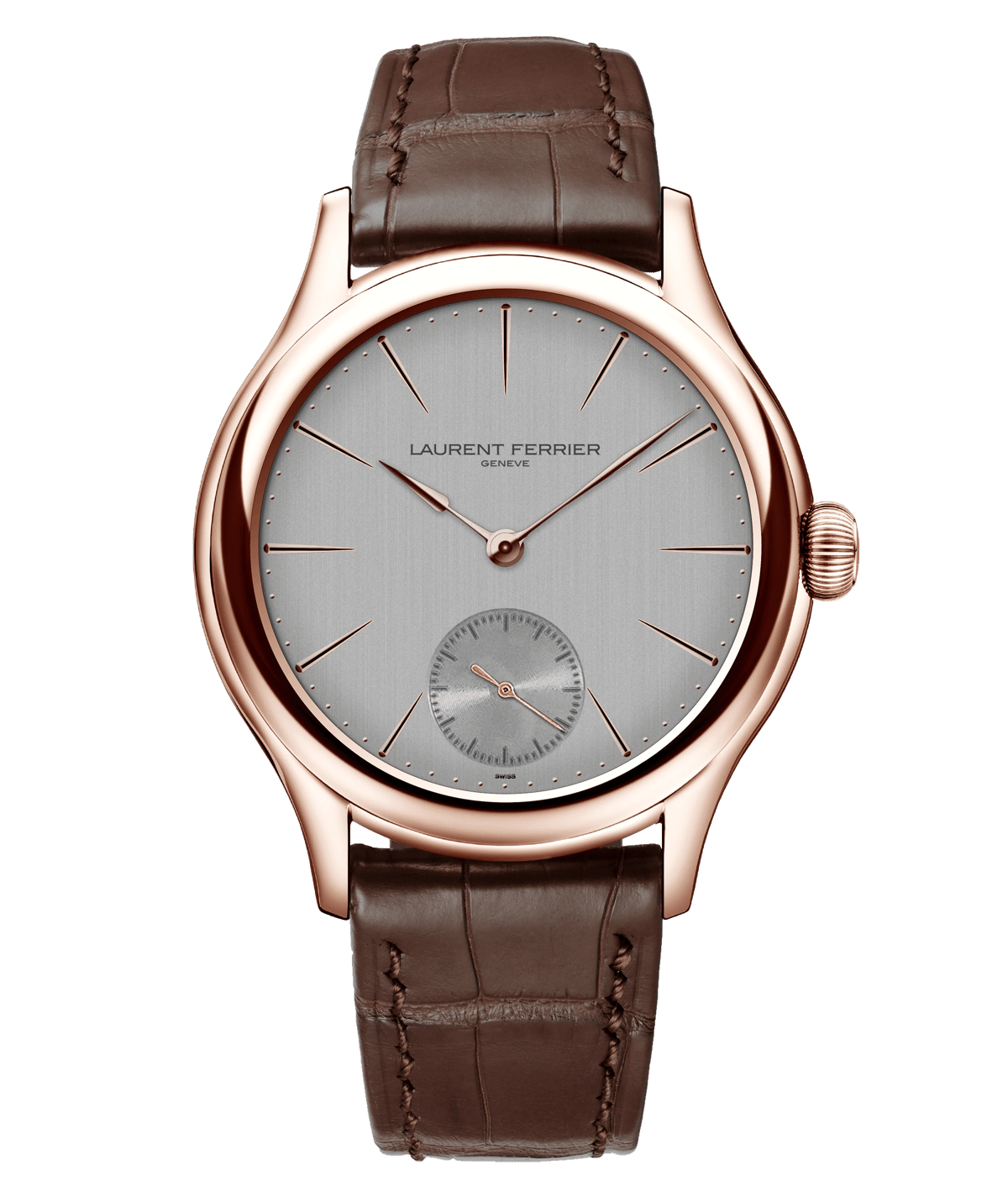
The case is stainless steel, and the finish is where the money goes. Laurent Ferrier's cases are hand-finished in a way that most volume manufacturers simply cannot replicate on a production line: the curves are continuous, the transitions between polished and satin surfaces are clean, and the whole thing has a softness that reads as expensive long before you know what it is. There are no hard edges to catch on a shirt cuff and no slab-sided flanks to make the watch look bigger than it is.
The dial is the part that sells the watch. Silver opaline is a deceptively difficult finish to get right, because it has to be bright enough to read as silver and warm enough to avoid looking like painted plastic. In daylight it goes almost white, and in low light it turns a soft, warm grey that makes the applied indices stand out. The small-seconds subdial at six o'clock is the only real complication, and it is executed with a finely worked ring that catches the light differently from the main dial surface.
The hands are the house's signature Assegai-inspired shape, long and tapered with a pronounced point, and they are polished to the point where they nearly vanish against the dial at certain angles and then flash black against it at others. It is a small detail that separates a watch designed by someone who spent a career looking at dials from one designed by a committee. There is no date window, no text clutter, and no lume. The dial is allowed to be a dial.
The movement: FBN229.01 and the natural escapement
This is the reason to buy the watch. The FBN229.01 is an automatic calibre built around an off-centre micro-rotor in gold, and it runs at 21,600 vibrations per hour with a 72-hour power reserve. Those numbers are respectable but not remarkable on their own. What is remarkable is how the movement delivers them.
Laurent Ferrier's signature technical story is the double direct-impulse escapement, often called a natural escapement. In a conventional Swiss lever escapement, the escape wheel pushes a pallet fork, which pushes the balance, and the whole chain involves sliding friction that wastes energy and requires lubrication. A natural escapement delivers impulse directly to the balance through two escape wheels and two pallet levers, with silicon components reducing friction and wear. The result is a movement that needs less energy to keep time, which is how a micro-rotor with a relatively small mainspring can still deliver 72 hours of running autonomy.
It is also beautiful in a way that a photograph only partly conveys. The micro-rotor sits flush with the bridges rather than floating above them, and because it does not sweep across the whole movement, you can actually see the architecture underneath: Cotes de Geneve striping, circular graining, and bevels that have been polished by hand rather than machine. This is the sort of finishing that collectors mean when they say a movement is worth turning over.
One thing worth noting: this calibre is not COSC certified. Laurent Ferrier regulates its movements in-house and does not chase certificates. If you are the kind of buyer who needs a piece of paper to validate accuracy, that will bother you. If you are the kind of buyer who understands that a certificate is a snapshot and not a guarantee, it will not.
On the wrist
The Classic Micro-Rotor is designed to be worn, not displayed. The case profile is soft and rounded, the lugs curve down toward the wrist rather than standing away from it, and the result is a watch that sits low and stays centred through a full day. It does not slide around on the wrist, and it does not dig in when you rest your hand on a desk. On a properly sized alligator strap, the whole package feels light for something this well made.
The pin buckle is a deliberate choice that some buyers will question. A deployant clasp is more convenient and kinder to the strap over time, but it also adds bulk under the wrist and interrupts the line of the case. Laurent Ferrier's standard buckle keeps the underside clean and lets the strap do the work. If you wear your watches tight, you will notice the difference immediately.
Balance is the standout quality. Because the dial is uncluttered and the case is not oversized, the eye lands on the small seconds and the way light moves across the opaline surface rather than on mass. Under a shirt cuff the watch disappears completely. With the sleeve pushed up it reads as jewellery without ever looking flashy. Collectors who own both this and a heavier gold dress watch tend to reach for the steel one on the days they actually have to work.
Accuracy and daily life
Because the movement is not COSC certified, there is no certificate number to quote, and anyone who tells you otherwise is guessing. What you get instead is a calibre regulated in-house around an escapement designed for efficiency and stability rather than for a lab test. In practice, owners report the watch running comfortably inside a handful of seconds per day in normal wear, with the rate settling rather than drifting as the mainspring unwinds. That stability is the practical payoff of the low-friction escapement.
Expect the usual sensitivities. If the watch sits in a drawer for a week, it will need a wind and a settle before you judge it. If you rotate it with five other pieces, give it a few days of consistent wear before you form an opinion. There is no anti-magnetic cage here and no silicon hairspring marketing story, so keep it away from tablet cases, speaker magnets and the magnetic clasps on laptop bags. None of that is unusual for a hand-finished dress watch, but it is worth saying out loud.
Where it fits in a collection
This is a formal and dress watch first, a daily wearer second, and a travel watch third. It works with tailoring, it works with a knit polo and trousers, and it works at a wedding. It does not work at the beach, in the pool, or on a hiking trip. There is no lume, so reading it in a dark cinema is a matter of catching the screen light. And while the case will survive a splash, it is not built for water and should not be treated as if it were.
For collectors, the smarter framing is that this is the watch you buy after you have already bought the sports watch. It is the piece that fills the gap between a steel chronograph and a gold dress watch, and it does so without asking you to choose between them. It is also the piece most likely to become the one you actually wear most, which is the highest compliment a dress watch can receive.
Variants and family
The Classic Micro-Rotor family is built around the same calibre and the same dial architecture, with the variables being case metal and dial colour. The 18k rose gold version is the warmest and most traditional, and it carries noticeably more weight on the wrist. The white gold version reads cooler and more formal, and it is the one to choose if the watch will live mostly under a dinner jacket. Steel versions with darker dials shift the character entirely, reading more modern and letting the small-seconds ring sit quietly in low light.
Within the broader Laurent Ferrier catalogue, the closest siblings are the Galet Micro-Rotor, which established the micro-rotor formula, the Square Micro-Rotor, which applies the same thinking to a different case shape, and the Galet Classic Tourbillon Double Spiral, which is the watch that started it all. Beyond those, the brand's other notable models include the Grand Sport Tourbillon, the Sport Auto, the Galet Annual Calendar School Piece, the Galet Traveller Globe Night Blue and the Classic Tourbillon Double Spiral.
What else to consider
The most obvious alternative is the F.P. Journe Chronometre Bleu. It is the other independent dress watch that collectors whisper about, it uses a tantalum case, and it carries the same low-key, in-the-know energy. It is also harder to find and usually more expensive.
H. Moser and Cie's Endeavour Centre Seconds offers a minimalist dial, an in-house micro-rotor movement and a similarly stubborn refusal to chase trends. Chopard's L.U.C XPS gives you a micro-rotor dress watch with serious hand-finishing and Geneva Seal credibility at a comparable price point. Patek Philippe's Calatrava remains the establishment reference, and it is the model most buyers cross-shop before deciding they would rather have something nobody else owns. Czapek's Quai des Bergues is another small Geneva house building unusual, beautifully finished movements for exactly the same kind of buyer.
If the budget is not there yet, the Baltic MR01 is a genuinely micro-rotor automatic dress watch with a small-seconds dial for a fraction of the price, and it is the closest thing to this silhouette you can buy without a five-figure outlay. Seiko's Presage Cocktail Time and Orient's Bambino Small Seconds both capture the silver-dial, small-seconds mood at entry level.
Price, market and service
Indicative pricing for this reference sits in the mid four figures in US dollars, with retail having climbed steadily since the model launched and pre-owned examples typically trading below current retail. That gap is the honest reality of buying a small independent new: you are paying for the watch, not for a financial instrument. The Classic Micro-Rotor is nonetheless the model that brought a wave of new collectors into the brand, which is the kind of demand that supports values over a decade rather than a quarter.
If you want a return, buy a tourbillon. If you want a watch, buy this. The smarter play is to buy a well-kept pre-owned example from a reputable dealer, verify the service history, and let someone else absorb the initial depreciation.
On servicing, the micro-rotor and the natural escapement are not jobs for a generalist watchmaker. Plan to send the watch back to Laurent Ferrier's own atelier or an authorised partner, expect a turnaround measured in weeks rather than days, and budget for a bill that reflects the complexity of the movement rather than the simplicity of the dial. The brand's service network is small, which is the trade-off for owning something this specialised.
The verdict
The Classic Micro-Rotor Silver is the rare steel dress watch that earns its price through engineering rather than branding. The natural escapement and the hand-finished micro-rotor give you something to talk about when someone finally asks what is on your wrist, and the case and dial give you something to look at when nobody asks at all. It is comfortable, it is quiet, and it is finished to a standard that most watches at twice the price cannot match.
If you want a watch that flatters you in a room full of recognised references, this is not it. If you want the one that quietly wins the conversation afterwards, it is very hard to beat. Buy it to wear, keep it serviced, and let the rest of the room catch up.