Why the Moon Phase Matters Again
Every few years the collector market rediscovers the moon phase. It tends to happen late in a cycle, once the steel sports watch trade has run out of oxygen and buyers start looking for something that rewards a second glance rather than a first. The moon phase is the natural beneficiary of that mood. It is the only complication in horology that serves no practical purpose whatsoever — you cannot time a lap with it, you cannot cross a time zone with it, and it drifts out of sync with the sky by roughly a day every two and a half years. That is precisely the point. It exists because someone, a long time ago, thought the night sky was worth putting on a dial.
Laurent Ferrier has been making that argument since 2009 from a small workshop in Geneva, at a rate of a few hundred watches a year. The Classic Moon, reference LCF039.R5.G3N, is the house's astronomical dress watch: a 5N red gold case, a silver-toned dial, and a moon-phase display executed with the sort of hand-finishing most of Geneva abandoned decades ago.
This review is written for the collector weighing the Classic Moon against the obvious alternatives from Lange, Vacheron Constantin and Jaeger-LeCoultre — and who wants to know not only whether it is a good watch, but whether it is a good place to put seventy thousand dollars. Those are two different questions, and the answers are not identical.
Laurent Ferrier: Four Decades at Patek, Fifteen Years Alone
Laurent Ferrier founded his eponymous brand in 2009 with his friend François Servanin. Ferrier had spent the better part of four decades at Patek Philippe, rising to a creative leadership role, and he left with a very specific idea of what a watch should be: round, legible, warm, and finished to a standard only a handful of ateliers could match.
The breakthrough came in 2010, when the Galet Classic Tourbillon Double Spiral took the men's watch prize at the Grand Prix d'Horlogerie de Genève. That watch — two balance springs, a double direct-impulse escapement — announced that Laurent Ferrier was not a nostalgia exercise. It was a technical house with a romantic streak.
Fifteen years on, the brand remains independent and deliberately small. Production is measured in the low hundreds of pieces a year, the collection is built around a handful of calibres, and there are no ambassadors, no boutique programme and no volume targets. That has consequences for the secondary market, which we will get to. It also means the person sitting across from you at dinner is unlikely to be wearing one.
Design: Silver on Red Gold
The Classic collection is built around the galet — pebble — case, and the Classic Moon is a faithful expression of it. The case is round, softly profiled and entirely polished, with lugs that curve away from the caseband rather than jutting from it. There is no bezel to speak of, no crown guards and no sharp transitions. From the side it reads as a single continuous form; from above, as a clean circle broken only by the crown at three.
The Silver version under review pairs that 5N red gold case with a silver-toned dial, and the combination is more interesting than it sounds. Red gold against a cool silver surface produces a warm-cold tension that photographs poorly and wears beautifully. It is one of the great underrated pairings in dress watchmaking, and it is the reason this reference exists alongside its darker-dialled siblings.
The dial itself is restrained to the point of austerity. Laurent Ferrier's signature Assegai hands — long, tapered, spear-like, with pronounced counterweights — sweep across a surface that is finished rather than decorated. Applied indices mark the hours. The moon-phase display is the only concession to theatre: a night-sky disc carrying a hand-applied gold moon and a scatter of stars, advancing once every 29 days, 12 hours and 44 minutes. Because the true synodic month is 29.53059 days, the display drifts by roughly a day every two and a half years — a discrepancy that is easy to correct and that no owner has ever noticed.
What the Classic Moon does not have is anything it does not need. No lume. No screw-down crown. No oversized date, no openworked dial, no theatrics beyond the movement itself. It is a watch that assumes you own other watches for other purposes.
Calibre LF 126.01: Hand-Wound, Hand-Finished
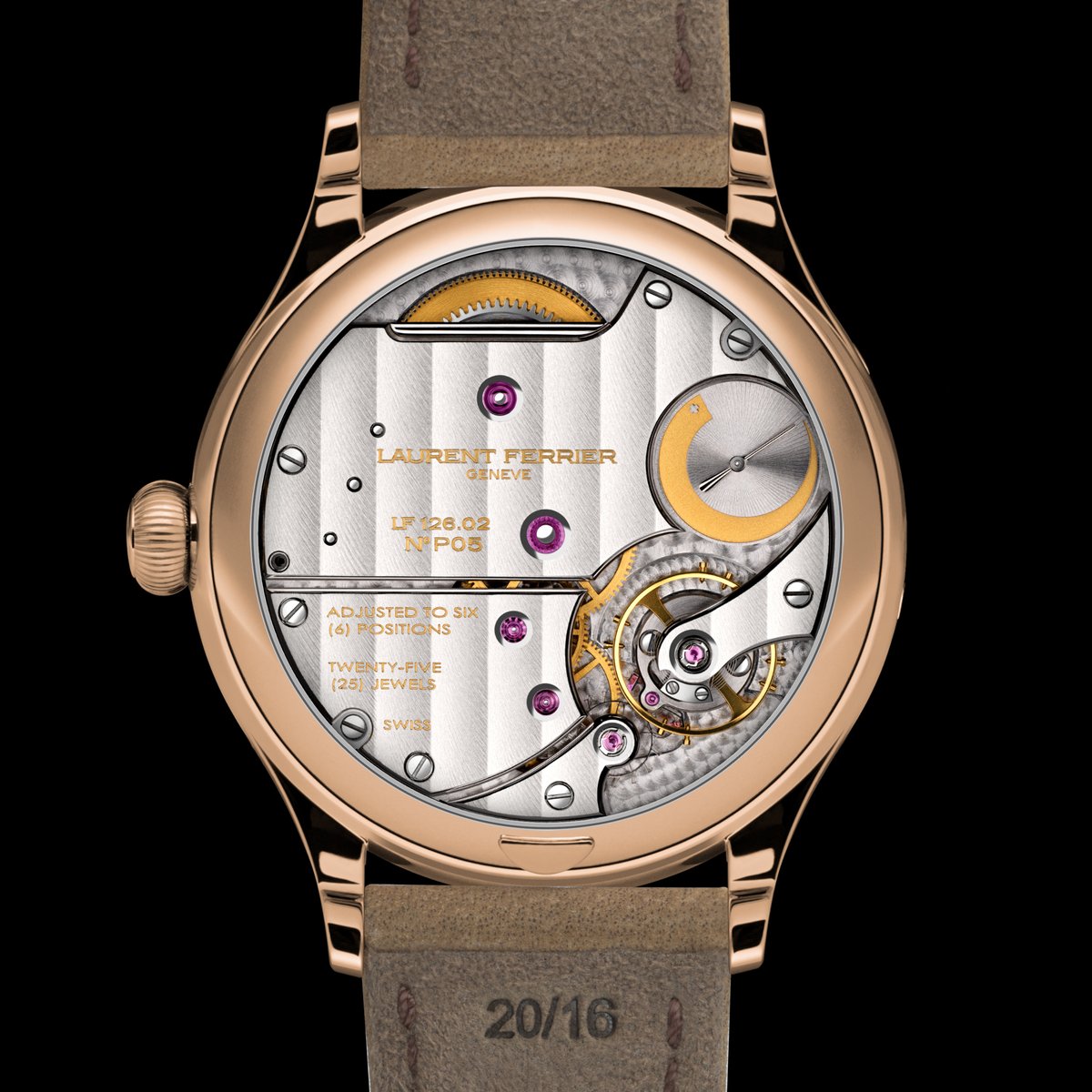
Powering the Classic Moon is Laurent Ferrier's in-house hand-wound moon-phase calibre, LF 126.01, running at 21,600 vibrations per hour and carrying roughly 72 hours of power reserve. The specification is deliberately old-fashioned: three hertz, a moon-phase mechanism, and no automatic winding to hide behind.
Hand-winding matters more than the spec sheet suggests. A moon-phase dress watch is a ritual object, and the daily act of winding it — feeling the mainspring load through the crown — is part of the ownership experience. Collectors who have only owned automatics assume this is a chore. In practice, for a watch worn two or three days a week, it is a small ceremony that keeps you connected to the object.
Finishing is where Laurent Ferrier separates itself. Bridges are hand-bevelled, the mainplate is decorated, and the assembly rewards a loupe in a way mass-produced movements simply do not. This is not a movement designed to be admired through a display back at arm's length; it is a movement designed to survive scrutiny.
Service is the flip side of independence. Laurent Ferrier is a small house, and parts, tooling and expertise live with the brand and its authorized agents rather than in the wider independent watchmaker ecosystem. Budget for service through official channels, and expect turnaround measured in months rather than weeks.
On the Wrist
Numbers matter less than geometry, and the Classic Moon's geometry is its strongest card. The case is compact by contemporary standards, and more importantly it is shaped to sit down on the wrist rather than on top of it. The lugs curve sharply downward, the caseback is gently domed, and the whole assembly tucks under a shirt cuff in a way that few modern dress watches manage.
On a 17cm wrist the Classic Moon reads as a proper dress watch: present, but not dominant. On a larger wrist it will look slightly small — which is the correct look for this genre, and the wrong look if you have spent the last five years wearing 42mm divers. The weight is noticeable in the hand and disappears on the wrist, which is exactly what you want from a gold case.
The strap deserves a paragraph of its own. Laurent Ferrier cuts its alligator thin and tapers it aggressively toward a pin buckle, which keeps the visual weight of the watch on the dial rather than on the arm. The trade-off is durability. Thin alligator and daily wear are not natural allies, and an owner who wears this watch five days a week should expect to replace the strap every year or two. Budget for it.
Accuracy and Everyday Ownership
Laurent Ferrier does not submit its movements for chronometer certification, and the Classic Moon is not a COSC-rated watch. In practice a well-regulated example will run within a handful of seconds a day — think in the region of minus two to plus six seconds in normal wear, with the caveat that hand-wound movements are sensitive to how consistently you wind them and how much tension is left in the mainspring.
The bigger point is that accuracy is not the reason to buy this watch. If split-second precision is your priority, an independent hand-wound dress watch is the wrong category entirely. What the Classic Moon offers instead is consistency of character: it will feel the same in ten years as it does today, and it will still be serviceable, because Laurent Ferrier is a going concern with a documented archive and a real workshop.
The Market: Pricing, Resale and the Independent Discount
Now the part that decides the purchase for most collectors.
Laurent Ferrier prices the Classic Moon in 5N red gold in the region of seventy to eighty thousand US dollars at retail, depending on market and currency at the time of order. That places it squarely in the territory of a rose gold moon phase from one of the big three, and comfortably above a Lange Saxonia Moon Phase or a Jaeger-LeCoultre Master Ultra Thin Moon.
On the secondary market, expect to pay somewhere between roughly forty-eight and seventy thousand dollars for a clean example, with the bottom of that range reserved for watches without full sets or with a tired strap. That spread — a meaningful discount to retail — is the defining feature of the Laurent Ferrier secondary market, and it is not a knock on the watch. It is a function of a brand producing a few hundred pieces a year, with no boutique network, relying on a small group of specialist dealers to move inventory. Thin markets trade at discounts. That is true of Laurent Ferrier, and it is true of most independents of comparable scale.
What that means depends entirely on why you are buying. If you are buying to wear, the secondary market is your friend: you can acquire a Classic Moon for less than the first owner paid, often from a dealer who will include a fresh service or an extra strap. If you are buying to invest, the arithmetic is less flattering. Laurent Ferrier does not have the auction record of a Philippe Dufour or a Kari Voutilainen, and its pieces do not command the waitlist premiums of a Royal Oak or a Nautilus. Auction appearances are sporadic and rarely headline-making; there is no comparable-sales record deep enough to anchor a valuation.
The honest position is this: the Classic Moon is a stable asset with a soft edge. It will not collapse — production is too small and the collector base too committed — but it will not double either. Buy it because you intend to wear it for twenty years, and treat any appreciation as a bonus rather than a thesis.
Where the Classic Moon holds up relatively well is within its own peer group. Measured against a rose gold moon phase from a major maison, the depreciation curve looks similar. Measured against a steel sports watch bought at the top of a hype cycle, the Classic Moon looks positively conservative.
Alternatives Worth Cross-Shopping
A. Lange & Söhne Saxonia Moon Phase. The obvious German answer: colder, more architectural, more obviously technical. It will hold value better and it will never feel as warm on the wrist.
Vacheron Constantin Patrimony Moon Phase Retrograde Date. The closest thing to a direct competitor from a major house, with a retrograde date and a beautifully finished movement. It carries the weight of a big brand and a big service network — and considerably less exclusivity.
Jaeger-LeCoultre Master Ultra Thin Moon. The value play. You give up hand-finishing and independent-brand cachet, and you save a great deal of money.
F.P. Journe Octa Lune. The other independent in the conversation. Journe's secondary market is stronger, his design language is louder, and the price of entry is higher.
Patek Philippe Ref. 5396 Annual Calendar Moon Phase. More complication, more brand, more liquidity — and a dial that will never be mistaken for a Laurent Ferrier.
The Verdict
The Classic Moon Silver is not a watch for someone who wants to win an argument. It is a watch for someone who has already won a few and no longer needs to. The red gold case and silver dial combination is quietly beautiful, the moon phase is executed with genuine craft, and the hand-wound calibre is finished to a standard that most of the industry has quietly given up on.
Buy it to wear. Buy it on the secondary market if you can, and let someone else absorb the first depreciation. Buy it knowing that it will be worth roughly what you paid in five years, and that the pleasure of owning it will not be measured in basis points.
And if you are buying it purely as an investment? Look elsewhere. Laurent Ferrier builds watches for people who love watches, and the market treats them accordingly — which is, on balance, a compliment.