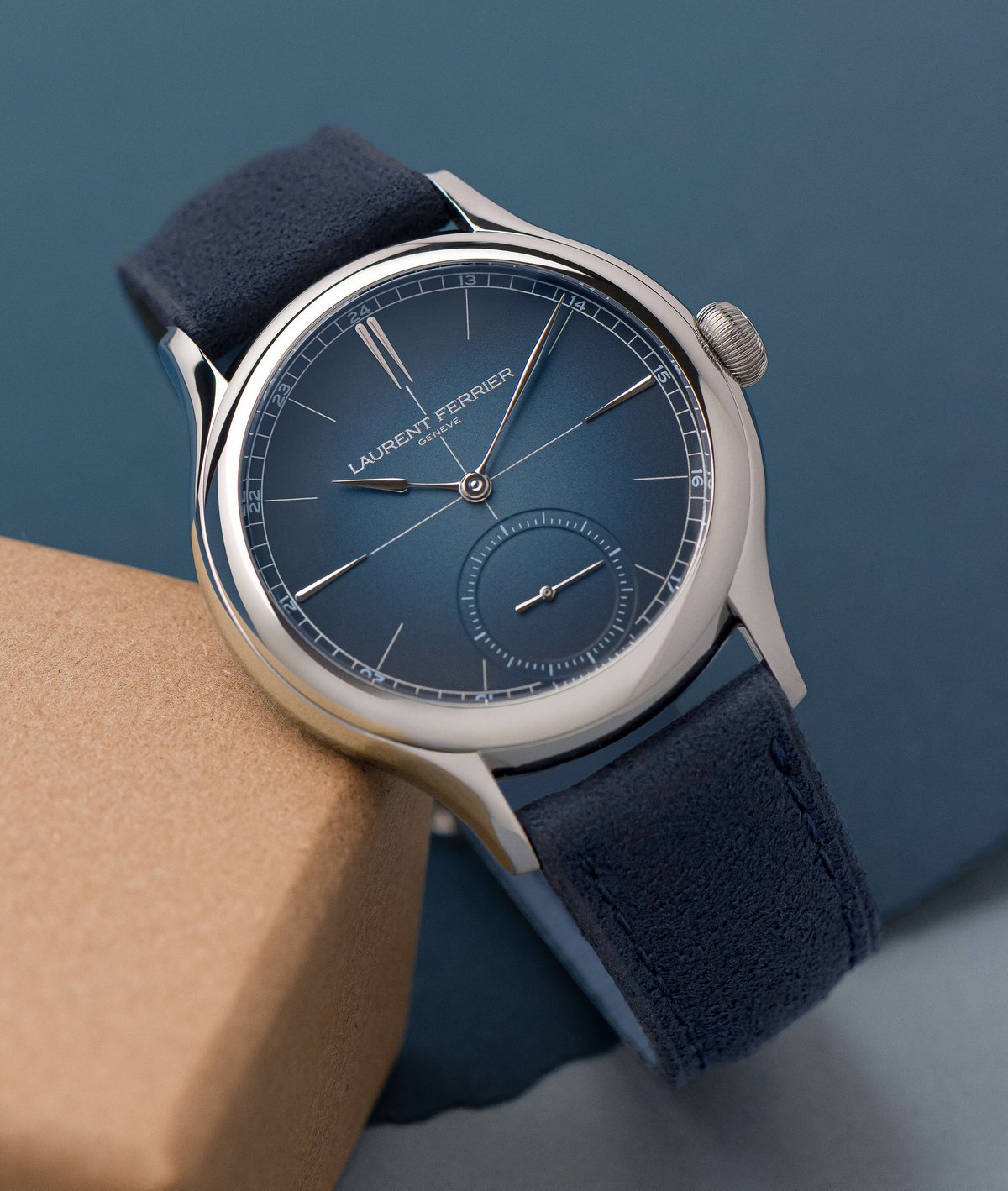
First impressions: the watch that waits for you
Some watches announce themselves from across a room. The Laurent Ferrier Classic Origin Blue does the opposite. It is a round titanium case, a deep blue dial, a small seconds at six and a leather strap — and from a metre away it could be any well-made dress watch. Then someone leans in, and the finishing, the proportions and the quiet confidence of the thing become obvious. That is the entire point of the Classic Origin, and it is why the watch rewards a week on the wrist far more than five minutes in a boutique.
I wore ref. LCF036.TI.CG for seven days: desk work, two dinners, a train journey, a rainy school run and a Saturday of errands. This is what survived.
Laurent Ferrier in context
Laurent Ferrier is a Geneva house founded in 2010 by Laurent Ferrier and François Servanin. Ferrier spent close to four decades at Patek Philippe, finishing his career there as creative director, and the design language he carried with him — soft round cases, restrained dials, an obsession with how a watch actually sits on a wrist — runs through everything the brand makes. The first watch the house released, the Galet Classic Tourbillon Double Spiral, won the Men's Watch Prize at the 2010 Grand Prix d'Horlogerie de Genève. It was a debut that set an unreasonable bar.
The Classic Origin arrived in 2020 as the entry point to the collection. It shares the house's hand-wound philosophy and its finishing standards while leaving the tourbillons and the more exotic escapements to the rest of the catalogue. In practical terms, it is the Laurent Ferrier you can buy without a conversation about allocations — which, in a market like today's, is worth something in itself.
The case: titanium changes the character
Ref. LCF036.TI.CG uses grade 5 titanium, and that single decision shapes everything about how the watch wears. Titanium is light — noticeably lighter than steel — and it does not take a mirror polish the way gold does. It stays grey and slightly matte, developing a soft sheen rather than a shine. On a dress watch this is a quietly subversive choice. The Classic Origin Blue never looks like a watch you are showing off. It looks like a watch you happen to be wearing, which is a harder trick to pull off than it sounds.
I am not going to quote you case dimensions I have not verified. What I can tell you is how the case behaves on a wrist. It sits low and flat. It does not roll to one side. The bezel is narrow enough that the dial gets the space it deserves, and the whole thing disappears under a shirt cuff without a fight. There is none of the head-heavy tug you get from a solid gold dress watch on a thin strap, and none of the top-heavy wobble that plagues watches with tall cases and short lugs.
The finishing is where you start to notice the difference between this and a mass-produced dress watch. Surfaces transition cleanly from one to the next, the edges are crisp without being sharp, and nothing about the case looks like it was designed by committee. It is a shape that has been thought about, and it is the kind of shape that looks better after a year of wear than it did in the box.
One practical note on titanium: it is not a scratch-proof miracle. It hides fine marks better than polished steel because there is no mirror surface to break up, and a light rub with a soft cloth brings back the sheen. After a week of keyboard edges and door frames, mine still looked new.
Water resistance is not the story here. This is a dress watch and I treated it like one — no swimming, no showers, no beach. If you need a watch that shrugs off a pool, buy something else; nobody at Laurent Ferrier is pretending otherwise.
The strap and the clasp
The Classic Origin comes on a leather strap, and the pairing matters more than it usually does. Titanium is a cool, matte metal, and leather softens the whole package — it keeps the watch from reading as technical and pushes it towards the dress side of the spectrum. The strap is well made, it broke in within a couple of days, and the pin buckle is light enough that it never digs into the underside of the wrist. If you are used to deployant clasps, the change takes an afternoon to get used to and then you stop noticing it, which is the highest compliment a clasp can receive.
One styling note: leather plus a blue dial plus a titanium case means this watch looks best with navy, grey and charcoal, and slightly odd with brown. Plan accordingly.
The dial: a blue that behaves
The dial is a deep blue that changes with the light. In a dim restaurant it reads almost black; in daylight it lifts into a proper blue with real depth. It is a restrained blue rather than a party blue, and it works with the cool grey of the titanium case — a warmer, more saturated blue would have fought the metal instead of complementing it.
The layout is classic and, more importantly, legible. Hours and minutes in the centre, a small seconds subdial at six o'clock, applied indices around the perimeter. The small seconds is the detail that makes the dial, and it is genuinely useful in daily wear: it gives your eye a focal point and gives you something to check when you have no reason to check the time at all.
Over a week, legibility was excellent. The hands reach far enough to point cleanly at the indices, the contrast holds up in low light, and I never had to tilt my wrist towards a window to read the time. That sounds like a low bar. Spend a month with a dark blue dial and you will discover that it is not.
The movement: hand-wound, and better for it
Inside is Laurent Ferrier's in-house Calibre LF 116.01, a hand-wound movement with an 80-hour power reserve running at 21,600 vibrations per hour. The 80 hours matter more than the number suggests. Wind it on Monday morning and it will still be running on Thursday, which means the Classic Origin slots into a rotation instead of demanding daily attention. Winding is a pleasure: smooth, with a defined click at the crown and no gritty resistance at the end of the wind. If you have never owned a hand-wound watch, this is a very good place to find out what you have been missing.
The finishing is where the money goes. Striped and hand-bevelled bridges, polished steelwork, an architecture designed to be looked at rather than hidden behind a rotor. This is the part of a Laurent Ferrier that photographs badly and looks superb through a loupe, and it is a large part of why the watch costs what it costs. There is no COSC certificate, and the brand does not chase one; movements are regulated to the house's own standard and the result speaks for itself.
Accuracy over a week
My sample ran between roughly +2 and +4 seconds a day, depending on how it rested overnight. That is exactly where a watch at this level should be. One caveat, stated plainly: a week with one watch proves very little statistically. What it does tell you is that the movement is stable and that the rate does not drift with the state of wind — which is what actually irritates owners over years rather than days.
Positional variation was mild. Dial up overnight it lost a touch; crown up it gained a little. Nothing that needed correcting during the week, and nothing that would bother anyone who does not own a timegrapher.
A week of occasions
Formal. This is the Classic Origin's home ground. It slides under a cuff, it does not catch on a jacket lining, and it reads as considered rather than expensive — which, at a wedding or a client dinner, is usually the better impression.
Daily. Titanium plus a hand-wound movement plus no date means there is nothing to fiddle with. It survived a week of desk work and keyboard edges without picking up a mark I could find, and the strap settled in quickly.
Travel. No date, no GMT, no problem — there is nothing to reset when you cross a time zone. The 80-hour reserve means it can sit in a hotel safe for a couple of days and still be running when you come back. Just do not take it in the sea.
Weekend. This is where it is weakest, and that is fine. It is not a sports watch and it does not want to be. If your Saturday involves a mountain bike, wear something else.
Presence on the wrist
3/5. The Classic Origin Blue is a whisper, not a statement. People who know watches will notice it — the case shape, the small seconds, the way titanium catches light — and people who do not will see a nice blue dress watch. If you want a watch that gets comments, this is not it. If you want a watch that makes you feel good every time you look down, it very much is.
Price, value and the secondary market
At the time of writing, the Classic Origin Blue sits somewhere in the mid-twenty-thousands in US dollars, depending on taxes and currency. That is a lot of money for a time-only watch with no date, and it is worth being clear about what you are buying: a hand-wound, in-house movement finished to a standard most brands reserve for their flagship pieces, in a titanium case, from a house that makes a few hundred watches a year.
On the secondary market, entry-level Laurent Ferrier references typically trade below retail — sometimes meaningfully so. The brand is small, the collector base is knowledgeable but narrow, and liquidity is thin. If you buy this watch, buy it because you intend to wear it. It is not a flipper, and the Classic Origin is unlikely to become one.
Service and ownership
Service runs through Laurent Ferrier's atelier in Geneva and its authorized retail network, which means it is not a watch you hand to the mall kiosk. Expect to send it back to the brand or to an approved watchmaker, expect to wait, and confirm current intervals and pricing directly with the brand rather than relying on a general rule of thumb. The upside of a small independent is that the people who service your watch are often the people who built it. The downside is that you cannot walk into any high street shop and get it done.
Alternatives worth trying
If you are shopping in this territory, try these before you commit.
Patek Philippe Calatrava 6119. The obvious benchmark for a hand-wound, small-seconds dress watch. It is more expensive, more recognisable and it holds value better. It is also less interesting to look at, and you will see three of them at any serious dinner.
A. Lange & Söhne 1815. German finishing, a bigger wrist presence and a very different philosophy of dial design. Try both; the one that suits you will be obvious within thirty seconds.
F.P. Journe Chronomètre Bleu. The other blue-dial independent that collectors argue about. Tantalum case, very different proportions and a price that has run away from retail. If you can find one, wear it before you decide.
Vacheron Constantin Traditionnelle Manual-Winding. A more classical, more formal take on the same brief, with a wider service network behind it.
Breguet Classique 7147. If you want enamel, a different kind of history and a softer case shape, this is the one.
Who this watch is for
It is for someone who has already owned a sports watch, has already owned a date window, and has realised that neither of those things made them happier. It is for someone who winds a watch in the morning because they like the ritual, who takes the caseback off once a month to look at the bridges, and who would rather have one beautifully finished thing than three competent ones.
It is not for someone who needs one watch to do everything. It is not for someone who wants to be asked about their watch at a party. And it is not for someone who measures a purchase by what it will be worth in five years. That is a small audience, but it is a real one, and the Classic Origin Blue serves it almost perfectly.
Verdict
The Laurent Ferrier Classic Origin Blue is not trying to win a spec-sheet argument, and that is precisely why it works. In titanium, with a hand-wound movement and a dial that stays legible in every light I put it in, it is the most wearable thing the brand makes — and one of the most quietly satisfying dress watches you can buy at any price.
It is not for everyone. There is no date, no lume, no water resistance worth mentioning and no resale story. What there is instead is a watch that feels considered every single time you put it on, made by a house small enough that the people who built it might actually answer your email. If you want a dress watch you will still enjoy in ten years, put this on your shortlist. If you want a watch that will impress strangers, buy something else.