Two Time Zones, One Case
Most dive watches with a GMT hand are compromises. The bezel is either a 60-minute dive scale or a 24-hour travel scale, rarely both executed with conviction; the case swells to absorb the extra mechanism; and the fourth hand is often a friction-fit afterthought you set once and never touch again. The Longines HydroConquest GMT is not that watch. It is a 300-metre diver with a COSC-certified, Longines-exclusive caliber behind a solid caseback, and a genuine traveller's GMT — the kind where the local hour hand jumps independently as you cross time zones and home time stays exactly where you left it.
That combination is rarer than it ought to be. Tudor builds a traveller's GMT in the Black Bay line; Grand Seiko builds one in the Evolution 9; Omega builds one in the Seamaster Planet Ocean. All of them cost meaningfully more than the Longines. What Longines has done with the HydroConquest GMT is take the technical content of a four-figure-plus travel watch and place it inside a case that still reads as a working dive instrument — ceramic bezel, screw-down crown, luminous everything — at a price that sits at the entry point of serious Swiss watchmaking rather than above it.
It is, in other words, one of the most quietly consequential watches Longines has released in the last decade. Here is how it holds up under scrutiny.
Longines: Saint-Imier, 1832, and a Traveller's Instinct
Longines was founded in 1832 in Saint-Imier, in the Swiss Jura, by Auguste Agassiz, and it has spent nearly two centuries building instruments for people who needed to know exactly where and when they were. That is not marketing gloss; it is archive. The brand's early twentieth-century catalogue is dense with navigation and aviation pieces — the Weems Second-Setting Watch of 1927, designed with Philip Van Horn Weems so pilots could synchronise a seconds hand to a radio time signal, and the Lindbergh Hour Angle Watch of 1931, built with Charles Lindbergh to let a navigator calculate longitude in flight. Longines also holds one of the deepest chronometry records in watchmaking, and the brand describes its winged hourglass as the oldest still-registered watch logo in continuous use.
Today Longines sits inside the Swatch Group, positioned deliberately below Omega and above Tissot and Hamilton. That positioning matters for this review: it gives the brand access to the group's industrial movement base — the same ETA facilities that supply far more expensive watches — while keeping the retail price in the low four figures. The HydroConquest name has anchored Longines' dive line since the mid-2000s, and the GMT variant arrived in 2023 as the family's technical flagship. It is the first HydroConquest to carry a true GMT caliber, and it is COSC-certified, a distinction that sets it apart within the family.
Case, Bezel, and the Language of Legibility
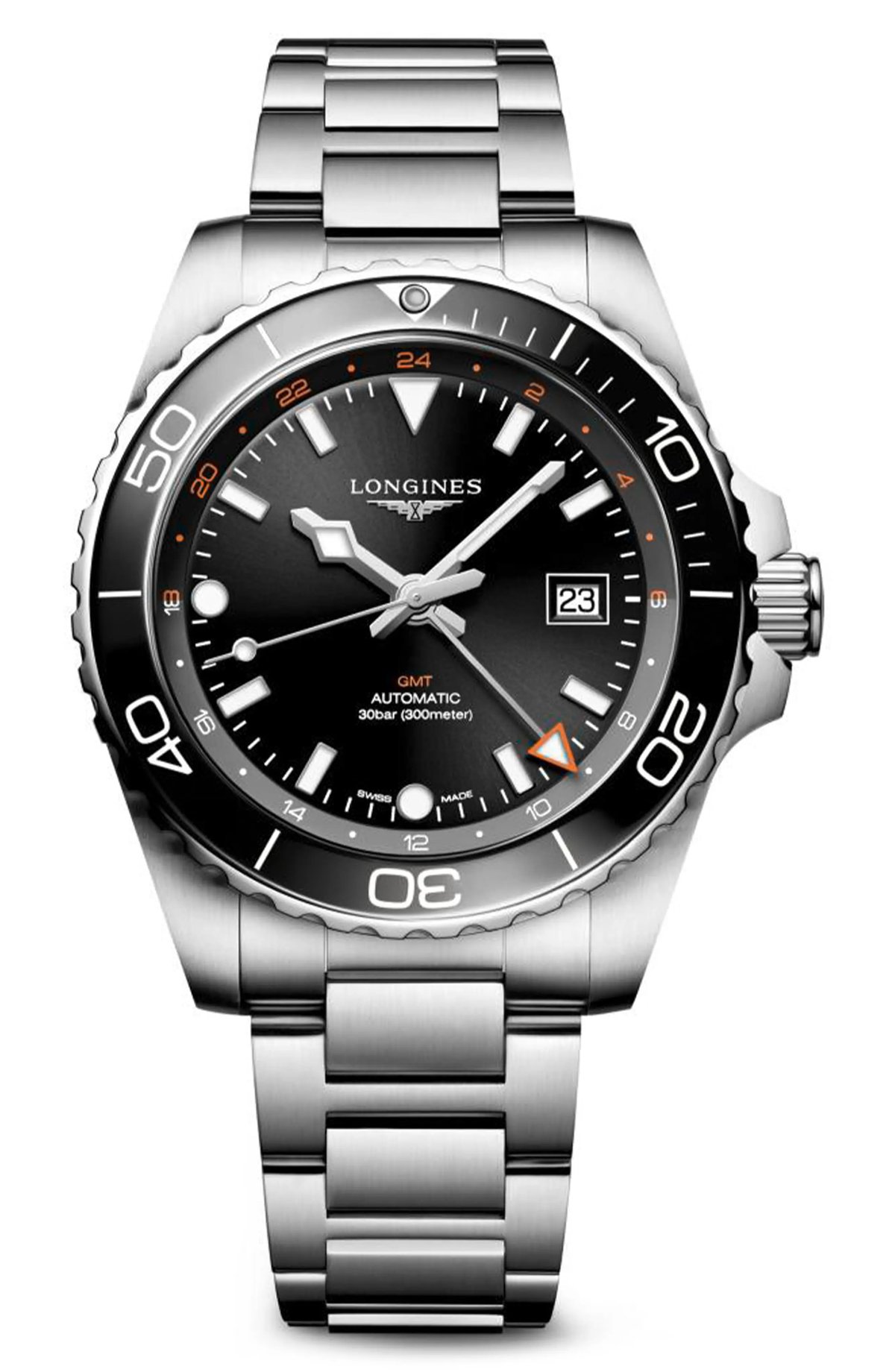
The HydroConquest GMT is built around a 41mm stainless steel case — the reference dimension for the line — with a screw-down crown flanked by crown guards and a solid, screw-down caseback engraved with the winged hourglass. Water resistance is rated to 300 metres, which is the standard the family has held for years and which places the watch firmly in saturation-adjacent dive territory rather than the 100-metre lifestyle-diver bracket.
The bezel is where the GMT identity announces itself. Longines fits a ceramic insert with a 24-hour scale, the numerals and graduations cut cleanly into the ceramic and filled for legibility. Ceramic is the right material here: it will not fade under UV, it resists scratching far better than aluminium, and its slight gloss gives the bezel a depth that anodised aluminium cannot match. The insert rotates on a finely toothed ratchet with no discernible back-play.
The dial carries the HydroConquest family's signature legibility — large applied markers, generous luminous fill, and a date window at three o'clock. The GMT hand is slim and unobtrusive, its tip lumed so that it remains readable in the dark without competing with the hour and minute hands for attention. That is the correct hierarchy: on a dive watch, the GMT hand is a reference, not a protagonist. Crystal is sapphire with anti-reflective treatment, and the dial sits beneath it with minimal distortion at the edges.
Luminous material is Super-LumiNova, applied generously to the markers and hands. In practice the glow is bright on initial charge and holds well through a full night — not quite at the level of the very best Japanese or Swiss lume, but comfortably ahead of what most people will ever need.
Calibre L844.5: Architecture and Finishing
Inside sits the Longines-exclusive caliber L844.5, an automatic GMT built within the Swatch Group's ETA industrial base and reserved for Longines. The specification is where this watch separates itself from its price bracket.
Power reserve is 72 hours — three full days — which means the watch can come off the wrist on Friday evening and still be running and on time on Monday morning. Frequency is 25,200 vibrations per hour, or 3.5 hertz, a deliberate choice: the slightly lower beat rate relative to a 4Hz movement reduces wear on the escapement and helps deliver the longer power reserve without enlarging the mainspring barrel beyond what the case can accommodate. The balance spring is silicon, which brings two concrete benefits — immunity to the magnetisation that ruins accuracy in everyday life, from laptop speakers to tablet covers to bag clasps, and greater thermal stability than a traditional alloy spring.
The movement is certified by COSC, the Controle Officiel Suisse des Chronometres, which means each individual movement is tested in five positions and at three temperatures and must run within −4 to +6 seconds per day. This is not a marketing certificate applied to a sample; it is per-movement testing, and it is the reason the watch is sold as a chronometer.
Finishing is honest rather than decorative. The movement is rhodium-plated with circular graining on the bridges and a branded rotor, executed to an industrial standard that is clean and consistent but emphatically not hand-finished. That is the correct trade at this price: money spent on silicon, COSC certification, and a 72-hour reserve rather than on anglage that nobody will see behind a solid caseback. Longines has made the right call, and collectors who understand where value actually lives in a movement will recognise it.
How the GMT Function Actually Works
There are two kinds of GMT watches, and the difference is not cosmetic.
The first is the office GMT, where the fourth hand is set independently and the main hour hand behaves like a normal three-hander. This is useful for tracking a second time zone from a desk, but it is awkward when you actually fly: you have to reset the GMT hand each time you land, and the local time you read off the dial is the one you have to adjust by hand.
The second is the traveller's GMT, where the local hour hand jumps forward or backward in one-hour increments via the crown, and the GMT hand stays locked to home time. This is the system the L844.5 uses, and it is the system that pilots and frequent flyers actually want. Land in Tokyo, pull the crown to the first position, click the hour hand forward nine hours, and you are done — the date follows correctly, home time is untouched, and the minute and seconds hands keep running.
Paired with the 24-hour ceramic bezel, the watch becomes a three-time-zone instrument: home time on the GMT hand, local time on the dial, and a third zone tracked by rotating the bezel. That is genuine travel utility, not a decorative fourth hand.
On the Wrist
The HydroConquest GMT wears like a proper dive watch, which is to say it has presence without becoming a burden. The 41mm case sits within the mainstream of contemporary sport-watch sizing — large enough to read at a glance, small enough to slide under a shirt cuff without a fight. The case is predominantly brushed, with polished flanks that catch light and give the watch a sense of structure; the interplay between the two finishes is one of the more satisfying details at this price point.
On the three-link stainless steel bracelet, the watch balances well on the wrist. The links are brushed on their upper surfaces with polished edges, and the bracelet tapers slightly toward the clasp, which keeps the visual weight centred rather than letting the head pull the whole thing forward. The folding clasp closes with a reassuring click and carries safety pushers, so there is no realistic risk of an accidental release. Buyers who prefer a lighter, more casual feel can specify a rubber strap, which changes the character of the watch considerably — more tool, less jewellery.
The crown is easy to grip and the screw-down action is positive. The bezel rotates with a firm, well-damped click that requires deliberate effort — exactly as it should be on a bezel that might one day be used for something other than decoration.
Accuracy in Daily Use
COSC certification sets a floor and a ceiling: −4 to +6 seconds per day. In real-world ownership, most L844.5 examples settle comfortably inside that band, with many running between +2 and +5 seconds per day depending on position, temperature, and how the watch is worn. That is excellent for a watch at this price, and it is a meaningful step up from the uncertified movements in the standard HydroConquest range.
The silicon balance spring is the unsung hero here. Watches without it can lose or gain minutes per day after a single encounter with a magnetic field, and most such encounters go unnoticed until the owner checks the time against a phone. With silicon, that entire class of problem largely disappears. If you want a watch you can set once and trust, this is the specification that delivers it.
The Reference Range
Longines offers the HydroConquest GMT in several dial and strap configurations. The core references pair a ceramic bezel in the same colour as the dial with either a stainless steel bracelet or a rubber strap, and the dial palette runs to black, blue, and green — each with matching bezel and luminous treatment. Reference numbers vary by dial colour and strap configuration, so buyers should confirm the exact code with an authorised dealer, but the L3.790.4 family covers the 41mm steel models.
Practically speaking, the choice between them is aesthetic rather than technical: the movement, case, and water resistance are identical across the range. The black dial is the most versatile and the most conservative; the blue is the classic dive-watch choice and reads slightly larger in person; the green is the most contemporary and, in my view, the most interesting against the ceramic bezel.
Rivals and Alternatives
The obvious competitor is the Tudor Black Bay GMT, which offers a traveller's GMT in a 41mm steel case with 200 metres of water resistance and a similar tool-watch philosophy. The Tudor carries more brand cachet and a stronger secondary market, but it costs meaningfully more, and it does not offer 300 metres of water resistance. If you want the watch that holds value best, the Tudor wins. If you want the better-specified dive-GMT for the money, the Longines does.
The Tudor Black Bay Pro is the other natural comparison — a smaller, more vintage-inflected traveller's GMT with a fixed steel bezel. It is a lovely watch, but it is not a diver, and it does not pretend to be.
At the more accessible end, the Christopher Ward C65 Aquitaine GMT and the Monta Skyquest GMT both offer genuine traveller's GMT functionality for less money. Neither matches the Longines on brand heritage, service network, or COSC certification, and both trade on direct-to-consumer economics rather than authorised distribution. They are legitimate choices; they are simply playing a different game.
Below that sit the ubiquitous micro-brand homages — San Martin, Steeldive, Seestern, and their many cousins — which reproduce the HydroConquest GMT's silhouette with generic movements and no certification. They are not competitors in any meaningful sense, but they are worth acknowledging: the fact that a $200 watch can imitate the look is precisely why the Longines' movement, finishing, and certification are where the money goes.
Ownership: Service, Value, and Resale
Longines does not publish a fixed service interval, and the honest answer is that it depends on use. A watch worn daily in a humid climate will want attention sooner than one worn occasionally in a dry one. The general guidance for a modern Swiss automatic of this specification is a check every five to seven years, or sooner if amplitude drops or timekeeping drifts outside the COSC band. Servicing is straightforward: Longines has a global authorised service network and parts availability is excellent, which is not something every brand at this price can claim.
On value, the HydroConquest GMT is a depreciating asset, as nearly all steel sports watches at this price are. Expect pre-owned examples to trade well below retail, particularly for earlier production. This is a watch to buy because you intend to wear it, not because you intend to flip it. The good news is that depreciation works in the buyer's favour on the secondary market: a lightly worn HydroConquest GMT is one of the better value propositions in Swiss watchmaking.
There is no meaningful auction history for this reference, and there is unlikely to be. That is not a criticism; it is simply what the watch is. The HydroConquest GMT is an instrument, not an investment.
Verdict
The Longines HydroConquest GMT is the most technically convincing watch Longines makes at this price. A 300-metre dive case, a ceramic 24-hour bezel, a Longines-exclusive caliber with a silicon balance spring, 72 hours of autonomy, and per-movement COSC certification — assembled into a 41mm steel watch that looks like it was designed by people who actually dive and actually fly.
It is not perfect. The finishing is industrial, the brand does not carry the resale gravity of its nearest rival, and the solid caseback hides a movement that is more interesting than most owners will ever know. But those are the compromises that make the price possible, and they are the right compromises.
If you are building a collection and want one watch that can handle a beach, a boardroom, and a long-haul flight without apology, this is one of the most sensible purchases in modern horology. Buy the green dial.