The GMT Problem, and Why Lorier Solved It
Walk into any watch forum in 2024 and you will find the same argument playing out. Someone wants a GMT under a thousand dollars. Someone else recommends the usual suspects. And then someone — usually a collector who has been through three or four of these watches — points out that almost every affordable GMT on the market is a caller GMT, not a traveler GMT.
That distinction matters more than any spec-sheet line. A traveler GMT lets you pull out the crown, jump the local hour hand forward or backward in one-hour increments when you land, and leave the 24-hour hand alone to track home. That is how a GMT is supposed to work, and it is how the great travel watches of the 1950s and 1960s worked. A caller GMT, by contrast, makes you hack the whole movement and rotate the 24-hour hand to set a second time zone — fine for tracking a supplier's time zone from your desk, useless when you are actually travelling.
The Lorier Hyperion SII has a traveler GMT movement. That single fact puts it in a very small group of watches under $600, and it is the reason this watch matters far more than its price tag suggests.
The Brand Behind the Watch
Lorier was founded in 2018 in New York by Lauren and Lorenzo Ortega, and the brand was built on a thesis that sounds almost naive until you handle one of their watches: that a well-proportioned, vintage-correct watch with an acrylic crystal and a reliable Japanese movement should not cost four figures. The company has spent six years proving that thesis, moving from a single diver into a broader catalogue of references that includes the Neptune, the Falcon, the Hydra, the Astra, and the Gemini.
What separates Lorier from the wave of microbrands that followed it is design discipline. The brand does not chase trends, it does not bolt on unnecessary complications, and it does not try to make a 44mm watch look sporty by adding shoulders and crown guards. Everything in the catalogue looks like it was drawn by someone who has spent time with actual vintage watches — because it was.
The Hyperion was Lorier's first GMT, and the second-generation Hyperion SII is a substantial rethink rather than a colourway refresh. The headline change is the movement, and it is the change that matters.
The Movement: Miyota 9075
The Miyota 9075 is an automatic GMT with 24 jewels, a 28,800 vph beat rate, and roughly 42 hours of power reserve. Those numbers are unremarkable, and they are not the point. The point is the architecture: the 9075 is a true traveler GMT with an independently adjustable local hour hand. Combined with an indexed 24-hour hand, it gives you exactly the functionality of a GMT-Master II at a fraction of the cost.
What you do not get is finishing. The 9075 is an industrial Miyota workhorse, and Lorier does not pretend otherwise — there is no display caseback and no attempt to dress up the rotor. What you do get is serviceability. The 9075 is a mainstream movement that any competent independent watchmaker can handle, and you are not locked into a proprietary service network. For a watch at this price, that is a meaningful long-term ownership advantage that rarely shows up in reviews.
Accuracy is unregulated from the factory, so expect something in the region of minus ten to plus fifteen seconds per day. Most examples settle down after a few weeks of wear, and a watchmaker can regulate it during the first service for very little money. This is normal, acceptable, and entirely consistent with the price.
Case, Dial, and Crystal
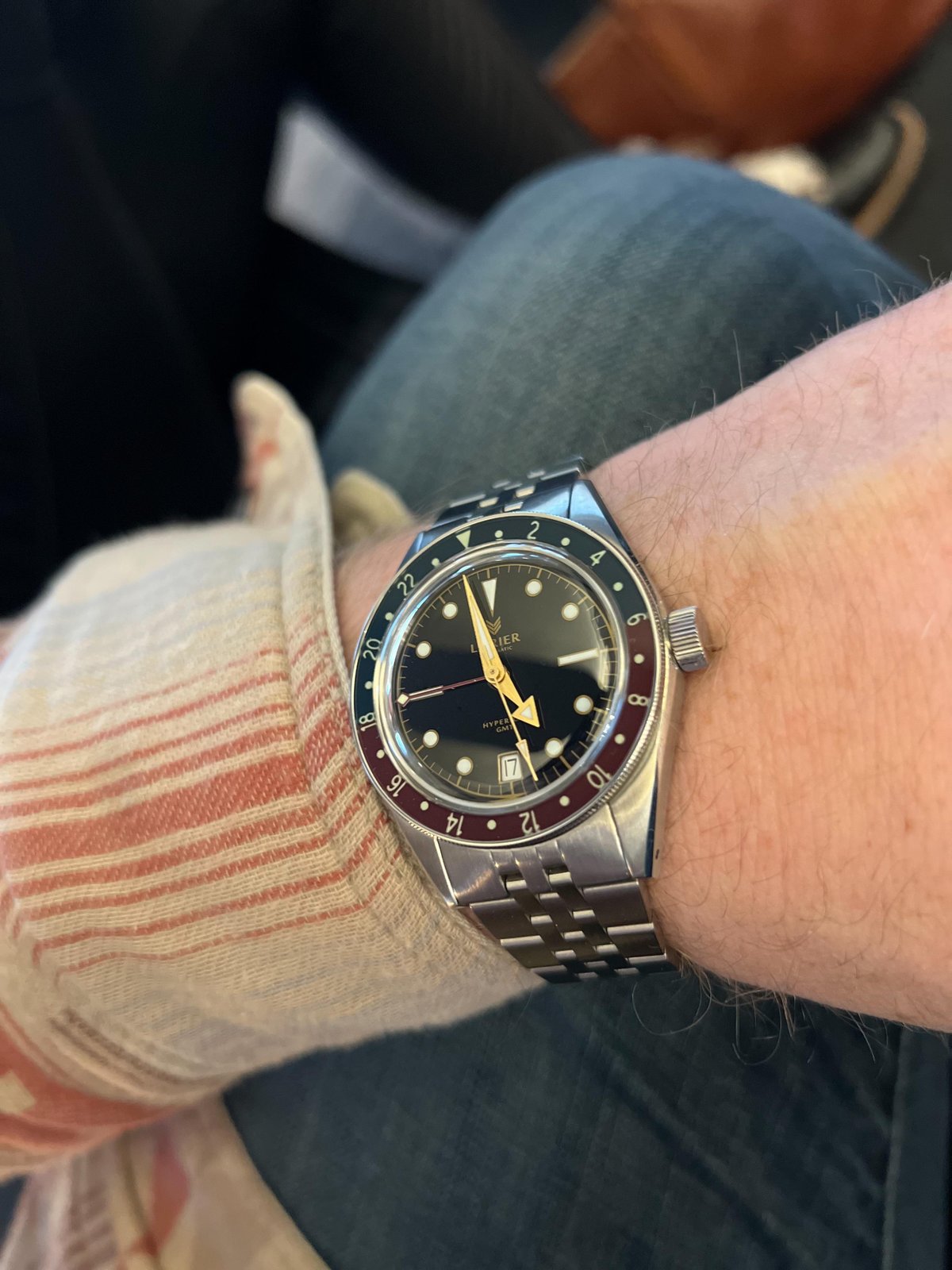
The Hyperion SII is built around a 39mm stainless steel case, which is the correct answer for a vintage-inspired travel watch and a welcome relief from the 42mm-plus norm. The proportions are restrained: soft case flanks, lugs that curve down toward the wrist, and a profile that is genuinely slim rather than merely claimed to be. Around the dial sits a printed 24-hour track, framed by a 24-hour bezel that gives the watch its unmistakable travel-watch identity without veering into tool-watch bulk.
The dial itself is clean and legible, with applied indices and Super-LumiNova BGW9 filling that glows a cool white in low light and fades to a pale green — the modern standard, and well executed here. There is a date window, which some purists will grumble about and most buyers will appreciate.
And then there is the crystal. The Hyperion SII uses a domed acrylic crystal, which is the single most divisive decision in the entire watch. Acrylic gives you the warm, slightly distorting, genuinely vintage look that sapphire simply cannot replicate, and it is why Lorier watches photograph the way they do. It also scratches, and it will need polishing with PolyWatch every few months if you wear it hard. Whether that is a feature or a bug depends entirely on what you want from a watch. Lorier has made its bet, and it is the right bet for the design.
On the Wrist
This is where the Hyperion SII quietly wins. A 39mm case with a low profile is a genuinely different wearing experience from the slab-sided GMTs that dominate this price point, and the difference is most obvious under a shirt cuff. The watch disappears in the best sense — it does not catch on fabric, it does not sit proud of the wrist, and it does not announce itself across a room.
The bracelet deserves particular praise. It tapers properly, the links are slim, and the folding clasp keeps the underside flat and comfortable. Lorier has clearly spent time on this component rather than treating it as an afterthought, and the result is a bracelet that would not be out of place on a watch costing twice as much. On leather it reads almost like a vintage dress watch with a travel complication, which is a genuinely rare trick at any price.
Water resistance is rated at 100 metres, which is more than enough for swimming and daily life, and consistent with the watch's role as a do-everything travel piece rather than a dedicated dive watch.
Ownership, Servicing, and the Real Cost
Here is the part that most reviews skip. The Hyperion SII retails in the region of $499 to $549 depending on configuration and timing, and pre-owned examples trade between roughly $350 and $475. That means the real cost of ownership over three or four years, assuming you keep the bracelet complete and the crystal reasonably clean, is remarkably low — you are effectively renting a well-made travel watch for a couple of hundred dollars.
Servicing is straightforward. The Miyota 9075 is a mainstream movement, any competent independent watchmaker can service it, and you are not forced into a proprietary service centre. Budget around $200 every five years or so, and have the watchmaker regulate it while it is open. That is it. There is no exotic parts problem, no six-month waiting list, and no reason this watch cannot be kept running for decades.
The Resale Reality
Let us be direct: the Hyperion SII is not an investment. Microbrand watches almost never are, and anyone telling you otherwise is selling something. What the Hyperion SII is, however, is stable. Lorier's drop-based distribution model means retail availability is inconsistent, demand consistently exceeds supply at release, and secondary prices therefore hold up better than most of the category. Expect to recover somewhere between seventy and eighty-five percent of retail depending on condition and completeness.
Compare that to the broader sub-$1,000 segment, where many watches lose half their value the moment the box is opened, and the Hyperion SII looks genuinely disciplined. It will not appreciate, and you should not buy it hoping it will. But it will not punish you either, and in this price bracket that is a meaningful compliment.
How It Stacks Up
The obvious rival in spirit is the Baltic Aquascaphe GMT, which occupies similar vintage-inspired territory with a caller-style GMT and a comparable price. The Christopher Ward C63 Sealander GMT is a step up in finishing and uses a Sellita-based movement, but it is a more contemporary design and does not have the same vintage warmth. The Seiko 5 Sports SSK series is the budget benchmark and gets you into a GMT cheaply, but it is a caller GMT with noticeably less refined casework.
At the aspirational end sits the Tudor Black Bay GMT, which is the reference point for a true traveler GMT with real resale depth — and costs roughly ten times as much. The Hyperion SII is not trying to compete with it. It is trying to give you the same functional architecture in a package you can actually wear every day without worrying about it, and it succeeds.
The Verdict
The Lorier Hyperion SII is the rare microbrand watch that earns its reputation on architecture rather than aesthetics alone. A true traveler GMT movement, vintage-correct 39mm proportions, an excellent bracelet, and a servicing story that any independent watchmaker can handle — that combination does not really exist elsewhere under $600.
It is not perfect. The acrylic crystal is a commitment, the movement is industrial, and availability requires patience. But if you want a daily-worn travel watch that will still look right in a decade and will not cost you a fortune to keep running, this is close to the obvious answer. Buy it to wear. That is what it was built for.