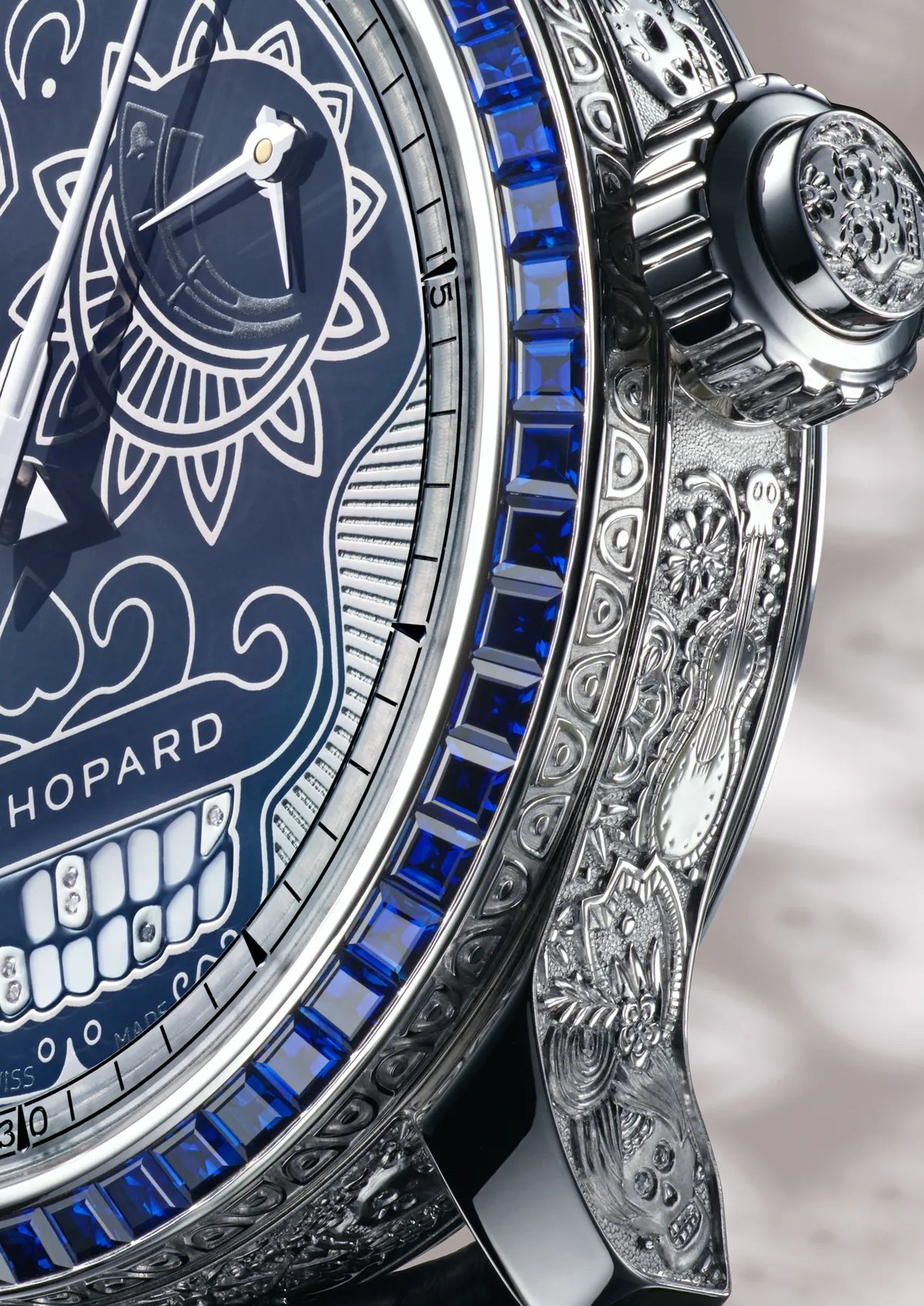
The Cultural Collision: Why This Watch Matters
In the luxury world, 'limited edition' often feels like a hollow marketing phrase. However, in the hands of Louis Erard and Romaric André (the artist known as seconde/seconde/), it becomes a manifesto. The Dia de los Muertos is not just a watch; it is a cultural artifact that sits at the intersection of Swiss precision and Internet irony. For the sophisticated young collector, the appeal isn't just in the gears and springs—it's in the narrative. We live in an era where the 'flex' has evolved. It’s no longer about how much gold is on your wrist, but how much 'intellectual property' and cultural relevance you’re carrying. This watch, with its pixelated skull and vibrant fuchsia accents, is the ultimate insider’s handshake.
The choice of the 'Dia de los Muertos' theme is particularly poignant. While traditional watchmaking often flirts with the 'Memento Mori'—the reminder that we all must die—it usually does so with somber engravings or gold-leafed vanitas. Louis Erard turns this on its head. By using the aesthetic of 8-bit video games and the celebratory colors of the Mexican holiday, they transform the grim reality of time’s passage into a celebration. It’s a watch for people who understand that time is fleeting, so we might as well have a bit of fun while it lasts.
The Brand: The Renaissance of Louis Erard
To understand this watch, you have to understand the trajectory of Louis Erard. Founded in 1929, the brand was for a long time the 'quiet achiever' of the Jura mountains. They were known for their regulators—watches where the hours, minutes, and seconds are separated, mimicking the master clocks used by watchmakers to regulate their work. It’s a nerdy, technical complication that appeals to purists. However, purism doesn't always pay the bills in a crowded market.
Enter Manuel Emch. A veteran of Jaquet Droz and Romain Jerome, Emch understood that Louis Erard had a unique asset in the regulator layout. It provided a 'three-act stage' on the dial that was perfect for artistic intervention. By opening the doors to collaborators like Alain Silberstein, Vianney Halter, and now seconde/seconde/, Louis Erard has become the coolest platform in Switzerland. They are doing for watches what Virgil Abloh did for sneakers: taking a classic silhouette and 'editing' it for a new generation.
Design Deep Dive: The Pixelated Soul
The dial of the Dia de los Muertos is where the magic—and the controversy—happens. The base is a beautiful silver-toned sunray finish that provides a sophisticated backdrop for the chaos. The regulator layout places the hour sub-dial at 12 o'clock, the running seconds at 6 o'clock, and a massive central minute hand. But here, the hands aren't hands. The hour and second indicators are replaced by pixelated elements that form a skull when the time aligns, or simply float as abstract digital 'glitches' throughout the day.
The color palette is electric. Fuchsia, orange, and bright blue pop against the silver and navy. This isn't the muted luxury of a 'stealth wealth' piece; this is 'loud luxury.' The minute hand is a long, slender needle in a deep blue, providing the only real sense of traditional legibility on the dial. The skull itself is a masterclass in minimalist character design—using just a few 'blocks' to convey an iconic image. It’s a nod to the early days of computing, a time when technology felt optimistic and playful, rather than monolithic and invasive.
Technical Specs: The Engine Under the Hood
While the dial is all play, the movement is all business. Powering the Dia de los Muertos is the Sellita SW266-1. For those who aren't movement geeks, Sellita is the primary alternative to ETA in Switzerland. The SW266-1 is their dedicated regulator caliber. It’s an automatic movement beating at 28,800 vibrations per hour (4Hz), which provides a smooth sweep for the seconds hand—or in this case, the pixelated jaw of the skull.
The movement offers 38 hours of power reserve. In an era where 70-hour reserves are becoming standard, 38 might seem modest. However, for a watch that is likely to be part of a larger rotation, it’s perfectly adequate. The real benefit of the Sellita base is its 'serviceability.' Any watchmaker from Tokyo to New York can service this movement. It’s robust, reliable, and keeps the cost of ownership down. Louis Erard has also customized the rotor, giving it an open-worked design that allows you to see more of the mechanics through the sapphire caseback.
Wrist Presence and Styling
At 42mm, the watch has a presence. It’s not a shrinking violet. On a 6.5-inch to 7.5-inch wrist, it looks contemporary and bold. The polished steel case gives it enough 'seriousness' to be worn with a blazer, but let’s be honest: this watch belongs with a crisp white tee, a chore coat, or a piece of high-end knitwear. It’s a weekend watch that occasionally moonlights as a weekday statement piece.
The strap is a masterstroke. The blue grained calf leather is high-quality, but it's the fuchsia lining that seals the deal. It’s a 'wink' to the wearer. Every time you buckle the watch, you see that flash of neon. It’s these small, thoughtful details that elevate Louis Erard above other brands in this price bracket. They understand that luxury is as much about how a product makes you feel as how it looks to others.
Investment Potential: The Seconde/Seconde/ Effect
Is it an investment? In the traditional sense—buying a watch to flip it for a 500% profit—probably not. But in the context of modern collecting, the Dia de los Muertos is a very 'safe' buy. Louis Erard’s collaborations almost always sell out instantly. Because they are limited to 178 pieces (a number that refers to the brand's address and the concept of 'togetherness' in certain cultures), there is a permanent scarcity built in. On the secondary market, these pieces tend to hold their value remarkably well, often trading slightly above their original retail price. For a sub-$4,000 watch, that is an incredible achievement.
Furthermore, Romaric André’s star is on the rise. As he continues to collaborate with bigger brands (like H. Moser & Cie), his early, more accessible works like this Louis Erard will likely become even more desirable for collectors who want to own a piece of his 'vandalism' history.
The Verdict
The Louis Erard x seconde/seconde/ Dia de los Muertos is a triumph of personality over prestige. It challenges the idea that a Swiss watch must be a solemn heirloom passed down through generations. Instead, it suggests that a watch can be a reflection of your sense of humor, your aesthetic tastes, and your place in the modern world. It’s technically interesting thanks to the regulator layout, aesthetically daring thanks to the pixel art, and financially accessible compared to the 'big' independents. If you’re tired of the same three steel sports watches dominating your feed, this is the antidote. It’s a celebration of life, death, and the 8-bit glitches in between.