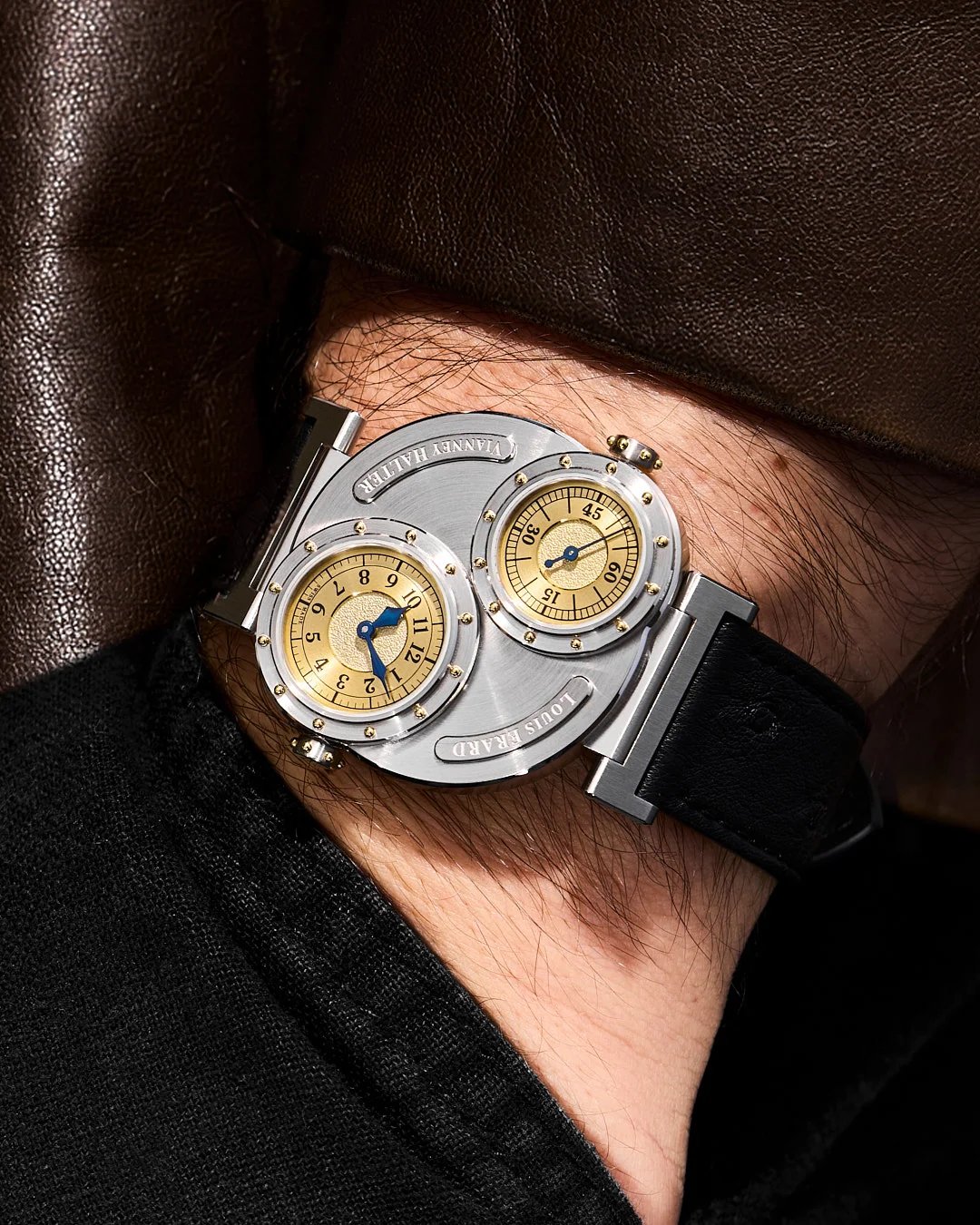
This is a piece built to be explained rather than recognized. It comes from a small house in the Swiss Jura that has spent the last several years turning itself into the most interesting independent in its price bracket, and it arrives through the kind of quiet, allocation-driven channels that the word Privé is meant to signal. None of that is accidental. Louis Erard has built an entire strategy around the idea that a watch can be a design object first and an engineering flex second — and the Gold Privé is that idea rendered in precious metal.
The Name Is the Whole Argument
Futur antérieur is a French grammatical tense — the future perfect. It's also a phrase that a certain strain of French philosophy spent the 1990s arguing about, and it has always carried a whiff of paradox: a future described from a vantage point that hasn't arrived yet.
Naming a watch after a tense is a statement of intent. It tells you that this is a piece looking backward at a future that never quite happened — a retro-futurist exercise in the tradition of the great mid-century design schools. Louis Erard has always operated at that intersection. The house's revival has been driven less by movement innovation than by dial architecture: the mismatched hands, the sector layouts, the printed railroad tracks, the refusal to smooth everything into a single tasteful gesture. That aesthetic is playful, occasionally confrontational, and absolutely not for everyone. The Futur Antérieur Gold Privé is the most grown-up expression of it so far.
A Very Short History of a Very Specific House
Louis Erard was founded in 1931 by Louis Erard and André Voirol and spent most of the twentieth century as a respected mid-tier Swiss producer. The quartz crisis hit the brand the way it hit most of the industry, and the decades that followed were a long, quiet restructuring, with the name changing hands and the identity thinning out.
The modern brand was rebuilt in Le Noirmont under Manuel Emch, who repositioned it deliberately — not as a manufacture chasing chronometer certificates, but as a design-led house producing small, art-directed runs in collaboration with independent designers and watchmakers. The 2019 partnership with Alain Silberstein was the turning point; the subsequent work with Vianney Halter, Konstantin Chaykin, Massena LAB and seconde/seconde turned it into a strategy. Small runs, strong opinions, prices that undercut the blue-chip independents by an order of magnitude.
That lineage matters when you're evaluating the Gold Privé, because it tells you exactly what you're buying into. You are not buying a hundred-year movement tradition. You are buying a piece from a house whose entire value proposition is taste, scarcity and the willingness to make something a little strange.
What "Gold Privé" Actually Means
The word Privé is doing two jobs. On the design side, it signals a more restrained, more formal reading of the Futur Antérieur language — the same architectural dial, but in a gold case and paired to leather rather than anything sportier. On the distribution side, it signals scarcity. Private editions in this industry are released quietly, allocated to known clients and select retailers, and never sit in a mall window waiting for a tourist.
That opacity is frustrating if you're the kind of buyer who wants to click a button. It's also, bluntly, the point. Louis Erard has understood better than almost anyone that in a market where everyone can see every watch on Instagram, the only remaining luxury is not being able to get one on demand.
The Dial, Up Close
The Futur Antérieur dial is what you're actually paying for, so it deserves to be described properly. What you get is an architectural, sector-style layout: concentric zones, printed markings that step rather than sweep, applied indices that catch light at an angle and vanish at another. It is a dial with a spine — a clear structural logic that reads instantly from across a room and rewards you for looking closer.
What separates Louis Erard from a hundred micro-brands doing "vintage-inspired" dials is the typographic confidence. The house mixes treatments that most brands would consider contradictory and gets away with it. On the Gold Privé, the gold case gives all of that a warmer, more settled foundation than the steel versions — the light behaves differently on a gold case, bouncing warmer tones onto the dial edge, and the whole thing reads less like a graphic exercise and more like an object.
The hands are the other tell. They're the piece of the design most likely to divide people, and they're the reason you either get this watch or you don't.
The Movement
Here's the part that will decide whether the Gold Privé is for you. It runs an automatic Sellita SW200-1 base, modified and regulated by Louis Erard in Le Noirmont. Roughly 38 hours of power reserve, 28,800 vibrations per hour, no chronometer certification, no in-house architecture.
Purists will object, and at five figures that objection is fair. Several rivals in this bracket will sell you a genuine manufacture calibre, and one or two will sell you a COSC certificate with it. What Louis Erard counters with is a different allocation of resources: the money went into a solid gold case, a dial that took real design work, and a production run small enough that you'll likely never see another one on a wrist.
There's also a practical upside that rarely gets mentioned. Sellita is the most widely serviced modern Swiss automatic in the world. Any competent independent watchmaker can strip, clean and rebuild one, which means you are not hostage to a single service center in a single country for the next thirty years. For a watch you actually intend to wear, that's worth more than a bridge decoration you'll never see.
On the Wrist
Gold on leather wears differently from steel on a bracelet, and the Gold Privé leans into that. The case sits warm and slightly top-heavy in the way precious metal always does — you feel the mass at the top of the wrist rather than distributed around it — and the leather softens quickly, so the whole assembly settles low and close after a couple of weeks of regular wear.
It reads dressy without being fragile. That's a harder balance than it sounds. Plenty of gold dress watches feel like they should be worn with gloves and put away in a safe; this one is happy under a shirt cuff on a Tuesday. The pin buckle is the right choice — a deployant would have added bulk and a formality the watch doesn't need, and on a piece this quiet, a plain tang is part of the argument.
The caveat is the material itself. Gold shows every hairline, and a polished gold case shows them fast. If you're the type who winces at the first scratch, either make peace with patina before you buy or accept that you'll be paying for refinishing more often than you'd like.
Accuracy and Living With It
Expect something in the region of -5 to +15 seconds per day, which is the standard working window for a well-regulated Sellita. Most examples will land comfortably inside that. The rate tends to be stable across positions and across the power reserve, and stability is what actually matters in daily wear — a watch that gains eight seconds a day, every day, is easier to live with than one that's perfect on the timing machine and erratic on the wrist.
Wind it regularly. Don't let it sit dead for months at a time. Treat it like the mechanical object it is and it will behave.
What It's Up Against
The obvious competitor is the Cartier Tank Louis Cartier — the default gold dress watch for people who want a design object rather than a status symbol, and the benchmark any gold-cased, non-round, design-forward piece gets measured against. On resale and brand recognition, Cartier wins without breaking a sweat.
The Jaeger-LeCoultre Reverso Tribute Monoface is the closer peer. Gold, architectural, driven by a case concept rather than complications, and supported by a genuine manufacture. The H. Moser & Cie. Endeavour Centre Seconds is a step up in movement pedigree at roughly double the money, and the Chopard L.U.C XPS 1860 trades Louis Erard's playfulness for classical restraint and COSC-grade finishing.
The most awkward competitor, though, is internal: Louis Erard's own steel Futur Antérieur. The same dial language, the same design thesis, a fraction of the price. If what you love is the design, the steel version delivers most of it. If what you love is the object — the weight, the warmth, the fact that only a handful exist — then the gold case is the whole point and the steel version is a different watch entirely.
Price and the Honest Question
The Gold Privé sits in the mid-to-high teens in US dollars, which puts it in direct competition with entry-level manufacture gold dress watches from established houses. On the secondary market, expect meaningful depreciation; small-brand gold limited editions from non-blue-chip houses almost always soften, and there is no auction history here to suggest otherwise.
So the honest framing is this: you are not buying an asset. You are buying gold, design, and scarcity from a house small enough that its continued existence is a business question rather than a certainty. That is a real risk and it should be priced into your decision.
What you get in return is a watch nobody else at the table is wearing, made by a team that clearly cares more about the dial than about the spec sheet, and backed by a movement any watchmaker on earth can service. For a certain kind of collector, that trade is obviously correct. For everyone else, it's obviously not.
Verdict
The Louis Erard Futur Antérieur Gold Privé is not the smartest five-figure purchase on paper. The movement is bought in, the resale is soft, and the brand's modern history is shorter than the price implies. But design-led watchmaking has never been judged on paper, and on the wrist this is a warmer, stranger, more interesting object than anything else in its bracket. Buy it because the dial does something to you. Wear it hard. Don't check the resale value.