The Geometry of Time: Understanding the Regulator
In the world of horology, the 'Regulator' is not merely a design choice; it is a nod to the very foundations of precision timekeeping. Historically, regulator clocks were the master timepieces in watchmaking workshops, used by technicians to set the watches they were assembling. By separating the hours, minutes, and seconds into different registers, the clock ensured that the hands never overlapped in a way that obscured the view of the seconds hand—the most critical element for precision synchronization. Louis Erard has taken this industrial necessity and turned it into an aesthetic signature.
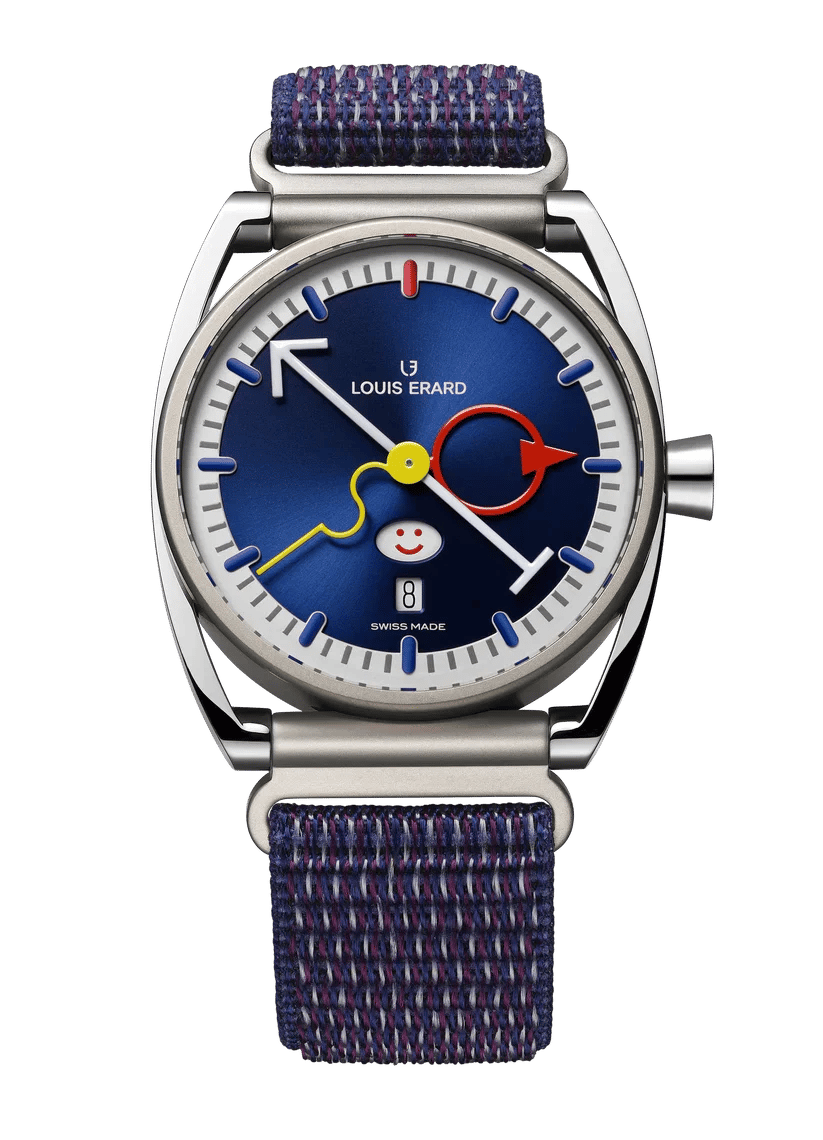
The 85248AA65.BVA158 is the culmination of this pursuit. When you first look at the dial, your brain has to do a quick bit of recalibration. The large central hand tracks the minutes. The sub-dial at 12 o'clock tracks the hours, and the sub-dial at 6 o'clock tracks the seconds. It sounds complicated, but after twenty-four hours on the wrist, it becomes second nature. In fact, I found that for daily tasks—timing a meeting or checking how long until a train arrives—having the minute hand as the primary focal point is actually more intuitive than a standard three-hand layout.
The Flinqué Dial: A Deep Dive into Blue
The term 'Flinqué' refers to a specific decorative technique where a metal surface is engraved—either by hand or, more commonly at this price point, by a rose engine or precision stamping—and then covered with a translucent layer of enamel or lacquer. This creates a mesmerizing play of light. On the Louis Erard Esprit Flinqué, the pattern is a radiating wave that originates from the center of the sub-dials, creating a sense of movement even when the hands are still.
The blue used here is not a flat navy. It is a vibrant, translucent azure that shifts in intensity depending on the ambient light. In direct sunlight, the dial explodes with detail, revealing the crispness of the geometric patterns. In the low light of a cocktail bar or a dimly lit office, it recedes into a dark, sophisticated indigo. This versatility is what makes it a 'daily wear' contender. It isn't so loud that it clashes with a casual sweater, but it is intricate enough to stand up to a tailored suit.
Case Ergonomics and Wearability
Let’s talk about the 42mm elephant in the room. In an era where the industry is trending back toward 36mm and 38mm cases, 42mm can sound daunting. However, case diameter is a deceptive metric. The real story is in the lug-to-lug and the case profile. The Esprit Flinqué features a stepped case design in polished 316L stainless steel. This 'stepping' breaks up the vertical mass of the case walls, making the watch appear thinner than its 12.25mm measurement suggests.
The lugs are short and curve aggressively toward the wrist. On my week-long test, I wore the watch through a variety of scenarios: a high-stakes board meeting, a casual weekend brunch, and even a quick dash through the rain. The 50m water resistance is 'splash-proof'—I wouldn't take it swimming, but it survived the humidity and the occasional raindrops of a Swiss autumn without a hint of fogging. The lack of crown guards gives the watch a cleaner, more classical silhouette, and the knurled crown is easy to grip, which is important since you'll be interacting with it every couple of days to keep that 38-hour power reserve topped up.
The Sellita SW266-1: A Reliable Heart
Purists might complain that Louis Erard doesn't use an in-house caliber. To that, I say: look at the price tag. By using the Sellita SW266-1, Louis Erard is able to offer a level of dial finishing that would otherwise be impossible at $2,500. The SW266-1 is a tried-and-true automatic movement, essentially a regulator-modified version of the SW200 family. It beats at 28,800 vibrations per hour, providing a smooth sweep for that 6 o'clock seconds hand.
One detail I appreciated during my time with the watch was the custom rotor. Visible through the sapphire caseback, the rotor is open-worked and features the Louis Erard logo. The movement itself is clean, with light perlage and snailing. It’s not 'haute horlogerie' finishing, but it’s honest, industrial Swiss watchmaking. The 38-hour power reserve is the only real sticking point. If you take the watch off on Friday evening, it will have stopped by Sunday morning. For a daily wearer, this isn't an issue, but for a collector in a rotation, a winding session will be part of your Monday morning ritual.
Legibility and Real-World Utility
How does a regulator actually function in a busy life? Legibility is excellent, provided you have light. The silver-toned hands provide a sharp contrast against the deep blue dial. The minute track is printed clearly on the periphery, allowing for precise reading. However, the lack of luminous material is a conscious design choice that favors aesthetics over utility. If you're checking the time in a dark cinema or a late-night taxi, you'll be reaching for your phone.
The calf leather strap (ref. BVA158) deserves its own paragraph. It is one of the most comfortable OEM straps I have tested in recent years. It features a quick-release system, which is a godsend for the modern collector who likes to swap looks. The blue leather matches the dial perfectly, but I found that swapping it for a grey suede strap completely changed the character of the watch, making it feel much more 'street-ready' and casual.
The Vivir Verdict
The Louis Erard Le Régulateur Esprit Flinqué is a watch for the person who is tired of the 'standard' luxury choices. It’s for the collector who wants to talk about guilloché and regulator history rather than resale value and waitlists. It wears its 42mm size with a surprising grace, and the dial is, quite frankly, one of the most beautiful things you can put on your wrist for under three thousand dollars.
Is it perfect? No. The power reserve is a bit short, and the size might alienate those with very slender wrists. But in terms of 'joy per dollar,' it is nearly unbeatable. It’s a watch that demands you look at it, not just to tell the time, but to admire the craft. For the sophisticated young collector, that is exactly what a watch should do.