The Genesis of a Tactical Standard
In the early 1990s, the landscape of military horology was dominated by disposable plastic cases and aging mechanical specifications. The intervention of Luminox, specifically through the development of the original Navy SEAL watch, marked a paradigm shift. The reference 3550 is the direct descendant of those early prototypes, refined through decades of feedback from operators in the field. To understand this watch, one must first appreciate the specific requirements of the Navy SEALs: absolute visibility in total darkness, a case that could withstand salt-water corrosion, and a movement that would not fail under the percussion of small arms fire.
The 3550 Series represents the 'Goldilocks' zone of the Luminox catalog. It sits between the entry-level 3000 series and the more over-engineered 3600 series. It is the purest expression of the brand's DNA, balancing modern material science with the classic silhouette that defined the tactical watch genre for a generation.
Material Science: The Carbonox Architecture
The most significant technical feature of the 3550 is its Carbonox case. Unlike traditional PVD-coated steel, which can chip and show silver underneath, Carbonox is a carbon-composite material where the color is consistent throughout the matrix. This material is six times lighter than steel and three times lighter than titanium, yet it possesses a structural rigidity that is essential for protecting the movement within.
From a technical standpoint, the Carbonox manufacturing process involves injecting a carbon powder-filled polymer into a precision mold. The result is a matte, slightly textured finish that is non-reflective—a critical requirement for tactical operations. The chemical resistance of the case is also noteworthy; it is largely unaffected by the oils, fuels, and salt water that would typically degrade lesser materials. The bezel, also crafted from Carbonox, features a unidirectional ratcheting system with a tactile, heavy click, designed to be operated with wet or gloved hands.
The Chronometric Core: Ronda 515
While some purists may scoff at the presence of a quartz caliber, the choice of the Ronda 515 is a logical one for the 3550's intended use-case. Mechanical movements, no matter how well-regulated, are inherently sensitive to the extreme G-forces and shocks encountered in modern combat. The Ronda 515 is a high-torque movement, necessitated by the weight of the tritium gas tubes mounted on the hands. Standard quartz movements often lack the torque to move such heavy indicators accurately over a long period.
The movement architecture is simple but robust. It features a single jewel and a power-saving mechanism that reduces power consumption by approximately 70% when the crown is pulled out. For the collector, this movement offers 'set-and-forget' reliability. It is the horological equivalent of a hammer: it is not beautiful, but it performs its task with absolute certainty.
Luminox Light Technology (LLT): The Radiance of Tritium
The defining characteristic of the 3550 is its illumination system. Unlike Super-LumiNova, which requires an external light source to 'charge' and fades over time, the 3550 utilizes borosilicate glass tubes filled with tritium gas. These tubes are coated internally with a phosphor layer. As the tritium undergoes beta decay, it releases electrons that strike the phosphor, causing it to glow continuously for up to 25 years.
In the 3550, these tubes are strategically placed at each hour marker and on the hands. The 12 o'clock marker features an orange tube to provide immediate orientation in total darkness, while the remaining markers and hands glow ice-blue. This constant-state illumination is what separates a true tactical instrument from a recreational dive watch. In a maritime environment, where light penetration is minimal, the LLT system provides a level of legibility that is technically superior to any photoluminescent alternative.
Wrist Presence and Ergonomics
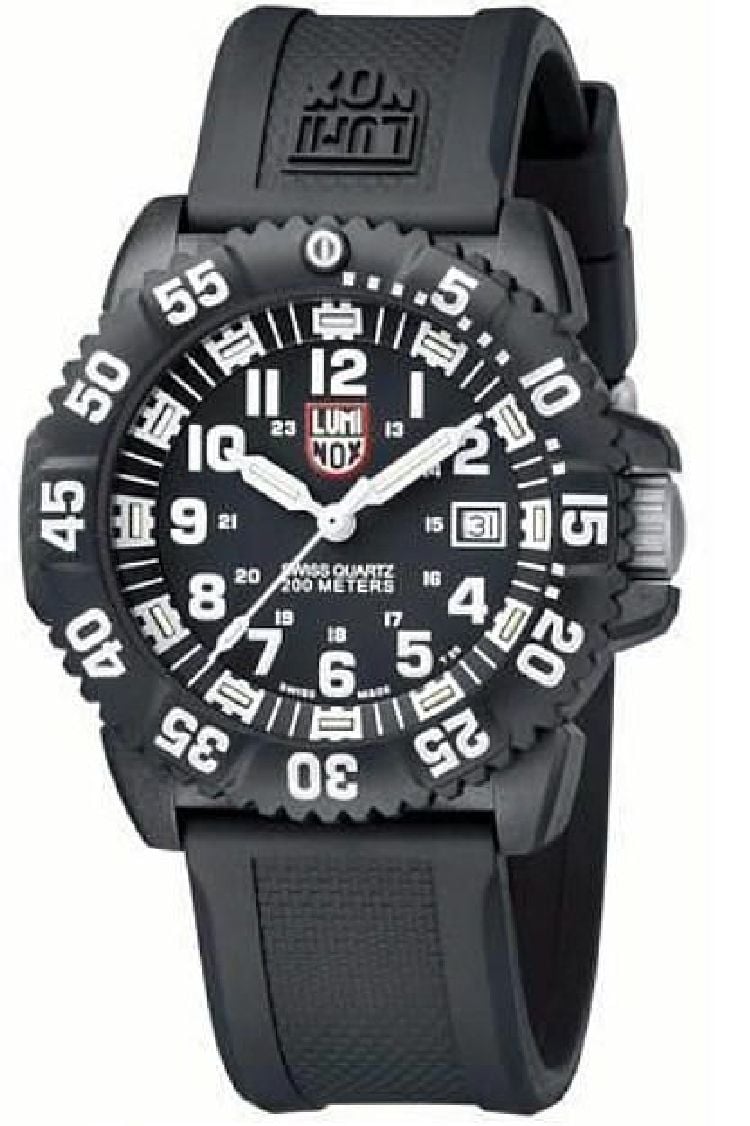
On the wrist, the 3550 is a study in contradictions. It is visually massive at 45mm, yet it feels almost ethereal due to its weight. The integrated silicone strap is designed with a slight 'bellows' near the lugs, allowing for expansion and contraction as the wearer's wrist swells during physical exertion or changes in depth. The double-gasket crown system, while not screw-down in all 3500 variants (though it is reinforced), provides a water resistance of 200 meters, which is more than sufficient for any littoral operation.
The dial layout is a masterclass in high-contrast design. The oversized Arabic numerals are printed in a bold, sans-serif typeface, with a secondary 24-hour scale on the inner ring. The date window at 3 o'clock is framed for visibility, though it does not feature a magnifier, maintaining the flat profile of the hardened mineral crystal. My only technical critique lies with the crystal itself; at this price point, a sapphire crystal would offer better scratch resistance, though mineral is arguably more shatter-resistant under extreme impact.
Final Verdict for the Sophisticated Collector
The Luminox Navy SEAL 3550 is not a watch for the faint of heart, nor is it a watch for those who seek the delicate finishing of a Genevan workshop. It is, however, a vital piece of horological history. It represents the moment when the watch industry stopped trying to make jewelry and started making equipment again. For the collector who appreciates the engineering of a G-Wagon or the utility of a Leica, the 3550 offers a similar satisfaction. It is a tool that does exactly what it says on the dial, and it does so with a rugged, unpretentious confidence that is increasingly rare in the modern market.