Tritium with a mechanical heartbeat
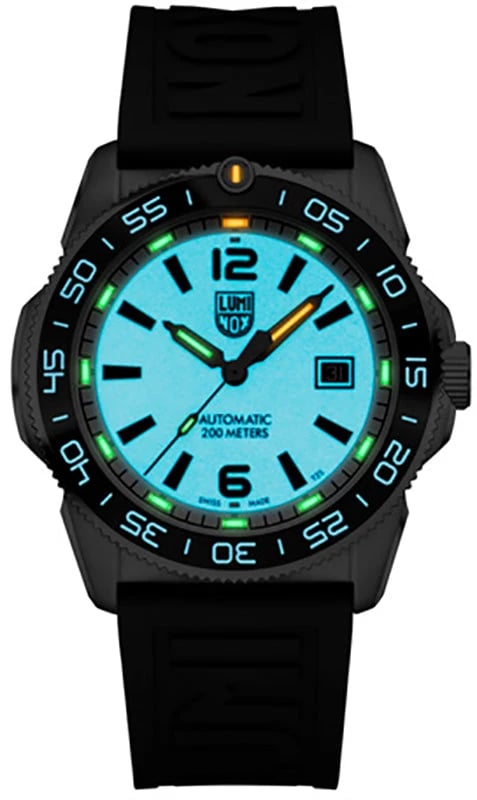
Luminox made its name with Luminox Light Technology: tiny tritium gas tubes that glow without sunlight or a charge. The 3100 carries that forward in a dial that reads like a tool, not a jewelry object. The automatic movement is the headline change. It moves the Pacific Diver from grab-and-go quartz territory into the daily-wear mechanical conversation, where collectors compare power reserves, accuracy, and service intervals.
That shift matters. Quartz Luminox watches are brilliant at being low-maintenance tactical kit. An automatic Luminox asks you to care about winding, setting, and service. It is a different relationship. The 3100 is for the person who wants the glow and the gear aesthetic but also wants the ritual of a mechanical watch. That is a narrower audience than the brand's quartz base, but it is a more committed one.
Brand history: from SEAL wristwear to Swiss automatic
Luminox was founded in 1989 and later became part of the Mondaine Group. Its breakthrough came through military credibility, especially its association with U.S. Navy SEALs in the 1990s. That origin story still shapes the design language: blacked-out cases, bold numerals, and tritium illumination that works in low light without a charge.
The Pacific Diver Automatic 3100 Series is a logical next step. Luminox has spent decades making quartz tool watches for people who need legibility in wet, dark, or dirty conditions. The 3100 keeps that brief but gives mechanical-watch fans a reason to stay in the brand. It is not a heritage reissue. It is a modern Luminox with a Swiss automatic movement and a dive-watch silhouette.
Movement: Sellita SW220-1
The engine is the Sellita SW220-1, a Swiss automatic with day-date display, 26 jewels, a 38-hour power reserve, and a 28,800 vph beat rate. It is not COSC-certified and it is not in-house, but that is not a scandal at this price. Sellita's SW200 family is one of the most trusted workhorse platforms in modern watchmaking, and the SW220-1 adds the day window for extra daily utility.
Finishing is industrial rather than decorative. You are paying for robustness and parts availability, not Geneva stripes. For a watch that is meant to be worn with a wetsuit, a field jacket, or a weekend tee, that is the right trade. The movement is serviceable by Luminox and by independent watchmakers who know Sellita. That matters more than a display caseback ever will.
Specs and build: the tool-watch essentials
The 3100 uses a 42mm stainless steel case, sapphire crystal, and 200m water resistance. The case is paired with a stainless steel bracelet and a folding clasp in the core reference. The bezel is a dive-style unidirectional unit, and the dial is built around tritium tubes rather than painted lume. That means the glow is always on, not dependent on how much sunlight you gave it before dinner.
The 42mm diameter is a sensible middle ground. It gives the watch enough wrist presence to read as a dive watch without drifting into oversized-trend territory. The sapphire crystal is the right call for a daily wearer, and 200m water resistance is more than most owners will ever need. This is not a desk diver pretending to be tough. It is a Luminox with real water-sports intent.
The design is deliberately functional. The dial prioritizes big markers and clear hands over decorative texture. The bezel gives you the dive-watch silhouette without turning the watch into a piece of costume gear. It is aggressive, but not silly. That balance is harder to pull off than it looks.
On the wrist: balanced, purposeful, not delicate
On the wrist, the Pacific Diver Automatic 3100 feels like a tool watch first. The case has a solid, planted feel, and the bracelet gives it a more finished look than a rubber strap would. It is not a featherweight titanium piece, and it is not trying to be. The weight is part of the experience. It sits with enough authority that you notice it, but the 42mm case keeps it from feeling like a cartoon diver.
The bracelet is robust and utilitarian. It does not have the silky articulation of a luxury sports watch, but it matches the brief. The folding clasp feels secure, and the whole package reads as something you can wear hard without babying it. If you prefer a lighter, more casual fit, a rubber strap will change the personality completely. On steel, it leans toward daily tool watch. On rubber, it becomes a weekend and travel piece.
Night legibility is the party trick. Tritium tubes do not flare up and fade like Super-LumiNova. They glow steadily, softly, and constantly. In a dark hotel room or a tent, that steady glow is more useful than a brighter burst that dies out. It is also more distinctive. People notice it.
Accuracy and daily ownership
The SW220-1 is not COSC-certified, so do not expect chronometer-grade discipline out of the box. Real-world examples typically run within about plus or minus 10 to 15 seconds per day, and some will do better. If you are the kind of collector who checks against a time server every morning, you can have it regulated. If you wear a watch to know the time and like the idea of a mechanical heartbeat, it will be fine.
The 38-hour power reserve means it will run through a night off the wrist and most of a lazy weekend. It is not a 70-hour modern movement, but it is enough for a daily wearer. The day-date function is genuinely useful, especially for travel and work schedules. This is not a purist's no-date dive watch. It is a practical automatic for people who want utility with their glow.
Occasions and wrist presence
This is a sport and daily watch first. It works with a T-shirt, a hoodie, technical outerwear, and casual tailoring. It is not a formal watch, and it should not pretend to be. For travel, the always-on tritium is a real advantage: hotel rooms, red-eyes, and night trains are exactly where a glowing dial earns its keep. For the office, it reads as purposeful rather than precious.
Wrist presence is 4/5. The 3100 has enough visual weight to register across a room, especially with the tritium glow and dive bezel. It is not a subtle dress piece, and that is the point. It looks like a Luminox, which means it looks like a watch with a job to do.
Variants and family context
The core reference is the XS.3101 with a black dial and stainless steel bracelet. The XS.3102 adds a blue dial on the same platform. Both keep the tritium display, day-date layout, and Swiss automatic movement. Luminox has built the Pacific Diver family around quartz and chronograph siblings, including the 3120 Series and the 3140 chronograph line. The 3100 is the mechanical heart of that family.
If you are shopping within Luminox, the Navy SEAL 3500 Series is the more overt tactical option, while the Master Carbon SEAL 3800 Series pushes composite materials and lightweight construction. The Bear Grylls Survival Series adds outdoor-brand energy, and the ICE-SAR Arctic 1200 Series leans into rescue-tool legibility. The 3100 sits in the middle: more mechanical than the quartz Pacific Divers, less extreme than the SEAL line.
Alternatives and homages
Against the Seiko Prospex SPB143, the Luminox is the more tactical and less vintage-minded choice. The Seiko has a deeper heritage-dive story and a strong modding community. The Oris Divers Sixty-Five is more polished and more expensive, with a softer retro silhouette. The Hamilton Khaki Navy Scuba Auto is a Swiss automatic daily diver with a more urban look. The Tissot Seastar 1000 Automatic offers higher water resistance and mainstream Swiss appeal at a similar price.
If you want the tritium look for less, the homage field is active. The Deep Blue Daynight T-100 delivers tritium illumination and a dive-watch silhouette at around $299. The ArmourLite Operator offers tritium tubes and tactical styling for roughly $350. The Nite Alpha is a British tritium specialist with a comparable always-on glow for about $325. None of them will match the Luminox's specific feel, but they prove the formula has pull.
Investment value and service
The 3100 is a wearer, not an investment. MSRP is around $1,095, current retail sits near $1,195, and pre-owned examples typically trade in the $650 to $900 range. The trend is depreciating, as it is for most modern Luminox models. There is no major auction history, and there is unlikely to be. That is not a criticism. It is a clarification: buy this watch because you want to wear it, not because you want to flip it.
Service is straightforward for a Sellita-based watch. Luminox can handle it, and a reputable independent watchmaker familiar with the movement is a practical option. There is no need to treat it like a fragile heirloom. The 3100 is built to be used, and its service story should be judged in that light.
Pros and cons
Pros: always-on tritium lume that needs no charging, a proven Swiss automatic with day-date utility, 200m water resistance, sapphire crystal, and a tactical look that stands apart from generic desk divers. The 42mm case is easy to wear, and the steel bracelet gives it enough polish for daily life.
Cons: non-COSC accuracy varies, resale is weaker than heritage dive brands, the day-date and tritium styling will not suit purists, and the bracelet finishing is utilitarian rather than luxury-grade. If you want a slender dress diver or a safe investment, this is not the one.
Final verdict
The Luminox Pacific Diver Automatic 3100 Series is a smart crossover for the brand. It keeps the tritium glow that made Luminox famous and adds a Swiss automatic movement with real daily utility. It is not the most refined dive watch at its price, but it is one of the most distinctive. For young collectors who want a mechanical watch with a tactical soul and no interest in babying it, the 3100 makes a compelling case.