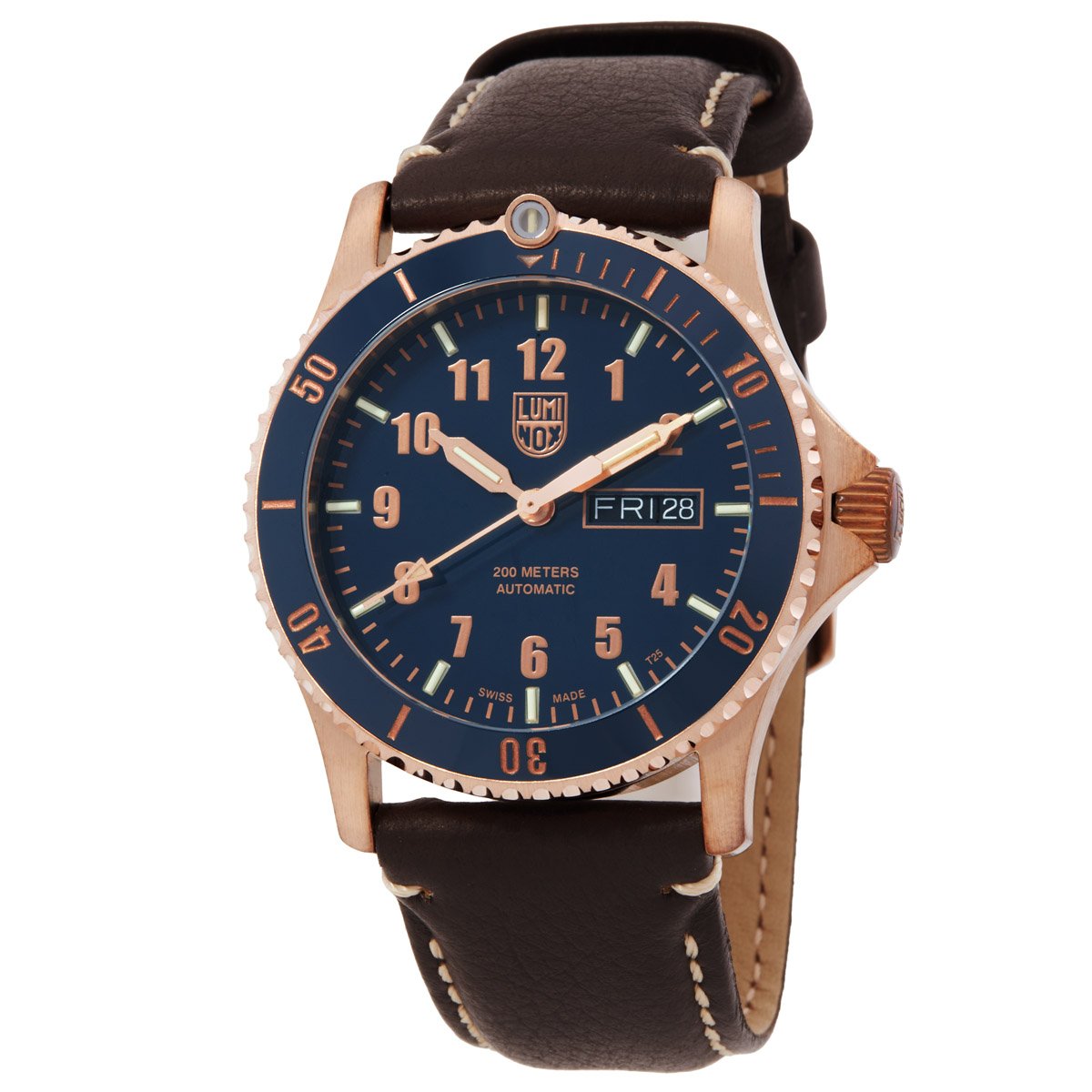
The Metallurgy of the CuSn8 Case
In the realm of horology, bronze is often misunderstood as a singular material. Luminox utilizes CuSn8, a premium phosphor bronze alloy consisting of 92% copper and 8% tin. This specific composition is favored for its structural integrity and its resistance to corrosion in marine environments. Unlike stainless steel, which remains inert, the copper in the Sport Timer reacts with oxygen, moisture, and skin acidity. Over weeks and months, the bright, gold-like hue of the fresh bronze will darken into a rich, chocolatey brown, eventually developing hints of verdigris if exposed to salt water.
The case finishing is primarily brushed, which is a strategic choice by Luminox. The microscopic grooves of a brushed finish provide more surface area for oxidation, ensuring that the patina develops evenly rather than in splotchy patches. The 42mm architecture is a direct nod to the 1990 original, but the inclusion of a ceramic bezel insert provides a necessary modern counterpoint. While the case ages and changes, the blue ceramic remains eternally pristine, creating a high-contrast aesthetic that highlights the watch's evolution.
Movement Architecture: The Sellita SW 220-1
Peering through the sapphire exhibition caseback reveals the Sellita SW 220-1. For the uninitiated, the SW 220-1 is an architectural twin to the ETA 2836-2. It is a high-beat movement, oscillating at 4Hz (28,800 vibrations per hour), which translates to a smooth eight-ticks-per-second sweep of the central seconds hand. The movement features 26 jewels, with the extra jewel over the SW 200-1 dedicated to supporting the day-date disc mechanism.
Luminox has opted for a custom execution here, featuring a black PVD-coated rotor. While the finishing is industrial rather than artisanal—lacking the hand-applied anglage or Geneva stripes of high-haute horlogerie—it is executed with a precision that speaks to its Swiss origin. The use of a Nivaflex mainspring and a Novodiac shock absorber ensures that the Sport Timer can withstand the rigors of its 'Sport' moniker. The day-date complication is particularly crisp, with an instantaneous jump at midnight, a feature often missing in lower-tier Japanese movements.
Illumination and Dial Legibility
The hallmark of any Luminox is the Luminox Light Technology (LLT). Unlike Super-LumiNova, which requires an external light source to charge, the Sport Timer utilizes borosilicate glass tubes filled with tritium gas. These tubes are lined with a phosphorescent material that glows constantly for up to 25 years due to the radioactive decay of the tritium. In the Sport Timer Bronze, these tubes are applied to the indices and the handset.
To supplement the LLT, Luminox has applied Super-LumiNova to the numerals on the ceramic bezel. This creates a dual-layered lighting system: the bezel provides immediate high-intensity glow for timing dives or events, while the tritium tubes ensure legibility in total darkness long after the photoluminescent paint has faded. The blue sunray dial serves as an excellent backdrop, catching the light in a way that complements the warm tones of the bronze case.
The Value Proposition
At an MSRP of $1,495, the Sport Timer Automatic Bronze sits in a competitive bracket. It competes directly with the likes of the Oris 65 and various Seiko Prospex models. However, the Luminox offers a unique combination of Swiss automatic reliability, exotic case material, and permanent illumination that is difficult to find elsewhere. For the collector who values a watch that changes alongside them—reflecting their own history through the accumulation of patina—this reference is a compelling choice. It is not merely a tool for telling time; it is a mechanical companion that celebrates the passage of time through both its movement and its metal.