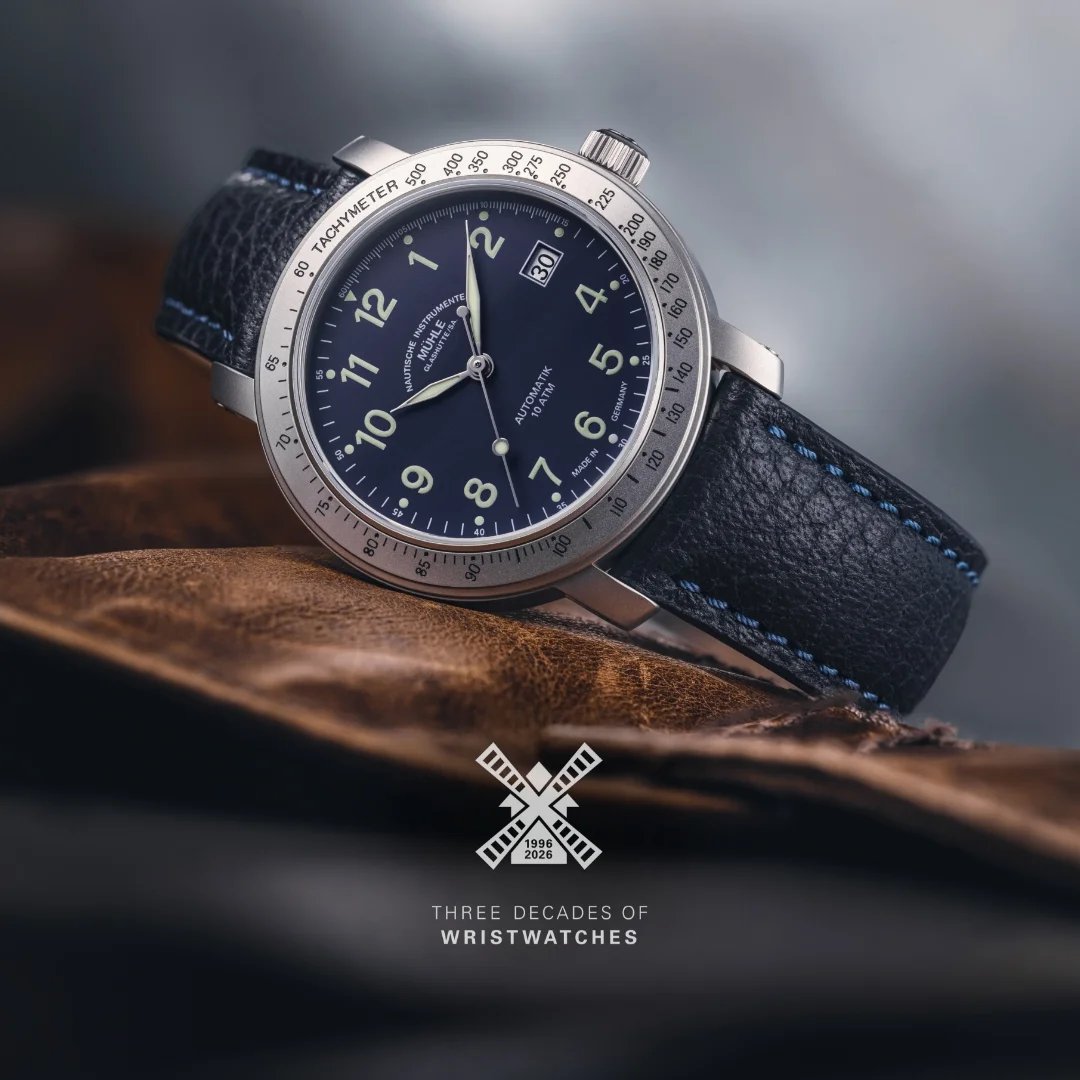
Naval Aviation, Wrist-Sized
Naval aviation runs on instruments. Not the romantic kind — the ones that tell a pilot, at two hundred knots and three hundred feet over open water, exactly what the aircraft is doing and exactly how much time is left. The Marinefliegeruhr line lives in that tradition: a legible, purpose-built cockpit tool that happens to look excellent with a wool overcoat.
The last five years have been a slow reclamation project for watches like this. Collectors in their twenties and thirties — raised on steel sports watches and waitlists — have discovered that German instrument watches deliver the same functional honesty without the queue, the premium or the group-chat gatekeeping. Mühle-Glashütte has been building them the whole time, in a small Saxon town, for a family that still owns the company.
The Marinefliegeruhr-I, reference M1-30-01-1996-LB, is the cleanest distillation of that idea in the current catalog. It does not try to be charming. It tries to be correct — and ends up charming anyway.
A Family Named Mühle
Robert Mühle founded the family workshop in Glashütte in 1869, building precision measuring instruments for the town's watchmakers long before the town became shorthand for German watchmaking. Four generations later, the company is still a Mühle affair: family-owned, family-run, and stubbornly focused on instruments rather than fashion.
That is not marketing copy. The brand's modern reputation was rebuilt on tools — marine chronometers, the S.A.R. Fliegeruhr developed with German maritime search and rescue, and the Kampfschwimmer line built around the requirements of the German navy's combat divers. When Mühle puts a flieger dial on a watch, it comes from a place where the dial had a job.
The Marinefliegeruhr sits squarely in that lineage: naval aviation rather than navy diving, cockpit legibility rather than extreme water resistance. It is the sort of watch a brand only gets to make credibly if it has spent a century making the unglamorous version first.
Reading the Dial
Mühle's instrument dials share a design grammar, and it is a strict one — a low-glare matte base, oversized high-contrast markings, and hands that can be read in a half-second glance in a dark cockpit. Nothing on the Marinefliegeruhr-I is decorative. The markers are built for contrast, the minute track is built for precision, and the luminescence is built for the moment the sun goes down and the instrument panel takes over.
What elevates it above the generic flieger is restraint. There is no faux patina, no oversized crown guard, no heritage logo shouting from the nine o'clock position. The dial is confident enough to be quiet, which is precisely what a new generation of collectors has responded to. In a market where every release wants to be a moment, a watch that simply reads well is its own statement.
The case is satin-brushed stainless steel with the kind of honest surfaces that hide a scuff rather than amplify one — a genuine consideration for anyone who intends to actually wear the thing. A sapphire crystal sits over the dial, and the caseback is solid rather than exhibition. That is the right call. This is a tool, not a display piece, and there is something refreshing about a brand that does not assume you bought it to stare at a rotor.
What Is Inside
Mühle builds its automatics on Swiss Sellita base movements, then does the part that actually matters in Glashütte: regulation, finishing and the brand's signature woodpecker-neck adjustment, a beat-correction system that lets a watchmaker fine-tune the rate with repeatable precision. Blued screws, a decorated rotor and a rate set by a human rather than a spreadsheet complete the package.
This is not an in-house caliber, and Mühle has never pretended otherwise. It is also not a compromise. A proven Swiss base with a time-and-date layout is the most serviceable architecture in horology — any competent watchmaker can work on it, parts are available, and you are not hostage to a single service center on a single continent. For a watch designed to be worn hard and often, that is a feature, not an apology.
The complication set is deliberately minimal: hours, minutes, seconds and a date. No GMT, no chronograph, no power-reserve indicator. The restraint is the point — fewer functions mean fewer failure points and a cleaner dial, and the Marinefliegeruhr is a watch that understands the difference between capability and clutter.
A note on numbers: Mühle publishes full dimensions and a water-resistance rating for this reference, but rather than recycle figures we could not independently confirm for this exact configuration, this review leaves the measurement table blank. Ask your dealer for the sheet and check it against your own wrist. What matters editorially is that the proportions are right — this is a watch that sits in the classic instrument-watch window rather than chasing either extreme of the size wars.
On the Wrist
Instrument watches live or die on balance, and this one carries its presence lightly. The satin case keeps the visual weight down, the matte dial refuses to flash under office lighting, and the whole thing reads as equipment rather than jewelry. That is why it works with everything from a field jacket to a navy blazer — it never looks like it is trying.
The leather band denoted by the '-LB' suffix in Mühle's reference conventions breaks in within a week and then stops being something you think about, which is the highest compliment you can pay a strap. The crown sits clean and unobtrusive against the case, the solid caseback keeps the profile flat against the wrist, and the package disappears under a shirt cuff until you need to read it. On a smaller wrist it does not overwhelm; on a larger one it does not vanish. That is a harder brief than it sounds, and Mühle gets it right.
Living With It
Mühle regulates each movement before it leaves the building, and owners of the brand's automatics typically report stable, single-digit-seconds-per-day behavior in normal wear. Do not expect chronometer certification — this is not a COSC watch — but do expect consistency: a rate that holds across positions and across the week rather than testing beautifully on day one and drifting by Friday.
Service is where the Sellita base earns its keep. Mühle maintains a service network, but because the architecture is widely understood, a good independent watchmaker can also handle routine maintenance and regulation. For anyone who has ever waited nine months for an in-house-only service, that freedom is worth more than a decorated bridge.
Day to day, the watch asks nothing of you. It does not need winding rituals, it does not punish a desk job, and it does not demand a safe. It is the rare mechanical object that gets better the less reverently you treat it.
The Company It Keeps
The obvious comparison is the IWC Pilot's Watch Mark XVIII — the benchmark modern flieger, cleaner and more polished, but at roughly double the money. The Sinn 556 I is the other great German answer: more austere, more industrial, equally legible, and aimed at the same buyer. Stowa's Flieger Klassik trades on original pilot-watch heritage and sells direct. Hamilton's Khaki Aviation is the accessible entry point, though the case finishing sits a tier below. And Laco carries genuine Beobachtungsuhr DNA at a friendlier price with less movement refinement.
What separates the Mühle is the combination: Glashütte regulation, family ownership, satin finishing that survives real wear, and a dial that was designed by people who think in instruments. Homages exist at every price point — the flieger is the most copied dial in watchmaking — but a homage copies the look, not the regulation, and certainly not the 150-year paper trail.
The Money Question
At retail, you are paying for genuine instrument heritage, hand regulation in Glashütte, and a case finished to a standard most sub-three-thousand-dollar fliegers cannot match. On the secondary market, the same money buys a nearly new example, and prices settle rather than spike — Mühle is a value-driven family brand with a small, loyal collector base rather than a hype machine.
That is not a bad thing. A stable floor is a better friend to a buyer than a speculative ceiling. If you want a watch that will be worth roughly what you paid in five years and will have given you five years of daily wear in exchange, this is precisely the behavior you want. If you want an asset, buy something else.
Auction-wise, Mühle-Glashütte rarely surfaces in the headline evening sales, and this reference has no notable auction record. That is the correct context for the price: it is a wearer's watch, priced as a wearer's watch.
Verdict
The Marinefliegeruhr-I is what happens when a 150-year-old instrument maker refuses to dress up for the trend cycle. It is legible, honest, hand-regulated and built to be worn hard. At its price it undercuts the Swiss and Japanese names it competes with while matching them on intent, and the leather-strap reference M1-30-01-1996-LB is the configuration to want.
Buy it if you want a tool watch with a story that is not borrowed. Skip it if you need a dial that performs for a camera. This one performs for a pilot — and it looks better for it.