Mühle-Glashütte S.A.R. Mission-Timer TITAN Review
Reference M1-51-03-KB · Titanium · Automatic chronograph
The Mühle-Glashütte S.A.R. Mission-Timer TITAN is the kind of watch the market tends to overlook and the kind serious collectors quietly keep. It is a chronograph built around the needs of the German maritime search-and-rescue service, dressed in titanium, and priced well below the Swiss tool-watch competition. In a segment crowded with heritage reissues and lifestyle chronographs, the Mission-Timer is unapologetically a working instrument — and that is exactly its appeal.
Where most sub-five-figure chronographs lean on nostalgia, the S.A.R. Mission-Timer leans on function. A central minute counter reads elapsed time at a glance; the dial is built for legibility rather than decoration; and the titanium case keeps a large tool watch from becoming a burden on the wrist. Mühle has supplied the DGzRS, Germany's maritime search-and-rescue service, with purpose-built watches for decades, and the Mission-Timer is the most specialised expression of that relationship.
This review looks at the M1-51-03-KB on its rubber strap — the configuration most buyers will encounter — and treats it the way a young collector actually should: as a watch to wear, service and live with. We will cover the design, the movement, the wear, the accuracy, and, most importantly, whether it makes sense as a keeper in a portfolio that already has its dress watches covered.
The chronograph market has spent the past decade chasing heritage. Reissues, limited editions and anniversary pieces dominate the sub-ten-thousand-dollar bracket, and most of them are exercises in nostalgia rather than engineering. The Mission-Timer is a useful counter-programme: a watch designed for a service branch, sold to civilians, and improved over the years according to the feedback of people who actually use it. That lineage is why it feels different on the wrist from a chronograph conceived in a marketing meeting.
Brand History
Mühle-Glashütte was founded in 1869 by Robert Mühle in Glashütte, Saxony, and remains a family-owned manufacturer — one of the few in the town still controlled by the descendants of its founder. The brand's modern identity rests on two pillars: precision measuring instruments and rugged sports watches. The second pillar is crystallised in the S.A.R. line, developed with the German Maritime Search and Rescue Service, whose crews need instruments that work when everything else has gone wrong.
The S.A.R. name — Search and Rescue — is not marketing. These watches are specified around the realities of a rescue deck: legibility in spray and darkness, timing that can be read without a second glance, and cases that survive knocks against steel and saltwater. The Mission-Timer is the chronograph branch of that family, engineered to time a search pattern, a fuel window or a tow. It carries that mandate into civilian hands, and it is priced as a working tool rather than a luxury object.
That positioning matters for collectors. Mühle is not trying to be Glashütte's answer to a Swiss maison; it is a specialist manufacturer with a clear brief. The Mission-Timer is what happens when a family firm builds a chronograph for people who actually have to use one.
Glashütte itself is a useful piece of context. The town's watchmaking tradition stretches back to the nineteenth century, and Mühle is one of the names that kept it alive through the twentieth. That continuity matters less for resale than for credibility: when Mühle says a watch is built for the sea, it is speaking from a long institutional memory of building instruments for people who cannot afford for them to fail.
Case, Dial and Design
Titanium is the headline. The case is rendered in the metal, which drops the weight noticeably compared with a steel chronograph of similar footprint and gives the watch a matte, utilitarian finish that suits its role. The bezel is fixed and clean, the crown and pushers are sized for gloved hands, and the whole assembly reads as a tool rather than a jewel. There is nothing decorative here, and that is deliberate.
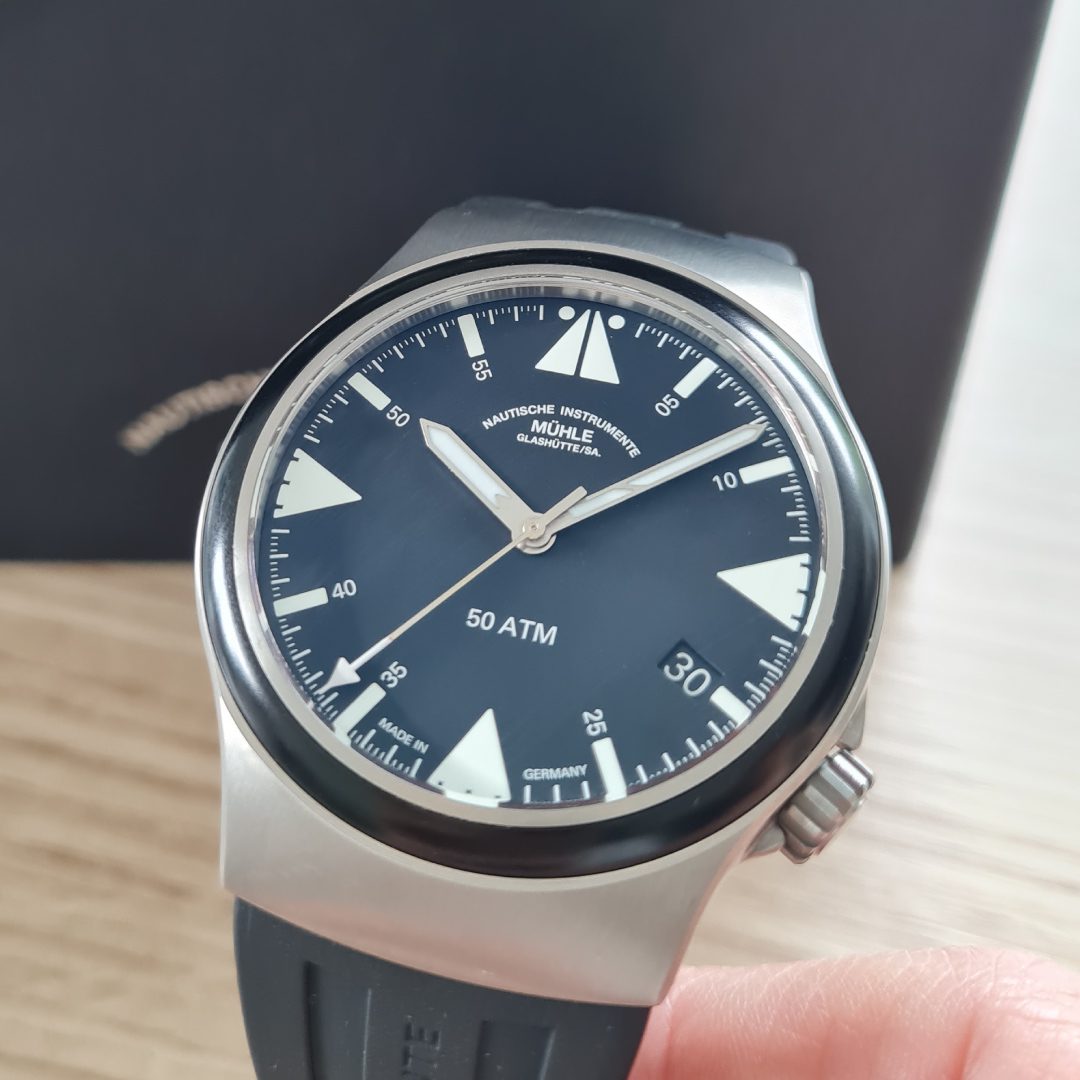
The dial is where the Mission-Timer earns its name. The chronograph's elapsed-minute hand runs from the centre, so a glance gives you minutes, not seconds — the metric that actually matters when you are timing a mission, a leg or a hold. Running seconds live in a subdial, and a date window keeps daily practicality. Applied indices and a healthy layer of Super-LumiNova keep it readable at night or in spray. It is not a pretty dial in the decorative sense; it is a legible one, and legibility is the entire point.
The concept is worth pausing on, because it is rarer than it should be. Most chronographs devote their central hand to seconds, forcing you to squint at a small subdial for elapsed minutes. The Mission-Timer inverts that hierarchy. When you are timing something that lasts minutes rather than seconds, the central minute counter is simply the right solution — and it is the single feature that most distinguishes this watch from the dozens of chronographs at its price.
The strap deserves a mention of its own. The rubber is functional and comfortable, with a texture that grips without chafing, and it is the right pairing for a case this purposeful. It is not a luxury strap, and it does not pretend to be — but it does the job, and it keeps the watch's price and its brief aligned. Owners who want more polish can source a titanium bracelet, and the watch will reward the upgrade.
Movement
Inside is Mühle's chronograph calibre, the MU 9413, an automatic movement built on a Sellita SW500 base and modified in Glashütte. It beats at 28,800 vph and carries roughly 48 hours of power reserve. Mühle finishes and regulates each movement in-house, and the brand's own rotor and detailing separate it from a stock ébauche. It is honest about its origins — this is a modified Swiss base, not a from-scratch in-house calibre — but that is also why the watch is serviceable and priced where it is.
Expect the usual chronograph caveats. The pushers have a firm, mechanical action rather than a buttery one, and the movement is built for reliability rather than decoration. There is no vertical-clutch poetry here, no hand-finished bridgework to admire through a display back. What you get instead is a robust, well-understood engine that any competent watchmaker can service, and a regulation that Mühle performs before the watch leaves Saxony.
For a tool watch, that is the correct trade. A collector buying a dress chronograph wants finishing; a collector buying a Mission-Timer wants it to start, stop, reset and keep time for the next decade. On that brief, the MU 9413 delivers.
Servicing is straightforward, and that is a feature. A Sellita-based chronograph can be maintained by a wide range of watchmakers, and parts are not a scavenger hunt. For a tool watch, that accessibility is worth more than the romance of an in-house calibre would be. You are buying a machine designed to be kept running, not a museum piece designed to be admired.
On the Wrist
Titanium transforms the way this watch wears. A chronograph of this footprint in steel can feel top-heavy after a full day; in titanium the Mission-Timer sits close and never drags, and the rubber strap keeps it locked down during activity. The case is substantial — this is not a slim dress chronograph — but the weight distribution is good, and the short, protected lugs keep it from overhanging smaller wrists as badly as a big tool chronograph might.
On the rubber strap the watch is a genuine daily driver. It shrugs off sweat, water and knocks, and it never asks to be taken off. The trade-off is that the strap feels more utilitarian than the case deserves; a titanium bracelet would elevate the package, and buyers who want one should budget for it. The crown and pushers fall naturally to hand, and the legibility that defines the dial is matched by a case that stays out of the way.
If you have worn steel chronographs and found them tiring, the titanium case is the reason to try this one. It is the rare tool watch that feels lighter at the end of the day than at the start, and that matters more than any spec-sheet number.
It is worth being clear about what this watch is not. It is not a dress chronograph; it will not slip under a tight cuff, and it does not try to. It is a sports watch with a mission-timer layout, and it should be judged on those terms. Worn with a casual wardrobe, it is at home; worn with a suit, it is a deliberate statement rather than a subtle one.
Accuracy and Ownership
Mühle regulates its movements in several positions before they leave Glashütte, and real-world examples of the Mission-Timer tend to run within a handful of seconds a day — comfortably inside what most owners will notice. It is not COSC-certified, and Mühle does not market it as a chronometer, but the practical accuracy is in line with the price. Day to day, expect a watch that keeps time well enough that you set it by the date change, not by the seconds.
The Sellita base is an ownership advantage. Parts and expertise are widely available, which keeps long-term running costs sane and means you are not hostage to a single service centre. The case is sealed for genuine outdoor use, though as with any watch you should have the seals checked at service. As a rule, avoid leaving the chronograph running continuously if you want the longest possible service intervals — a small habit that pays off over years.
Over the long term, the movement's simple architecture and the availability of parts mean the watch ages gracefully. A well-maintained example will still be keeping time a decade from now, and the case's titanium construction resists the dings that accumulate on steel. That durability is part of the value proposition, even if it does not show up in a resale chart.
Value, Resale and Investment
At retail the Mission-Timer TITAN sits in the low-to-mid four figures in US dollars — a fraction of what a Swiss titanium chronograph from a heritage maison commands. On the secondary market it trades below retail, as most modern Mühle does, so the smart money buys pre-owned or negotiates. That does not make it a bad watch; it makes it a bad flip. The investment case is essentially nil: German tool watches from independent family firms rarely appreciate, and the Mission-Timer is no exception.
Where it does hold value is in use. A titanium SAR chronograph that you can service affordably and wear without fear is worth more to a working collector than a safe queen that depreciates just as fast but hurts more. The pre-owned market is thin but functional — watches surface regularly, prices are soft, and condition varies. Buy the best example you can find, keep the box and papers, and accept that resale will be a convenience rather than a profit.
Collectibility is a different question from investment. The Mission-Timer is unlikely to become a cult object, but it has a small, loyal following among tool-watch enthusiasts who value the central minute counter and the SAR provenance. That following supports prices at the low end of the secondary market and gives the watch a floor that pure fashion pieces lack. It is a quiet kind of collectibility, and for many owners, that is enough.
If appreciation is part of your thesis, look elsewhere. If a tool that will outlast the trend cycle is the goal, this is a sensible place to put money — and a far more honest one than most.
The Competition
The obvious rivals are German. Sinn's EZM 13 offers a central minute counter and a similarly uncompromising brief, often with more cachet among tool-watch purists. Damasko's chronographs bring their own hardened-steel philosophy and a more technical feel. Tutima's M2 chronograph is the dressier alternative. Against these, the Mühle wins on titanium lightness and price, and loses on resale and, arguably, on the intangible cool factor that Sinn has cultivated over decades.
Swiss alternatives at the price tend to be less specialised. A Tissot or a Longines chronograph will be prettier and hold value marginally better, but neither is built around the mission-timer concept. The Mühle's differentiation is functional, and that is the right kind of differentiation for a collection that already has its dress watches covered.
There is also a broader point about the segment. The sub-five-thousand-dollar chronograph is crowded, but most of it is lifestyle product. The Mission-Timer competes on function, and that is a defensible position. Buyers who want a chronograph they can actually use — for sailing, for flying, for timing anything that lasts minutes — will find few better options at the price.
The honest summary: buy the Mühle if you want titanium and a central minute counter at a fair price; buy the Sinn if you want the same brief with stronger resale and community cachet. Both are correct answers, and the choice is about what you value more.
Verdict
The S.A.R. Mission-Timer TITAN is a specialist's watch at a generalist's price. It is not the chronograph you buy to impress a dinner party; it is the one you buy because a central minute counter and a titanium case make you a better-timed, more comfortable operator. Collectors who value function over flash will find a lot to like; flippers should look away.
As a keeper, it earns its place — provided you buy it right. The titanium case, the legible mission-timer layout and the affordable service story add up to a watch you can wear hard for years without regret. It will not make you money. It will make you better equipped, and for a certain kind of collector, that is the better trade.
In a market that rewards hype, the Mission-Timer rewards attention. It is a watch for the collector who has stopped chasing the next release and started building a collection that works. That is a mature brief, and Mühle has answered it well.