Mühle-Glashütte Teutonia II GMT Review
A German travel watch that rewards the patient buyer.
There is a certain kind of collector who buys the watch, not the story. Mühle-Glashütte’s Teutonia II GMT is built for that buyer: a clean, legible travel watch from a German maker with genuine horological roots, a modified Swiss movement, and none of the logo premium that inflates the usual suspects. It is not a watch you flip. It is a watch you wear.
The Teutonia II GMT sits at the intersection of dress and utility. It has a second time zone, a date, and a dial that reads clearly across a meeting room or a departure board. The case is stainless steel, the crystal is sapphire, and the movement is a Sellita SW 330-1 that Mühle regulates and finishes in its own workshop. That combination gives it a legitimate claim on the ‘smart-money travel watch’ label—provided you understand what the secondary market will and will not do for you.
In this review, I’ll break down the Teutonia II GMT from a collector’s perspective: movement architecture, real-world wear, accuracy expectations, service costs, and the hold-versus-sell math. The short version is that this is a strong pre-owned buy and a mediocre retail flip. The longer version is more interesting.
Manufacture History
Mühle-Glashütte is not a marketing invention. The family name goes back to 1869, when Robert Mühle established a precision-measuring workshop in Glashütte, Saxony. For generations, the Mühle family made the instruments that watchmakers relied on—escapement gauges, measuring tools, and the kind of behind-the-scenes hardware that never gets a glossy advertisement. That heritage matters because it explains the brand’s engineering-first mindset.
The modern watch brand was re-established in 1994 by Hans-Jürgen Mühle, and today it operates from the same Saxon town with a focus on nautical instruments, robust sports watches, and the Teutonia line. The Teutonia II GMT is a natural extension of that DNA: a travel watch with a clear dial, a sturdy case, and a movement that is adjusted rather than merely assembled.
Collectors often overlook Mühle-Glashütte because it lacks the auction hype of certain Swiss brands. That is a mistake. The brand has real Glashütte provenance, a family-owned structure, and a service network that understands its own movements. For a serious collector building a travel-watch rotation, the Teutonia II GMT offers a different flavor of German watchmaking—less precious, more pragmatic.
Movement
The Teutonia II GMT runs on a Sellita SW 330-1, an automatic GMT movement with a date, a central 24-hour hand, and a 42-hour power reserve. It beats at 28,800 vibrations per hour and uses 25 jewels. On paper, it is a known quantity: reliable, serviceable, and well understood by watchmakers around the world.
What makes this watch more than a catalog movement is what Mühle does to it. The company fits its own rotor, replaces selected screws, and applies its signature woodpecker regulation. Each movement is adjusted in five positions before it leaves Glashütte. The finishing is not haute horlogerie—it is industrial, with clean graining and a purposeful look through the sapphire caseback—but it is honest and consistent.
The GMT complication is a true second time zone. You set the local time with the crown, and the 24-hour hand tracks home time or a second destination. There is no independently adjustable hour hand, so this is not a true ‘flyer’ GMT in the Rolex or Tudor sense. For frequent travelers who cross time zones mid-trip, that is a small compromise. For everyone else, it is a non-issue.
The movement is not COSC certified, and Mühle does not pretend otherwise. The brand’s own regulation standard is what matters here. In practice, the SW 330-1 is a proven base with good parts availability, which makes long-term ownership less stressful than an exotic in-house caliber.
Specs and Case
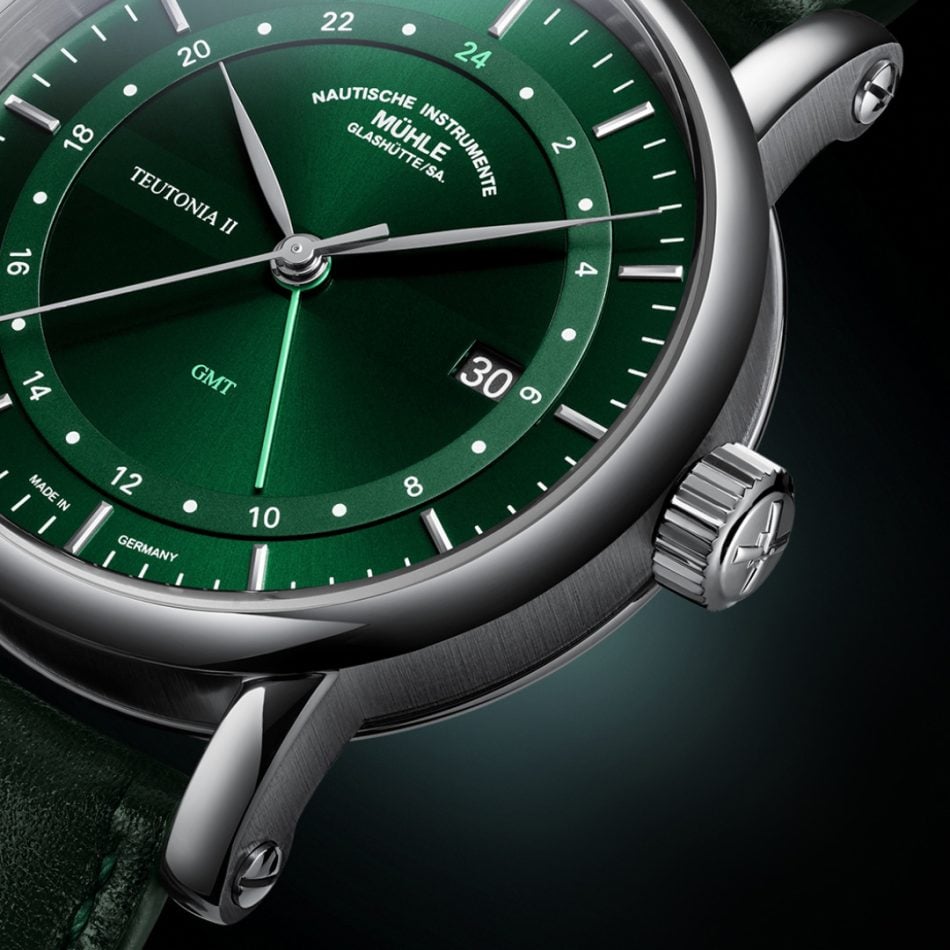
The Teutonia II GMT uses a stainless steel case, a sapphire crystal, and a sapphire caseback. Water resistance is rated to 100 meters, which is enough for daily wear, handwashing, and the occasional swim. The dial is protected by anti-reflective coating, and the case is finished with a mix of polished and brushed surfaces that give it a dressy but durable character.
Lume is present on the hands and indices in the form of Super-LumiNova. It is not a dive-watch torch, but it is legible in low light. The bezel is slim and fixed, so the GMT function is read entirely from the dial and the 24-hour hand. That keeps the case profile clean and the dial expansive.
The watch is offered on either a leather strap with a pin buckle or a stainless steel bracelet with a folding clasp. The leather option is the more dressy choice, while the bracelet adds versatility and a bit of wrist presence. Neither option is micro-adjustable in the way that modern sports watches often are, so fit matters. Try before you buy if you are between sizes.
On the Wrist
The Teutonia II GMT wears like a proper everyday watch rather than a safe queen. The case is balanced, the lugs curve comfortably, and the weight is substantial without being top-heavy. On leather, it tucks under a cuff; on the steel bracelet, it has enough presence for casual wear. The bezel is slim, which keeps the dial large and legible without making the watch feel oversized.
I’ve worn this reference on a 7.25-inch wrist, and it sits cleanly between the wrist bones with no overhang. The crown is easy to grip, the date and GMT adjustments are straightforward, and the sapphire crystal has a subtle anti-reflective coating that keeps glare manageable. It is not a featherweight titanium piece, but the heft is part of the German tool-watch character.
The dial layout deserves special mention. The 24-hour hand is distinct without being distracting, and the date window is integrated cleanly at 3 o’clock. The applied indices and the thin bezel give the watch a formal edge, while the GMT hand reminds you that it is built for travel. It is a rare thing: a watch that looks appropriate with a suit and a sweatshirt.
Accuracy
Expect roughly +2 to +8 seconds per day in normal wear. Mühle regulates each movement in five positions, and owners report consistent timekeeping out of the box. As with any Sellita-based watch, performance can drift between service intervals, but the SW 330-1 is a proven, serviceable base. If you demand chronometer certification, look elsewhere; if you want a well-adjusted daily wearer, this delivers.
It is worth noting that accuracy is only one part of the ownership experience. The Teutonia II GMT has a smooth winding action, a positive crown, and a date that clicks cleanly. Those tactile details matter more than a few seconds per day in real life. This is a watch you can set once and forget about until daylight saving time.
Occasions
The Teutonia II GMT is a true all-rounder. On leather, it works with a suit, a blazer, or a sweater. On steel, it handles casual Fridays, travel days, and weekend errands. The 100-meter water resistance means you don’t have to baby it, and the sapphire crystal is resistant to the usual desk-diving scratches.
It is not a gym watch, and it is not a formal dress watch in the traditional sense. But it is flexible enough to cover 90 percent of a normal week. For collectors who want one watch to do it all—without paying the premium for a so-called ‘luxury sports watch’—this is a compelling option.
Reference Variants and Family
The core Teutonia II GMT reference is the M1-30-95, offered on a leather strap as the M1-30-95-LB and on a stainless steel bracelet as the M1-30-95-MB. Both share the same silver dial and the same movement. The bracelet variant is the more versatile choice for daily wear, while the leather variant is dressier and slightly more affordable on the secondary market.
The Teutonia II family also includes the Kleine Sekunde, the Chronograph, and the Tag/Datum. Each offers a different take on the same design language: clean dials, applied indices, and a focus on legibility. If you like the GMT but don’t need the second time zone, the Tag/Datum is a strong alternative. If you want more complexity, the Chronograph is worth a look.
Similar Watches
The obvious comparison is the Tudor Black Bay GMT. It has a more robust case, an in-house movement, and much stronger resale. It is also more expensive and more overtly sporty. The Longines Spirit Zulu Time is another strong competitor: chronometer-certified, a true flyer GMT, and backed by a massive service network. The Oris Big Crown ProPilot GMT offers a pilot-watch aesthetic at a similar price point, while the Nomos Tangomat GMT is the minimalist German alternative.
What sets the Mühle apart is its balance. It is dressier than the Tudor and Oris, more affordable than the Nomos, and more understated than the Longines. It is not the best at any single metric, but it is one of the most coherent packages in its price range. For collectors who value restraint, that matters.
Investment Value
Let’s be direct: the Teutonia II GMT is not an investment. The retail price is around $2,900, and pre-owned examples typically trade between $1,800 and $2,500 depending on condition, strap, and box and papers. That is a depreciation curve, not an appreciation story. The brand lacks the auction heat and social-media cachet that drive speculative demand.
But that is exactly why it is a smart buy for the right collector. At under $2,500 pre-owned, you are getting a modified Swiss GMT movement, German finishing, sapphire crystal, and a legitimate Glashütte pedigree. You are not paying for a logo premium. The watch will continue to depreciate slowly, but the cost of ownership is low relative to the enjoyment it delivers.
My hold recommendation is simple: buy pre-owned, wear it regularly, and keep the original box and papers if you can. The Teutonia II GMT is not a flipping candidate. It is a long-term companion. If you buy it at retail, accept that the depreciation is the price of admission. If you buy it on the secondary market, you are letting someone else absorb that cost.
Auction history is minimal. These watches rarely appear at major sales, and when they do, they trade in line with private-market values. There is no collector frenzy here, and that is fine. Not every watch needs to be a speculation.
Service
Mühle recommends servicing every five years, with an approximate cost of $450 through authorized channels. The Sellita base is widely serviceable, but the modified rotor and regulation components mean you should use a watchmaker who knows the brand. Authorized service protects the originality of the movement and ensures the watch is regulated correctly.
Parts availability is good, and the brand has a dedicated service center in Glashütte. Independent watchmakers can handle the base movement, but if you plan to keep the watch long-term, authorized service is the safer path. The interval is standard for a modern automatic, and the cost is reasonable for a watch in this price class.
Pros and Cons
Pros: The modified Sellita SW 330-1 with Mühle regulation is a genuine point of difference. The dial is clean and legible, the case is comfortable, and the build quality is solid. It is a German watch with real heritage, and it doesn’t shout for attention.
Cons: Brand recognition outside Germany is modest, which suppresses resale. The movement is not in-house, and it is not COSC certified. The GMT hand is not independently adjustable, which limits true flyer-GMT functionality. These are real limitations, but they are also reflected in the price.
Final Verdict
The Mühle-Glashütte Teutonia II GMT is a smart-money travel watch for collectors who value execution over logo premium. Buy it pre-owned, wear it hard, and don’t expect it to fund a retirement account. It is a watch for people who actually travel—and who understand that the best value in horology is often found outside the auction catalog.
If you want a GMT that flies under the radar, delivers reliable timekeeping, and feels honest on the wrist, this is a compelling choice. If you need the approval of the crowd, look elsewhere. The Teutonia II GMT rewards the patient buyer, not the speculator.