Brand history: precision before lifestyle
Mühle-Glashütte was founded in 1869 by Robert Mühle in Glashütte, Germany. The original business was built on measuring instruments and precision tools, not just wristwatches. That industrial DNA matters. Even after the brand returned to watchmaking following German reunification, it kept a reputation for robust, practical engineering rather than fragile showpieces. The Teutonia line is its civilian dress family, and the Teutonia IV Chronograph is the line at its most social: polished enough for a suit, technical enough for a collector who cares about regulation and finishing.
This matters because the modern watch market is full of brands trying to sell you a story before they sell you a watch. Mühle’s story is quieter: precision instruments, small-series watchmaking, and a stubborn commitment to mechanical usefulness. The Teutonia IV Chronograph is not a museum piece. It is a watch designed to be worn, serviced, and worn again.
Case, dial, and strap
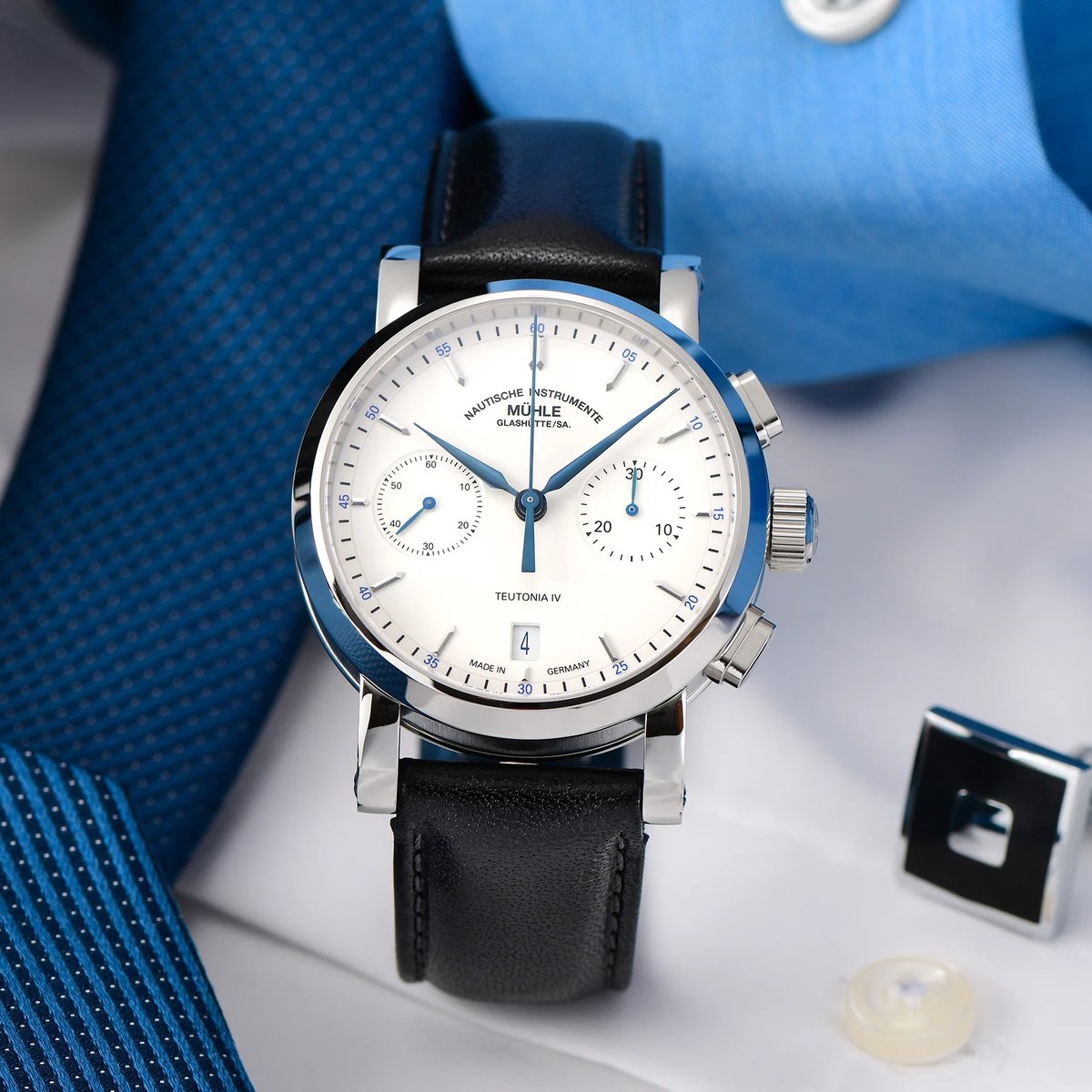
The ref. M1-44-35-LB pairs a stainless-steel case with a blue dial and a leather strap. The case is polished and confident in the hand, with a profile that reads dress-first rather than sport-first. A sapphire crystal protects the dial, which is the right call for a watch meant to be worn rather than stored. There is no lume here, and that is fine. This is not a watch for midnight tactical fantasy. It is a watch for daylight, boardrooms, and dinner reservations.
The dial is the reason to pick this reference. The blue tone gives it more depth than a plain silver or black dress chrono, and it shifts nicely under different lighting. The chronograph layout is traditional and legible, with the kind of balanced subdial arrangement that makes a dress chrono feel intentional rather than busy. Applied indices and crisp hands keep it formal, while the date aperture adds daily practicality. The leather strap completes the picture: it tapers neatly, keeps the watch under a cuff, and makes the steel case feel warmer on the wrist. A pin buckle is simple, classic, and easy to live with.
There is a temptation with dress chronographs to over-design the dial. Too many rings, too many colors, too many fonts. Mühle avoids that trap. The Teutonia IV Chronograph looks like it was designed by someone who wears a jacket to work and does not need the watch to perform for Instagram. The blue dial is the one concession to modern taste, and it is a good one. It gives the watch enough personality to avoid looking like an office-supply catalog item, but not so much that it fights with a tie.
Movement: MU 941-1
Inside is Mühle-Glashütte calibre MU 941-1, an automatic chronograph movement based on the Sellita SW500-1 architecture. It runs at 28,800 vibrations per hour, carries 25 jewels, and offers a power reserve of 48 hours. It is not an in-house movement, and Mühle does not pretend otherwise. What matters is what Mühle does with it: the brand adds its woodpecker neck regulation, a screw balance, and its own finishing and assembly standards. The result is a chronograph movement that is familiar to service networks, easy to maintain, and more interesting than a generic off-the-shelf unit.
The woodpecker neck regulation is the signature detail. It is a fine-adjustment system that lets a watchmaker dial in the rate with more precision than a simple regulator arm. In daily life, that means the Teutonia IV Chronograph has a better chance of staying stable than a basic chrono movement. The pushers feel crisp without being aggressive, and the chronograph action is the kind of mechanical interaction that makes owning a chrono worthwhile even if you rarely time anything more important than a pasta boil.
The Sellita base is not a weakness in this context. It is a pragmatic choice. It means parts are available, service is not exotic, and the watch can be maintained by more than a tiny handful of specialists. For a young collector building a real collection rather than a safe, that matters. You want watches you can wear and service, not watches that become paperweights because the movement is impossible to maintain.
On the wrist
The Teutonia IV Chronograph wears like a well-cut jacket. It has presence, but it does not dominate the wrist. The polished steel catches light at the edges, while the blue dial keeps the overall effect calm. The leather strap is comfortable from the first wear and helps the watch sit close to the wrist. It is not a lightweight titanium piece, but the weight feels appropriate for a mechanical chronograph with a dress-oriented build. You feel it when you put it on, then you forget about it until you need it.
This is not a watch that wants to be worn with gym shorts. It is at its best with a shirt cuff, a knit polo, or a dark suit. The pushers are easy to access without being chunky, and the pin buckle keeps the profile low. If you have a smaller wrist, the dress proportions will likely work in your favor; if you have a larger wrist, the watch will read as elegant rather than oversize. It is a watch that rewards a deliberate wardrobe, not a careless one.
The strap deserves a mention because it is doing a lot of the comfort work. Leather on a dress chrono should be supple, not stiff, and it should taper enough to keep the watch from feeling top-heavy. The pin buckle is the right choice for this watch. A deployant clasp can be convenient, but it also adds bulk and a different kind of formality. The pin buckle keeps the Teutonia IV Chronograph feeling like a watch you put on, not a piece of equipment you strap on.
Accuracy and daily use
This is not a COSC-certified chronometer, so do not expect lab-grade guarantees. In real-world use, a well-regulated MU 941-1 should run within roughly plus eight to plus twelve seconds per day, with some variation depending on wear habits and temperature. The woodpecker neck regulation gives a watchmaker room to tighten that up at service. Day to day, the Teutonia IV Chronograph is easy to live with: the date is useful, the chronograph is legible, and the automatic movement means you do not need to wind it every morning if you wear it regularly.
If it sits in a drawer for a week, expect to reset the time and date. That is normal for an automatic chronograph without a long power reserve. The reward is a movement that feels mechanical and alive, with a pusher action that is satisfying without being fragile. It is a watch for someone who likes the ritual of setting and wearing, not someone who wants a quartz appliance.
The 48-hour power reserve is practical for a daily wearer. It means you can take it off on Friday night and pick it up on Sunday without having to reset everything. It is not a travel watch in the sense of a GMT, but the chronograph is useful for timing flights, parking meters, and the length of a meeting that should have been an email.
Occasions and wrist presence
This is a formal and dress watch first, a daily watch second, and a travel watch third. It works for weddings, client meetings, dinners, and any situation where you want to look like you know what you are doing without wearing a logo that does the talking for you. It is not a sports watch, and it does not pretend to be. The lack of lume and the leather strap make that clear. If you need one watch for a beach holiday, keep looking. If you need one watch for the parts of life that involve a jacket, this is a strong candidate.
Wrist presence: 4/5. The blue dial and polished case give it enough shine to be noticed, but the overall effect is restrained. It reads as expensive to people who know watches, and as simply nice to people who do not. That is a rare balance.
Reference variants and family
The reviewed reference is M1-44-35-LB: blue dial, leather strap, pin buckle. The Teutonia family also includes other dress-focused models and chronograph siblings, including the Teutonia II Chronograph and other Teutonia IV pieces such as small seconds and big date variants. The through-line is the same: Glashütte-inspired design, practical German engineering, and a resistance to fashion-driven exaggeration.
If you are shopping the family, decide first whether you want a chronograph or a simpler dress watch. The chronograph adds visual complexity and mechanical interest, but it also adds cost and service complexity. The Teutonia IV Chronograph is the sweet spot for collectors who want one dress watch with a bit more going on than a three-hander.
Competition
At this price, the Teutonia IV Chronograph competes with several established dress chronographs. The Nomos Glashütte Club Chronograph is the obvious German alternative, with a more in-house story and a sportier personality. The Longines Master Collection Chronograph offers a classic look and a wide service network. The Baume & Mercier Classima Chronograph is a more accessible take on the same formal brief. The Frederique Constant Classics Chronograph is another value-focused option with traditional styling. None of them quite match the Mühle’s combination of industrial German precision and quiet dress-watch restraint.
For buyers who want the look at a lower price, the Tissot Le Locle Chronograph and Orient Bambino Chronograph deliver a similar traditional chronograph silhouette without the Glashütte name. They are not substitutes for the Mühle in finishing or movement quality, but they show how timeless this layout is.
The real competition might be a used example of a higher-end dress chronograph. At the Teutonia IV Chronograph’s secondary-market price, you are close to some interesting pre-owned pieces from larger brands. But those watches often come with higher service costs and more fragile ownership stories. The Mühle’s advantage is that it is a modern, serviceable watch with a clear identity and no drama.
Investment and service
The Teutonia IV Chronograph is not an investment piece. Retail is around $4,200, and pre-owned examples typically trade in the $2,300 to $3,200 range. That is a depreciating trend, which is normal for a modern mid-market German watch. The smart money buys secondary or negotiates retail. You buy this watch because you want to wear it, not because you want to flip it. Auction history is essentially nonexistent for this modern reference; it is a watch that lives on the secondary retail market, not in the saleroom headlines.
Service should be handled by Mühle-Glashütte or an authorized partner. The MU 941-1 is based on a known Sellita architecture, so parts and expertise are not exotic, but a chronograph still deserves a trained hand. Confirm the recommended interval with the brand or your authorized service center, and budget for the fact that chronograph servicing is more involved than a simple three-hand movement.
Pros and cons
Pros: strong German dress-chrono design; serviceable modified Sellita chronograph; blue dial and leather strap are versatile; woodpecker neck regulation adds real adjustability; excellent under-cuff comfort.
Cons: not an in-house movement; no COSC certification; no lume or sport-watch utility; depreciates from retail; the dress-first design will not suit everyone.
Final verdict
The Mühle-Glashütte Teutonia IV Chronograph ref. M1-44-35-LB is a watch for the collector who has outgrown hype cycles. It is beautifully judged, mechanically honest, and easy to wear with the clothes most of us actually wear to work. It will not appreciate like a stainless-steel sports watch from a bigger name, and it does not try to. What it offers is a German dress chronograph with real watchmaking detail, a strong dial, and a price that makes sense on the secondary market. Buy it to wear, service it properly, and keep it. That is the flex.