Introduction: The Evolution of a Military Icon
In the world of horology, the term "navigator" carries a weight that few other designations can match. It implies a necessity for precision that goes beyond the casual time-telling of a socialite. When I first strapped on the Marathon Steel Navigator (ref. WW194013BK-0101), I wasn't just wearing a watch; I was wearing a descendant of a 1986 MIL-SPEC requirement. Originally designed for pilots at Kelly Air Force Base, the Navigator was built to be lightweight, accurate, and capable of handling the rapid pressure changes inherent in flight.
For decades, this watch was synonymous with high-impact fibreshell—a composite material that was light but, for some collectors, lacked the 'heft' of luxury. The transition to the SSNAV-D (Stainless Steel Navigator with Date) represents Marathon's response to the collector who demands the same military toughness but in a package that feels more substantial on the wrist. This is the watch we are examining today: a 41mm piece of 316L stainless steel that bridges the gap between a government-issued tool and a sophisticated daily wearer.
The Case: Asymmetry with Purpose
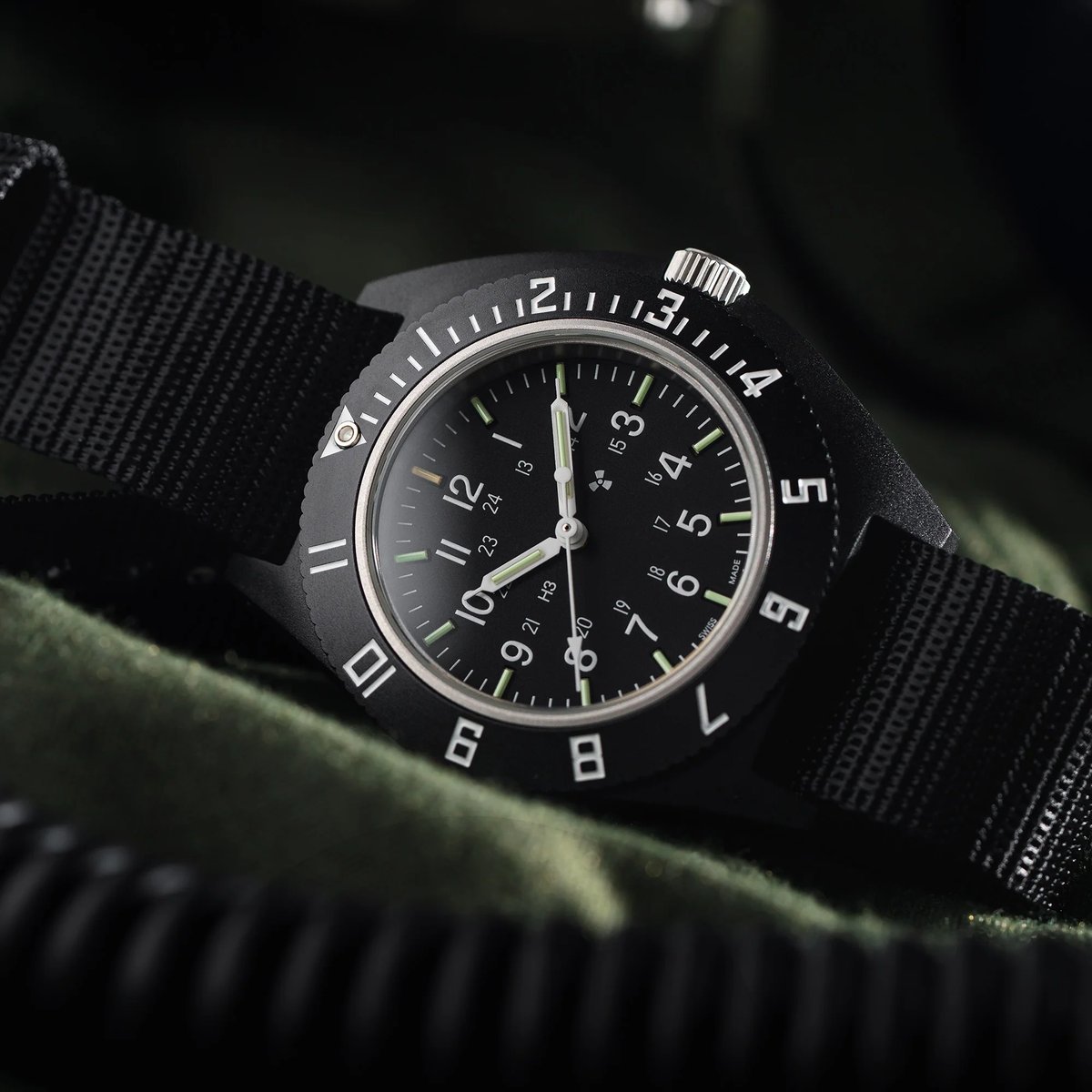
The most striking feature of the SSNAV-D is its asymmetrical case. At 41mm, it might sound large on paper, but the way it sits on the wrist is a masterclass in ergonomic design. The right side of the case extends outward to form an integrated crown guard. This isn't just an aesthetic choice; it protects the crown from being sheared off in high-intensity environments. For the daily wearer, this means no crown dig—a common complaint with larger pilot watches.
The lug-to-lug measurement is a sensible 48mm. In my week of testing, this proved to be the 'sweet spot' for my 6.5-inch wrist. The lugs curve downward sharply, hugging the wrist and preventing the watch from feeling like a flat slab of steel. The thickness—or lack thereof—is perhaps the most impressive feat. At just 11mm, the Navigator is thinner than most modern divers and even many 'dressy' chronographs. It slides under a button-down cuff with an ease that belies its rugged exterior.
The finish is a uniform bead-blasted matte. There are no polished surfaces here to catch the light or attract unwanted attention. This is a stealthy watch, designed to be non-reflective. While some might miss the flash of a polished chamfer, the matte finish is entirely consistent with the watch’s identity as a tool. It feels industrial, purposeful, and incredibly durable.
The Movement: PreciDrive and HeavyDrive
Purists often turn their noses up at quartz, but to do so here would be a grave mistake. The ETA F06.412 inside the SSNAV-D is not your standard $10 drugstore movement. This is a High-Accuracy Quartz (HAQ) movement featuring ETA’s PreciDrive and HeavyDrive technologies. PreciDrive uses thermocompensation to adjust the quartz crystal's frequency based on temperature changes, resulting in an accuracy of ±10 seconds per year.
HeavyDrive, on the other hand, is an integrated circuit that detects impacts and provides a counter-force to prevent the hands from jumping or skipping. During my week of wear, which included a particularly bumpy mountain bike trail and a session at the local firing range, the hands never once deviated. For a daily wearer, this level of 'set it and forget it' reliability is a luxury in itself. You never have to worry about winding it, setting the time, or whether it can survive your lifestyle.
Legibility and the Tritium Glow
Legibility is the primary directive of any pilot's watch, and Marathon excels here through the use of Gaseous Tritium Light Sources (GTLS). Unlike Super-LumiNova, which requires a light source to 'charge' and fades over several hours, Tritium tubes glow constantly for up to 25 years. They are self-powered, using the radioactive decay of tritium gas to excite a phosphor coating inside the glass tubes.
In total darkness, the Navigator is a beacon. The tubes are placed at each hour marker and on the hands. Marathon uses orange tritium at the 12 o'clock position and green for the remaining markers, allowing for instant orientation in the dark. During a late-night flight back to Toronto, the constant, steady glow of the dial was a comforting presence. It doesn't scream at you like a freshly charged Seiko diver; it provides a consistent, legible hum of light that is perfectly balanced for night-adjusted vision.
The dial itself is a deep matte black, providing maximum contrast for the white Arabic numerals. The 24-hour scale is printed on the inner ring, a nod to its military roots. The date window at 4:30 is polarizing for some, but I found it to be unobtrusive. The date wheel is black with white numerals, blending into the dial and only revealing itself when you specifically look for it.
The Bezel: Bi-Directional Utility
The bezel on the Navigator is a 12-hour GMT scale, allowing the wearer to track a second time zone with ease. Unlike a diver's bezel, which is uni-directional for safety, the Navigator's bezel is bi-directional. This makes it much faster to adjust when traveling between time zones. The action is firm, with 60 distinct clicks that feel more like a mechanical tool than a piece of jewelry.
I used the bezel to track GMT while coordinating with our European office. It is a simple, elegant solution that avoids the complexity of a fourth hand on the dial. The bezel is made of the same bead-blasted steel as the case, with recessed markings that are filled with black paint. It is easy to grip, even with gloves on, thanks to the deep scalloping around the edge.
A Week on the Wrist: Real-World Comfort
Living with the SSNAV-D for a week changed my perspective on what a 'luxury' tool watch should be. Usually, I rotate between several pieces, but the Marathon stayed on my wrist for seven days straight. On Monday, it sat under a blazer during a board meeting. Its matte finish and slim profile made it look like a deliberate, understated choice rather than a loud statement piece.
By Wednesday, I was hiking in the rain. The 100m water resistance and the secure NATO strap meant I never had to worry about the elements. One thing to note: the SSNAV-D features fixed spring bars. This is a traditional military feature designed to ensure the watch cannot be pulled off the wrist if a spring bar fails. While this means you are limited to pass-through straps (NATO, Zulu, or Erika’s Original), it adds a level of security that is rare in modern watches. The included Defstan nylon strap is of high quality, with sturdy hardware that matches the case finish.
The comfort of the NATO strap, combined with the watch's 11mm height, meant I often forgot I was wearing it. There is no 'top-heavy' sensation. It feels like an extension of the arm. For someone who spends their day moving between a desk, a gym, and social events, this versatility is the Navigator's greatest strength.
Investment Value and the Market Context
At an MSRP of $830, the Marathon Steel Navigator occupies a unique space in the market. It is more expensive than your average Hamilton or Seiko, but it offers a level of movement technology and specialized illumination that those brands don't provide at this price point. From an investment perspective, Marathon watches are known for their 'slow and steady' value retention. They are popular with a dedicated niche of military enthusiasts and tool watch purists.
You aren't buying this watch to flip it for a profit at an auction house. You are buying it because it is a piece of genuine equipment that will likely outlast its owner. In an era of planned obsolescence, there is something deeply satisfying about a watch that is built to a government specification and designed to be serviced rather than replaced.
Final Thoughts: The Vivir Verdict
The Marathon Steel Navigator (WW194013BK-0101) is a watch that demands respect through its performance rather than its price tag. It is a masterclass in 'form follows function.' Every design choice—the asymmetrical case, the tritium tubes, the high-torque quartz movement—is there for a reason. It doesn't pretend to be anything other than a navigator’s tool.
For the young collector who wants to move beyond the 'standard' recommendations and own something with real-world grit and Swiss precision, the SSNAV-D is an easy recommendation. It is comfortable, incredibly accurate, and possesses a heritage that most luxury brands would kill for. It survives a real week on the wrist not by being flashy, but by being indispensable.