Introduction
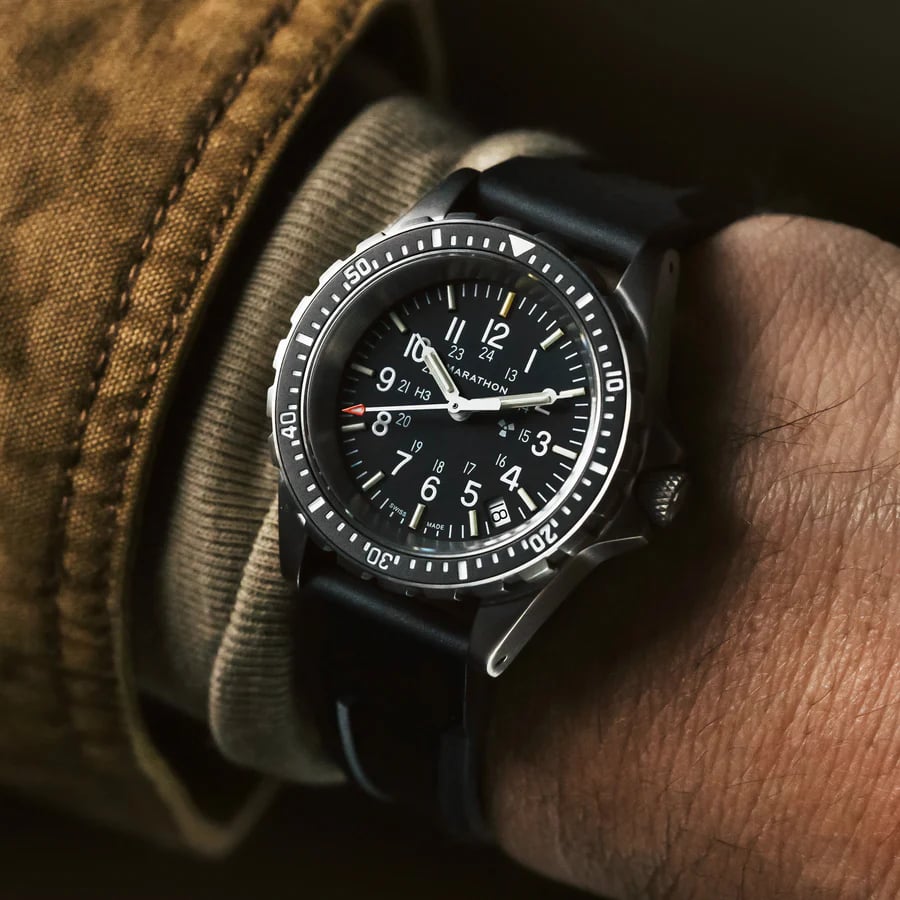
In an era where dive watches habitually balloon past 42mm, the Marathon MSAR (ref. WW194026) stands as a quiet rebuttal. At just 36mm in diameter, this medium-sized automatic diver is purpose-built for the wrist of a soldier, a pilot, or anyone who values function over fashion. But don't let its modest dimensions fool you: the MSAR is a serious instrument, one that has earned its place in the kit of Canadian and allied military personnel for decades.
Marathon, a Canadian brand with roots in government and military contracts, has long been the go-to for rugged, no-nonsense timepieces. The MSAR — short for Medium Search and Rescue — is the smaller sibling of the GSAR (General Search and Rescue) and shares the same DNA: a high-contrast dial, tritium gas tubes for 24/7 illumination, and a case that can handle 200 meters of water pressure. It is a watch that prioritizes legibility and reliability above all else.
For the sophisticated young collector, the MSAR offers something increasingly rare: a genuine tool watch that doesn't scream for attention. It wears like a vintage Submariner but with modern materials and a movement that can be serviced by any competent watchmaker. This review dives deep into the movement, the build, the wrist feel, and the investment case for this under-the-radar icon.
Manufacture History
Marathon Watch Company was founded in 1939 in La Chaux-de-Fonds, Switzerland, but moved its headquarters to Canada in the 1970s. The brand is best known for supplying rugged, military-specification watches to NATO forces, including the Canadian Armed Forces and the US Marine Corps. The MSAR is part of Marathon's Search and Rescue line, designed for extreme legibility and durability.
Movement
The MSAR is powered by the ETA 2824-2, a Swiss automatic caliber that has been the backbone of the industry for decades. It beats at 28,800 vph, offers 25 jewels, and a power reserve of approximately 38 hours. While not COSC-certified, Marathon regulates each movement to its own standards, typically achieving -10/+20 seconds per day. The movement is not in-house, but that is a strength: parts are abundant, and any competent watchmaker can service it. The finishing is industrial — signed rotor, basic perlage — but entirely appropriate for a tool watch.
Specifications
- Case Diameter: 36mm
- Case Thickness: 12.5mm
- Lug-to-Lug: 44mm
- Case Material: 316L stainless steel
- Crystal: Sapphire (flat, with anti-reflective coating)
- Water Resistance: 200 meters
- Lume: Tritium gas tubes (GTLS) on hands, hour markers, and bezel pip
- Bracelet/Strap: Rubber strap with signed pin buckle
- Clasp: Pin buckle
Wrist Feel
On the wrist, the MSAR is a revelation for those accustomed to modern dive watches. The 36mm case sits flat and low, hugging the wrist without any overhang. The 44mm lug-to-lug ensures it wears larger than its diameter suggests, but it never feels bulky. The rubber strap is supple and conforms immediately, though some may prefer a NATO for a more secure fit. At roughly 80 grams on the rubber, it disappears under a cuff — a rare feat for a 200m diver.
The crown is signed and easy to grip, though it is not screw-down (it uses a push-pull design with a gasket system). This is a deliberate choice for quick setting in the field. The bezel is unidirectional with a 60-minute insert, offering crisp, positive clicks. Overall, the MSAR feels like a tool that was designed by people who actually wear watches in harsh conditions — not by a marketing department.
Accuracy
The ETA 2824-2 in the MSAR is typically regulated to within -10/+20 seconds per day, but many examples run within -5/+10 seconds. In real-world use, expect around +5 to +10 seconds per day. The movement is robust and holds its rate well, even with moderate activity. For a non-COSC military watch, this is entirely acceptable and in line with the brand's philosophy of reliability over precision theater.
Occasions
The MSAR is a versatile tool watch. It excels in sport and daily wear, and is a natural travel companion thanks to its 200m water resistance and tritium lume. It is not a dress watch, but its compact size allows it to pair with a blazer if the occasion calls for it. It is equally at home on a dive boat, a hiking trail, or a casual office.
Wrist Presence
3/5 — The MSAR is understated and compact. It does not demand attention, but those who know will recognize its military pedigree. On a NATO strap, it has a rugged charm; on rubber, it is purely utilitarian.
Reference Variants
- WW194026 — Black dial, white markings, rubber strap. The standard MSAR.
- WW194027 — White dial, black markings, rubber strap. Often called the 'Arctic' variant.
- WW194028 — Black dial with orange minute hand, limited edition.
Family References
The MSAR is part of Marathon's Search and Rescue line. Siblings include the GSAR (41mm, ref. WW194001), the JSAR (46mm, ref. WW194003), and the TSAR (36mm quartz, ref. WW194005).
Other Notable Marathon Models
Marathon also produces the General Purpose (GP) field watch, the Navigator (pilot's watch), and the Arctic (white dial variant of the GP).
Similar Watches
- Rolex Submariner 14060 — Similar 40mm case size and tool-watch ethos, but the MSAR is smaller and more affordable.
- Tudor Black Bay 36 — Another 36mm diver with a clean dial and robust movement, though with Super-LumiNova instead of tritium.
- Seiko Prospex SPB155 — A 38mm diver with a similar compact profile, but with a 6R35 movement and a more modern design.
Homages
- Steeldive SD1970 — $120. A 42mm homage to the Marathon MSAR with a Seiko NH35 movement, but lacks tritium and military spec.
- Addiesdive AD2023 — $80. A budget-friendly 36mm diver with a similar dial layout, but uses mineral crystal and quartz movement.
Investment Value
MSRP: $850
Current Retail: $850
Pre-Owned Range: $600–$750
Trend: Stable
Hold Recommendation: The MSAR is not a speculative investment, but it holds its value well due to its military heritage and limited production. Buy it to wear, not to flip.
Auction History: No major auction history. Pre-owned prices remain consistent on forums and secondary markets.
Service Interval
Every 5 years. Approximate cost: $350. Authorized service not required; any watchmaker can service the ETA 2824-2. Marathon also offers factory service for around $400.
Pros and Cons
Pros
- Tritium gas tubes provide constant, no-charge lume for 10+ years
- Compact 36mm case fits most wrists and slips under a cuff
- Proven ETA 2824-2 movement is easy and cheap to service
- 200m water resistance with a push-pull crown (field-friendly)
- Military heritage and genuine NATO contract history
Cons
- Acrylic crystal on some variants (sapphire is optional, but standard on WW194026)
- No screw-down crown may concern some divers (though gasket system is proven)
- Rubber strap is functional but not luxurious
- Movement is not COSC-certified and accuracy can vary
- Limited availability outside of Marathon's direct sales and select dealers
Final Verdict
The Marathon MSAR is a masterclass in purposeful design. It sacrifices nothing in capability while offering a wrist presence that is both discreet and authoritative. For the collector who values authenticity over hype, this is a watch that will never feel out of place — whether in the field or at a casual dinner. It is not a status symbol; it is a tool, and a damn good one at that.