By Rina Park
Some watches are built to be admired. The Marathon OSAR is built to be relied on. Its reference number, 6645-21-588-0133, is not a boutique code; it is a NATO Stock Number, the kind of identifier that tells you this watch was procured for people who do not have time for fragile things. The OSAR, or Original Search and Rescue, is a quartz diver with tritium gas tubes, a stainless steel case, and a 300m water resistance rating. It is the sort of watch that looks better with a scratch than with a polish.
Marathon has always been a military-first brand. The OSAR sits in a family of Search and Rescue watches that includes the GSAR, TSAR, MSAR, and JSAR, but it has its own character. This is not a desk diver pretending to be a field tool. It is a field tool that happens to work as a daily watch. For young collectors who have spent the last few years chasing integrated bracelets and pastel dials, the OSAR is a useful corrective. It asks a simple question: would you trust this watch when the stakes are real?
The answer, for the right wearer, is yes. The OSAR is not luxurious in the conventional sense. It does not have a hand-finished movement or a dial that changes color in candlelight. What it has is clarity. The dial is black, the markers are bold, the date display is useful, and the tritium tubes glow without needing a charge. It is a watch for search and rescue swimmers, military divers, and collectors who prefer a tool with a paper trail to a hype piece with a waitlist.
Brand History: Military First, Civilian Second
Marathon Watch Company was founded in 1939 in Canada, and its early reputation was built on supplying Allied forces during the Second World War. That military relationship never really ended. Marathon has continued to produce watches for armed forces, law enforcement, and search and rescue teams, often with NSN markings that connect a specific watch to a specific procurement stream. The OSAR is part of that lineage. It is not a fashion watch that borrowed a military aesthetic. It is a military watch that became available to civilians.
The Search and Rescue family is central to Marathon's identity. The GSAR is the automatic Government Search and Rescue model, the TSAR is the tritium Search and Rescue quartz model, and the OSAR is the Original Search and Rescue. The naming is utilitarian, almost stubbornly so. There is no attempt to create a romantic story about alpine adventures or naval heroics. The story is in the specification: tritium illumination, sapphire crystal, 300m water resistance, and a movement that can be serviced without drama. That is the Marathon way.
For collectors, the NSN is the interesting part. The number 6645-21-588-0133 identifies this watch as a piece of military supply chain history. The 21 country code points to Canada, which makes sense for a Canadian company with deep ties to the Canadian Forces. The OSAR is not a limited edition or a boutique exclusive. It is a tool that was ordered in numbers, and that is precisely why it has credibility.
Movement: Swiss Quartz With a Job to Do
The OSAR runs on an ETA F06.161 quartz movement. This is not a movement that invites poetry. It is a Swiss quartz caliber with a date display, three jewels, and a frequency of 32,768 Hz. It is designed to be accurate, reliable, and easy to service. The battery life is approximately four years, which means the OSAR is the kind of watch you can pick up after a week in a drawer and trust to be running. There is no winding, no setting ritual, and no power reserve anxiety. You set it, wear it, and replace the battery when it stops.
For some collectors, quartz is a dealbreaker. That is understandable. Mechanical watches have a romance that quartz cannot match. But the OSAR is not trying to compete in that arena. The quartz movement is part of the watch's identity. It is there because search and rescue teams need a watch that works, not a watch that needs to be wound. The ETA F06.161 is a proven caliber, and its presence keeps the OSAR affordable and robust. The movement is not COSC-certified, and it is not in-house, but those facts matter less than the watch's overall reliability.
The date display is a practical addition. It sits on the dial without overwhelming it, and it is useful for anyone who wears the same watch every day. The OSAR is not a minimalist dress watch, so the date does not feel like clutter. It feels like part of the tool. The movement's finishing is industrial, which is exactly what you would expect. There is no exhibition caseback, no decorated bridges, and no attempt to make the quartz caliber look like something it is not. The OSAR is honest about what it is.
Case, Crystal, and Water Resistance
The OSAR uses a stainless steel case with a 41mm diameter. That is a sensible size for a military dive watch. It is large enough to be legible, but not so large that it becomes a liability on a smaller wrist. The case is paired with a sapphire crystal, which is a significant upgrade over acrylic or mineral glass. Sapphire is scratch-resistant and clear, and it suits the OSAR's role as a watch that is meant to be worn hard. The water resistance is rated to 300m, which is more than most owners will ever need, but that is the point. The OSAR is built to a standard, not to a lifestyle.
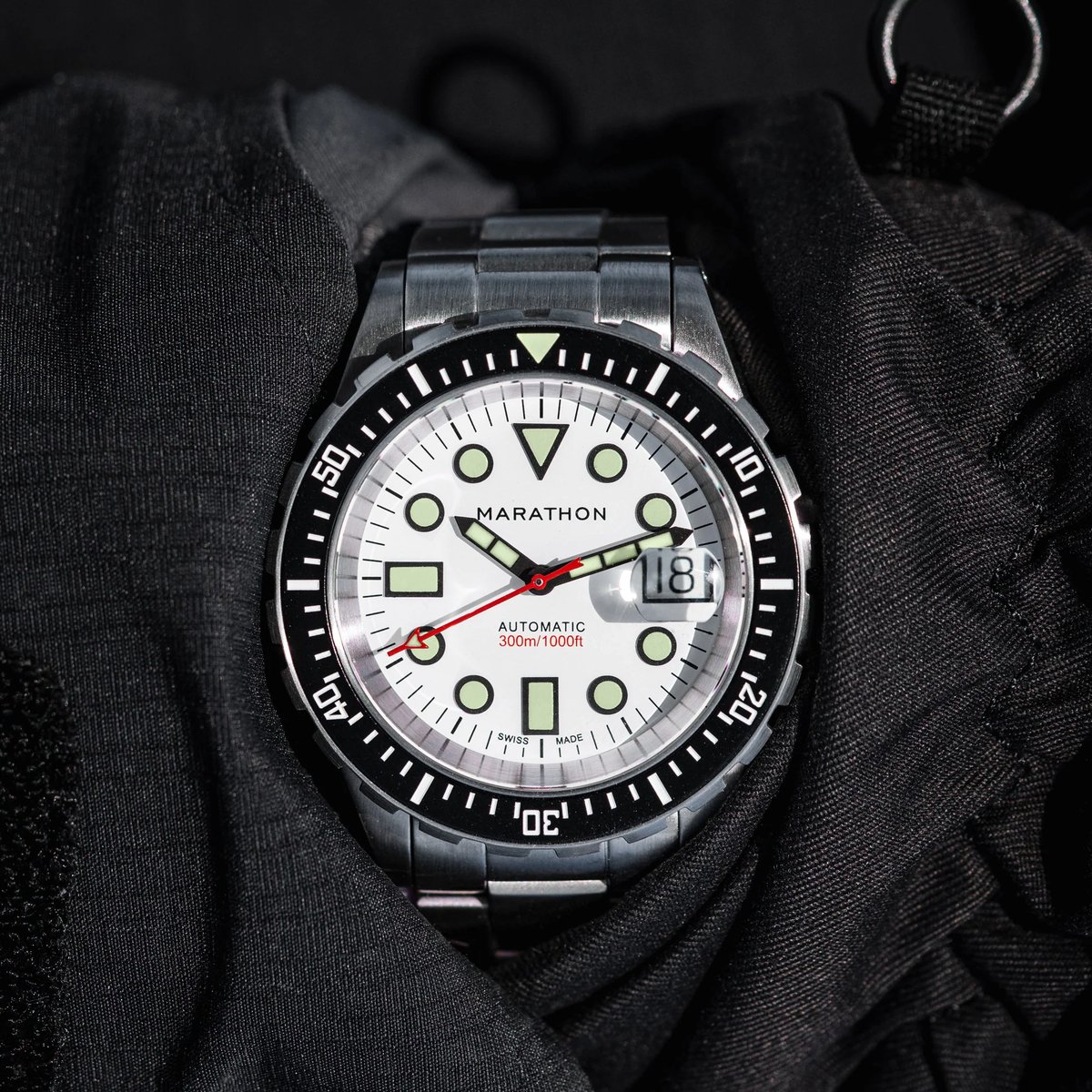
The dial is black and highly legible. The markers are bold, and the hands are easy to read at a glance. The tritium gas tubes are the standout feature. Unlike Super-LumiNova, tritium does not need to be charged by light. It glows continuously, although the brightness fades over the years. For a search and rescue watch, that is a crucial advantage. You do not want to be fumbling for a flashlight to charge your lume when you need to read the time in the dark. The tritium tubes provide a constant, low-level glow that is visible in low light and darkness. It is not blinding, but it is dependable.
The OSAR comes on a rubber strap with a pin buckle. The rubber strap is a practical choice for a dive watch. It is comfortable, resistant to water, and easy to clean. The pin buckle is simple and secure. There is no deployant clasp, no micro-adjustment system, and no luxury hardware. That is consistent with the OSAR's purpose. The strap is there to hold the watch on your wrist, not to be a fashion statement. If you want a bracelet, there are aftermarket options, but the rubber strap is the right starting point for a tool watch.
On the Wrist
On the wrist, the 41mm stainless steel case reads as a tool watch. It has a solid presence without feeling oversized. The rubber strap keeps the watch planted, and the case sits comfortably on the wrist. The OSAR is not a featherweight, but it is not a brick either. The quartz movement keeps the case relatively slim compared to some automatic divers, and the rubber strap helps balance the weight. It is the kind of watch you can wear all day without thinking about it, which is exactly what you want from a daily tool.
The legibility is excellent. The black dial and bold markers make the time easy to read in almost any light. The tritium tubes are a joy in a dark room or a movie theater. They are not as bright as a freshly charged Super-LumiNova dial, but they are always on. That constant glow is one of the OSAR's defining characteristics. It makes the watch feel alive, even when it is sitting on a nightstand. The date display is also useful, although it is not the centerpiece of the dial. The overall impression is one of competence. The OSAR does not try to be elegant. It tries to be clear, and it succeeds.
The wrist presence is strong but not loud. This is not a watch that announces itself across a room. It is a watch that rewards a closer look. The NSN markings, the tritium tubes, and the utilitarian dial all signal that this is a serious piece of kit. For collectors who appreciate military watches, the OSAR has a quiet authority. It does not need a limited edition number or a celebrity endorsement. The provenance is built into the reference number.
Accuracy and Daily Use
Quartz accuracy is the OSAR's quiet superpower. You can expect it to run within a few seconds per month under normal conditions. It is not a thermo-compensated quartz movement, so extreme temperatures may affect it slightly, but for everyday wear it is extremely reliable. You do not need to worry about positional variation, magnetic fields, or power reserve. You just wear it. That simplicity is a large part of the OSAR's appeal. It is a watch for people who want to know the time, not for people who want to obsess over the rate.
The OSAR is also easy to live with. The sapphire crystal resists scratches, the 300m water resistance means you can swim and shower without concern, and the rubber strap is comfortable in heat and water. The date display is useful for daily planning, and the tritium tubes are always ready. The only real maintenance is battery replacement, which is straightforward. The OSAR is not a watch that demands attention. It is a watch that earns trust through consistency.
For travel, the OSAR is a solid companion. It is robust, legible, and water-resistant. It does not have a GMT complication, so you will need to adjust the time when you change time zones, but that is a minor inconvenience. The quartz movement is not affected by the bumps and jolts of travel, and the sapphire crystal can handle the inside of a carry-on bag. The OSAR is not a luxury travel watch, but it is a reliable one. It is the kind of watch you can throw in a bag and forget about until you need it.
Who It Suits
The OSAR suits people who value function over form. It is a natural choice for military and law enforcement personnel, search and rescue teams, divers, and outdoor professionals. It also suits collectors who want a military watch with genuine provenance. The OSAR is not for everyone. If you want a watch with a hand-finished movement, an exhibition caseback, and a dial that shifts from green to blue, the OSAR will disappoint you. But if you want a watch that works, the OSAR is hard to beat.
It is also a good entry point for young collectors who are curious about military watches. The OSAR is affordable compared to many Swiss dive watches, and it has a clear identity. It is not a generic field watch with a military label. It is a real tool with an NSN. That matters to collectors who care about authenticity. The OSAR is a watch you can wear to the office, to the gym, and to the water. It is not a formal watch, but it can pass in casual settings. It is at its best in a t-shirt and jeans, or in a wetsuit.
Alternatives and Homages
If you are considering the OSAR, you should also look at the CWC SBS Diver. It is a British military quartz diver with a similar no-nonsense approach. The Luminox Navy SEAL 3001 is another tritium-lit tactical quartz watch, although it has a different design language. The Seiko Prospex SNE573 is a solar quartz dive watch with a compact case and a strong everyday appeal. Each of these watches offers a different take on the military diver formula, but the OSAR stands out for its Canadian Forces NSN and its Marathon-specific design.
For budget-conscious buyers, there are homages and spiritual cousins. The Luminox Navy SEAL 3001 offers tritium illumination and a tactical look for less money. The Bertucci A-2T Original Field is a simple, rugged quartz field watch that captures the utilitarian spirit without the dive watch specifications. These are not exact copies of the OSAR, but they appeal to the same instinct. If you want the real thing, the OSAR is worth the extra money. If you just want the look, there are cheaper options.
Value and Investment
The OSAR is not an investment watch in the traditional sense. It does not have the auction history of a Rolex or a Patek Philippe. It is not a limited edition, and it is not likely to appreciate in value. That is not a criticism. The OSAR is a tool watch, and its value comes from utility and provenance. The current retail price is around $780, and pre-owned examples typically trade between $450 and $650. The trend is stable. If you buy one, you should buy it to wear, not to flip.
That said, the OSAR holds value reasonably well for a quartz military watch. The NSN provenance and the Marathon name give it a dedicated following. Military watch collectors appreciate the OSAR for what it is, and that support keeps prices from collapsing. If you find one in good condition at a fair price, it is a solid purchase. Just do not expect it to fund your next grail watch. The OSAR is a watch for using, not for storing in a safe.
Service and Ownership
Service on the OSAR is straightforward. The quartz movement is reliable, and battery replacement is a simple job for a qualified watchmaker. Marathon and its authorized service partners can handle more extensive work if needed. The sapphire crystal and stainless steel case are durable, so you are unlikely to need major repairs unless you subject the watch to serious abuse. The rubber strap can be replaced easily if it wears out. Overall, the OSAR is a low-maintenance watch. That is part of its appeal. It is a tool that is designed to be used, not coddled.
Final Verdict
The Marathon OSAR is a military quartz diver with a clear purpose. It is not luxurious, and it does not try to be. It is accurate, legible, water-resistant, and equipped with tritium gas tubes that glow without a charge. The NSN reference number gives it a provenance that most watches cannot match. If you want a watch with mechanical romance, look elsewhere. If you want a watch that works, the OSAR is an excellent choice. It is a tool watch in the best sense of the term: honest, capable, and ready for whatever you throw at it.