Marathon SAR WW194006BK Review: A Search-and-Rescue Automatic With No Decorative Excess
There are tool watches that gesture toward military service and tool watches that come from it. The Marathon SAR belongs to the second group. Reference WW194006BK is a black-dial, rubber-strap version of Marathon's Search and Rescue automatic, a watch designed around legibility, durability, and the kind of unglamorous reliability that matters when a watch is part of a kit rather than a collection. It is not delicate, not precious, and not trying to be a dress watch. That is precisely the point.
In a market crowded with vintage-inspired divers and luxury sports watches, the SAR takes a different route. Its case is stainless steel, its crystal is sapphire, its water resistance is rated to 300 meters, and its dial is illuminated by tritium gas tubes rather than a conventional luminous paint. The result is a watch that reads like equipment: purposeful, legible, and honest about its materials. For young collectors who care about movement architecture and finishing detail without wanting a safe queen, the SAR is a useful counterpoint to the polished everyday diver.
This review covers the WW194006BK reference specifically: black dial, black rubber strap, pin buckle, and the standard SAR automatic platform. Where production has varied between ETA and Sellita movements, that variation is noted rather than hidden. The goal is not to turn a military-derived watch into a luxury object. It is to assess whether the SAR's engineering, wearability, and value make sense for a discerning collector who wants a watch with a clear job.
Manufacture history: Marathon Watch Company
Marathon Watch Company was founded in 1939 in Montreal, Canada, and has built its reputation as a supplier of watches and timing instruments to military, government, and professional users. That history matters for the SAR. This is not a fashion diver with a military-inspired story added by a marketing department. Marathon's catalog has long been shaped by government contracts, field use, and the practical requirements of people who need a watch to work in bad conditions.
The SAR, or Search and Rescue, sits within that lineage. It is related to Marathon's GSAR, TSAR, and other government-oriented dive watches, and it shares their core priorities: a robust case, a highly legible dial, a rotating dive bezel, and illumination that does not depend on charging with light. The WW194006BK is one expression of that formula, pairing the black dial with a black rubber strap for a purely functional presentation.
Case, dial, and design
The SAR uses a 41mm stainless-steel case, a size that keeps it firmly in tool-watch territory without becoming a novelty. The design is compact in intent but substantial in feel. A protected crown, a prominent bezel, and a dial that prioritizes contrast over decoration define the watch. The case is not trying to be slim or jewel-like. It is built around a screw-down crown, a sapphire crystal, and a 300-meter water-resistance rating, all of which signal that the SAR is meant to be used.
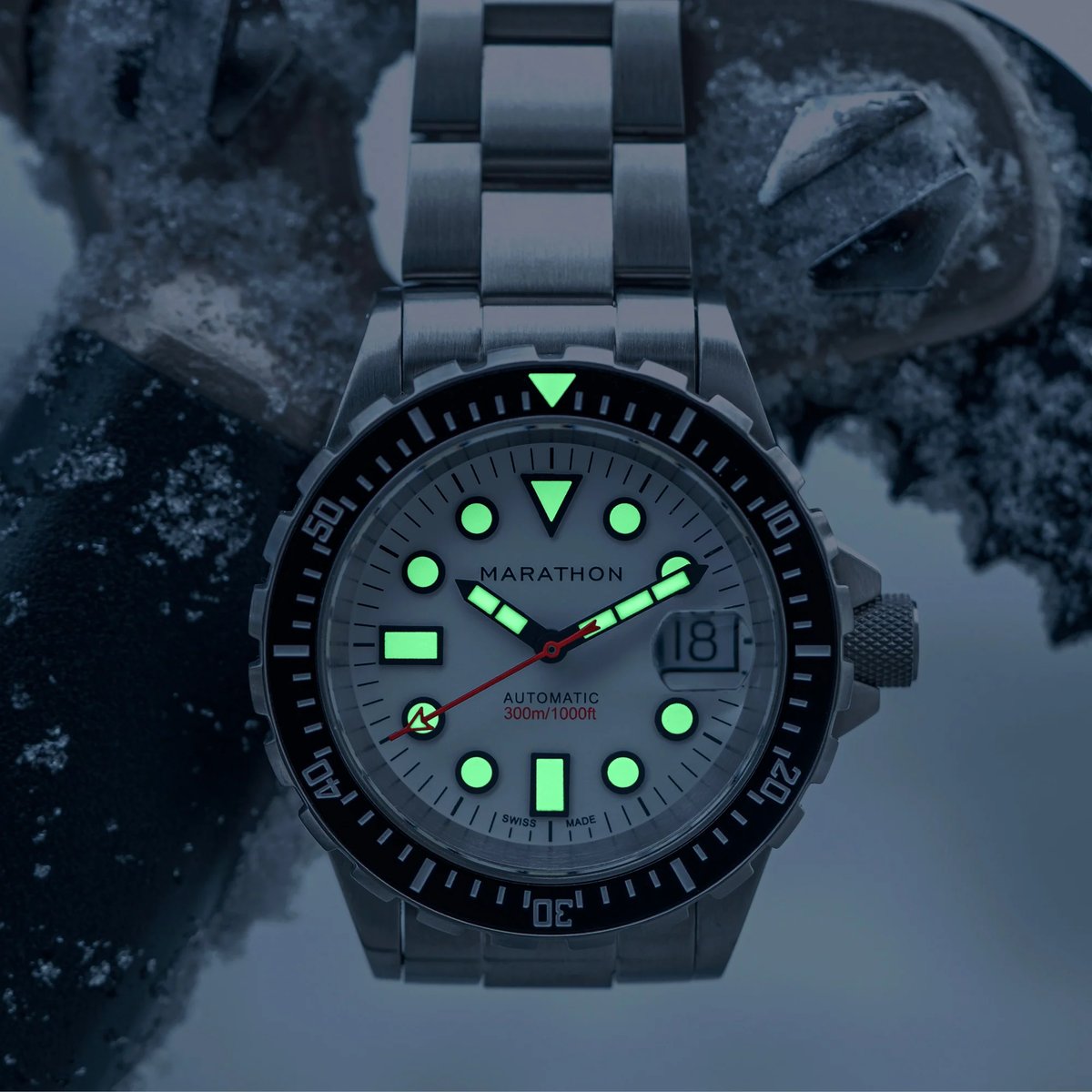
The black dial is the center of the design. Marathon uses tritium gas tubes for the hour markers and hands, which gives the SAR a different kind of presence from a conventional Super-LumiNova dial. The tubes are always active, though their brightness fades over time as the tritium half-life takes its course. In practice, this means the SAR is exceptionally legible in low light without needing a light charge. The trade-off is that tritium has a finite service life, and collectors should understand that the illumination is a consumable component rather than a permanent feature.
The bezel is a dive-style rotating bezel with clear markings, and the date window is integrated into the dial without disrupting the overall legibility. The black dial and black rubber strap of the WW194006BK make the watch look purposeful rather than flashy. There is no unnecessary polishing, no decorative text, and no attempt to soften the military DNA. The SAR looks like what it is: a search-and-rescue tool watch with a Swiss automatic movement inside.
The finishing is brushed and utilitarian. The case sides and lugs are designed for durability rather than sparkle, and the bezel insert is meant to be read rather than admired. The crown is protected by guards, and the overall geometry is built around impact resistance and water sealing. This is not a watch that invites close-up admiration of polished bevels. It invites use. The sapphire crystal is a practical choice for a tool watch, and the dial's high contrast is the main visual event. The date window is small and unobtrusive, which is the right call for a watch like this.
The rubber strap deserves mention because it defines the WW194006BK reference. It is not a luxury integrated bracelet, and it does not try to be. It is a functional rubber strap with a pin buckle, comfortable in heat and water, and easy to replace. For collectors who prefer metal, the bracelet version of the same family is the obvious alternative, but the rubber strap makes the SAR feel more like a piece of field equipment. It also keeps the weight manageable and the watch secure during activity.
Movement and architecture
The SAR is powered by a Swiss automatic movement from the ETA 2824-2 family, with later production using Sellita SW200-1 equivalents. Both are proven workhorse calibers with a long service history, widely understood by watchmakers, and well supported by parts networks. The movement runs at 28,800 vibrations per hour and offers roughly 38 to 40 hours of power reserve. It is not chronometer-certified, and it is not an in-house caliber. That is not a weakness in this context. The SAR is a tool watch, and the ETA/Sellita base is chosen for reliability and serviceability rather than exclusivity.
Architecturally, the movement is conventional in the best sense: a compact automatic winding system, a quick-set date, hacking seconds, and a robust gear train. Finishing is industrial rather than decorative. There is no hand-bevelled bridge work or elaborate anglage to admire through a display back, and the SAR does not pretend otherwise. The watch is built to be sealed, worn, and serviced. For a collector who values movement architecture, the interest lies in the movement's reputation and its role in the watch's durability, not in decorative finishing.
One of the advantages of the ETA/Sellita base is that it is a known quantity. A watchmaker can regulate it, service it, and source parts without the complications of an in-house caliber. For a tool watch, that is a feature. The SAR is not trying to be a collector's movement showcase. It is trying to be a reliable automatic that can be maintained over years of use. The quick-set date and hacking seconds are practical details that make daily ownership easier, and the automatic winding system is efficient enough for regular wear.
Wrist feel and wearability
On the wrist, the SAR feels like a tool watch first. The 41mm case has deliberate mass, and the rubber strap keeps the watch stable during movement. It is not a slim dress diver, and it does not try to disappear under a cuff. The crown is protected, the bezel is easy to grip, and the dial remains readable at a glance. The rubber strap suits the watch's purpose: it is comfortable, secure, and easy to clean, which matters for a dive watch that may see salt water, sweat, and outdoor use.
The balance of the watch is functional rather than elegant. The SAR sits with a sense of purpose, and its presence is noticeable without being ostentatious. It is the kind of watch that works with a t-shirt, a field jacket, or casual workwear, and it looks slightly out of place with formal tailoring. That is not a flaw. The SAR is designed for search-and-rescue use, and its wrist feel reflects that brief. For collectors who want a watch that feels engineered rather than styled, the SAR delivers.
Accuracy and daily performance
The SAR is not a chronometer, so owners should expect real-world accuracy in the range typical of a well-regulated ETA 2824-2 or Sellita SW200-1. Many examples will run within tens of seconds per day, and regulation can improve performance if desired. The movement is robust and easy to service, and its accuracy is consistent with its tool-watch role. This is not a watch for someone who needs certified precision or a guarantee of daily rate. It is a watch for someone who values reliability, legibility, and a proven mechanical platform.
In daily use, the SAR is easy to live with. The date function is useful, the bezel can be used for timing, and the tritium illumination is a genuine practical advantage in low light. The watch does not require careful handling, and its 300-meter water resistance gives confidence around water. The main caveat is the tritium tubes: they will eventually dim, and replacement or reluming is a consideration for long-term ownership. That is part of the trade-off for always-on illumination.
Owners should also consider how the watch is worn. The SAR is not a delicate office watch, and its accuracy will be influenced by activity, temperature, and position. A watch that is worn during outdoor activity may run slightly differently from one that sits on a desk. The movement is robust enough to handle normal use, but it is not shock-proof in the way a dedicated sports chronograph might be. The SAR's accuracy story is one of consistency rather than precision. That is appropriate for its role.
Occasions and wrist presence
The SAR is best suited to sport, daily wear, and travel. It is at home on a hike, in the water, or on a casual weekend, and it works as a robust everyday watch for someone who does not need a dress piece. It is not a formal watch, and it does not pretend to be. Its wrist presence is strong: 4/5. The SAR looks substantial and purposeful on the wrist, with a clear tool-watch identity that is immediately readable. It is not flashy, but it is noticeable in the way a well-designed piece of equipment is noticeable.
Reference variants and family context
The WW194006BK is the black-dial SAR on a black rubber strap. A bracelet version has been offered within the same GSAR/SAR family, often catalogued under a different suffix, and collectors should verify the exact reference with the dealer if bracelet configuration matters. The broader family includes the GSAR, TSAR, and JSAR, all of which share the search-and-rescue brief and the same general design language. These are not fashion variants; they are different expressions of a military-derived dive watch formula.
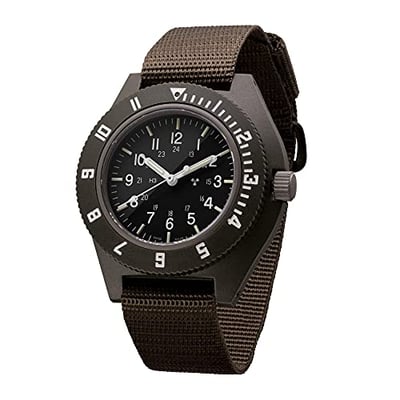
Within Marathon's catalog, the SAR sits alongside other professional-oriented models such as the Navigator, the Medium Diver, and the Arctic Edition. Each has a different role, but the common thread is legibility, durability, and a lack of decorative excess. The SAR is one of the clearest expressions of that philosophy because it combines a dive bezel, tritium illumination, and a Swiss automatic movement in a package that is meant to be worn hard.
Similar watches and alternatives
Collectors considering the SAR often look at the Sinn U1, a German dive watch with a submarine-steel case and a similarly industrial ethos. The Sinn is more expensive and more overtly engineered, but the comparison is useful because both watches prioritize function over polish. The CWC Royal Navy Diver Automatic is another natural alternative, with military-spec DNA and a comparable focus on legibility. The Seiko Prospex MarineMaster 300m is a Japanese tool diver with strong lume and a robust case, though its design language is different.
The Tudor Pelagos is another alternative for collectors who want a modern tool diver with strong water resistance and a utilitarian design, though it sits at a higher price point and has a different brand identity. The SAR's appeal is more specific: it is a military-derived search-and-rescue watch with tritium illumination and a Swiss automatic movement. That combination is relatively rare, and it gives the watch a clear place in a collection. It is not a watch for everyone, but it is a watch with a point of view.
For a lower-cost alternative, the MWC Automatic Military Diver offers a similar military-diver formula with tritium-style illumination at a fraction of the price. It is not a substitute for the Marathon's movement or build quality, but it shows how much of the SAR's appeal comes from its straightforward design rather than from luxury materials. The SAR's closest competitors are not dress divers; they are other purpose-built tool watches with clear professional intent.
Investment value and service
The SAR is not an investment piece in the speculative sense. It is a user watch, and its value comes from its utility rather than from scarcity or auction hype. Retail pricing for the WW194006BK has varied, but the model generally sits in the low four figures in US dollars. On the secondary market, examples typically trade below retail, with condition, completeness, and tritium brightness affecting the price. The trend is stable rather than appreciating. Buyers should expect modest depreciation from retail and should purchase the watch to wear, not to flip.
Service is straightforward because the movement is a known Swiss automatic. Marathon and independent watchmakers familiar with ETA/Sellita calibers can service the watch, and parts are generally available. The tritium tubes are the main long-term consideration. They are not a service item in the same way as a movement, but their brightness will decline over time. Collectors who want permanent illumination should understand this before buying. The SAR is best treated as a mechanical tool with a finite illumination lifespan, not as a watch that will look identical forever.
From a value perspective, the SAR occupies a sensible middle ground. It is more expensive than a basic Seiko diver, but it offers a Swiss automatic, tritium illumination, and a military-derived design that is difficult to replicate at a lower price. It is less expensive than luxury tool divers from Sinn, Tudor, or Omega, but it does not try to compete on finishing or brand prestige. The value proposition is clear: you are paying for a purpose-built watch with a proven movement and a strong identity. The secondary market reflects that, with prices that are reasonable for buyers who want a user watch rather than a collectible.
Final verdict
The Marathon SAR WW194006BK is a convincing tool watch because it does not apologize for what it is. It offers 300-meter water resistance, sapphire crystal, tritium illumination, a proven Swiss automatic movement, and a design that prioritizes legibility over decoration. It is not the right choice for someone who wants a slim dress diver or a luxury status object. It is the right choice for a collector who wants a genuine search-and-rescue automatic with honest engineering and a clear purpose.
At its price point, the SAR delivers real utility and a strong sense of identity. The movement is serviceable, the case is robust, and the tritium dial is genuinely useful in low light. The trade-offs are equally clear: the watch is substantial on the wrist, the rubber strap is functional rather than luxurious, and the tritium tubes will eventually dim. For a discerning young collector building a collection around purpose rather than hype, the SAR is a strong, coherent choice.