The Macro Context: The British Horological Renaissance
In the last decade, the United Kingdom has undergone a quiet revolution in watchmaking. While the Swiss giants continue to dominate the luxury stratosphere, a fleet of agile, design-focused British brands has captured the attention of the 'value-conscious' enthusiast. Marloe Watch Company stands at the vanguard of this movement. Unlike many microbrands that simply repackage vintage Rolex or Omega aesthetics, Marloe—led by designers Oliver Goffe and Gordon Fraser—has consistently pushed for an original visual vocabulary. The Aerodyne R3 is the culmination of this effort, a watch that feels less like a tool and more like an architectural study.
From a market perspective, the Aerodyne R3 occupies a 'sweet spot.' It sits above the entry-level Seiko and Orient offerings but comfortably below the $1,000 threshold where competition from brands like Sinn or Oris becomes fierce. This positioning makes it an essential case study for any analyst looking at the growth of independent horology.
Design Philosophy: Streamline Moderne
The core inspiration for the Aerodyne series is 'Streamlining'—the design movement of the 1930s that saw industrial designers like Raymond Loewy apply aerodynamic principles to everything from locomotives to pencil sharpeners. This is evident in the Aerodyne R3’s case architecture. The sides of the case are scalloped, a detail that serves two purposes: it reduces the visual weight of the 43mm diameter and it creates a play of light and shadow that mimics the fuselage of a vintage aircraft.
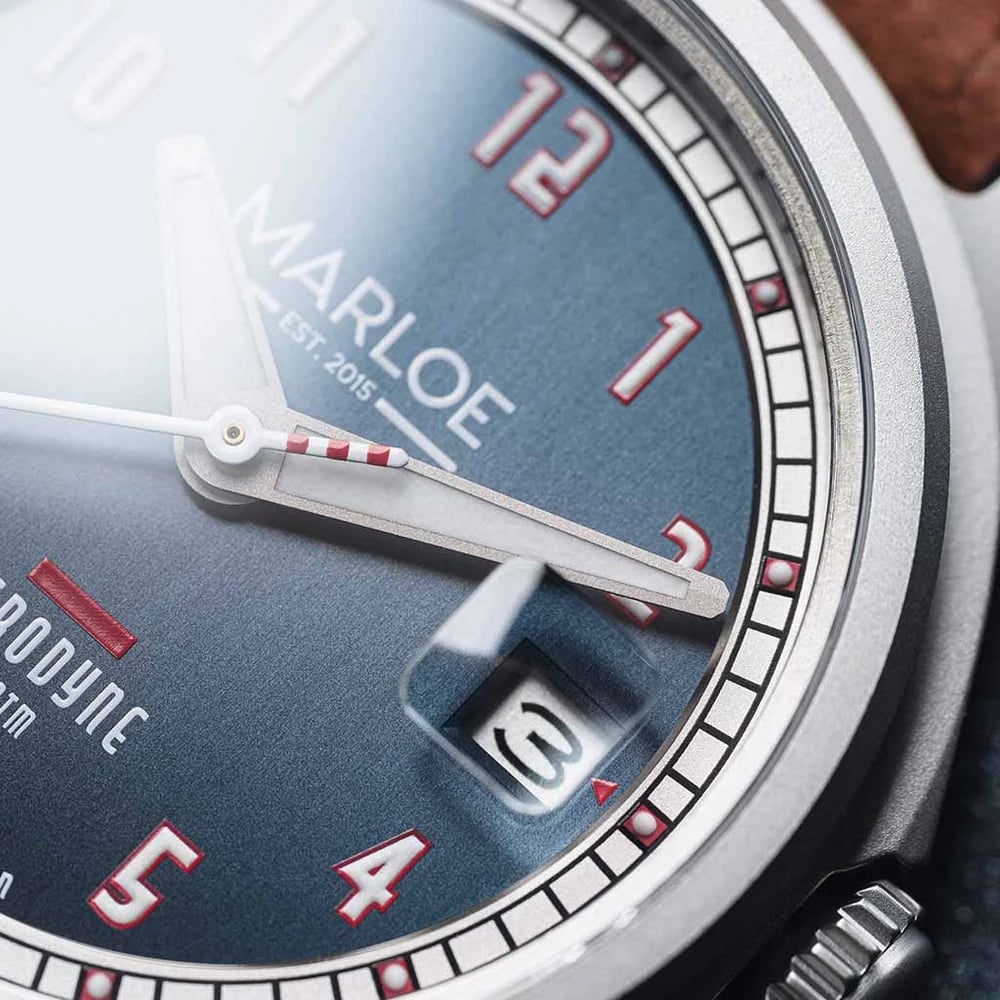
The dial of the R3 is a masterclass in depth. It utilizes a multi-layered construction, with a recessed outer track and a textured central section. This isn't just for show; the layering provides a clear hierarchical view of the time, essential for an aviation-themed watch. The R3 specifically introduces new textures and colorways—such as the 'Night' and 'Ewan'—that feel more mature and cohesive than the previous R1 and R2 iterations.
Technical Analysis: The Miyota 9039 Advantage
A watch is only as good as its heart, and the choice of the Miyota 9039 is a strategic masterstroke by Marloe. In the sub-$1,000 market, the standard choice is often the Seiko NH35 or the Miyota 8-series. However, the 9039 is a 'premium' caliber. It beats at 28,800 vibrations per hour (4Hz), providing a much smoother sweep of the seconds hand compared to the 21,600 vph of lower-tier movements.
Perhaps more importantly for the Aerodyne's aesthetic, the 9039 is a slim movement. This allowed Marloe to keep the total case thickness to just 11mm. When you consider that many automatic pilot watches exceed 13mm or 14mm, the Aerodyne's profile is a significant engineering achievement. Furthermore, the 9039 is a 'true no-date' movement. There is no phantom crown position for a date setting, which is a detail that serious collectors appreciate as it demonstrates a commitment to technical purity.
Wrist Experience and Ergonomics
Wearing the Aerodyne R3 is a surprising experience. On paper, 43mm is a large watch, often reserved for those with wrists over 7.5 inches. However, the short 48mm lug-to-lug measurement means it wears much more like a 41mm watch. The lugs curve downward aggressively, ensuring that the leather strap meets the wrist at a natural angle.
The legibility is outstanding. Marloe has utilized Super-LumiNova C3 and BGW9 across the different variants, ensuring that the watch remains functional in low-light environments. The sapphire crystal features an anti-reflective coating that is applied effectively, minimizing the glare that often plagues large-dial watches. Whether you are in a boardroom or a cockpit, the Aerodyne R3 maintains a presence that is both professional and adventurous.
Market Analysis and Investment Potential
As an investment analyst, I must be candid: microbrand watches in the $500 range are rarely 'investments' in the sense that they will triple in value at Christie's. However, 'value' is not just about appreciation; it is about capital preservation. Marloe has a very high 'sell-through' rate, and their limited edition runs often sell out quickly. On the secondary market, a well-maintained Aerodyne R3 typically retains 75-85% of its MSRP, which is significantly better than mass-market fashion watches or even some entry-level Swiss brands.
The demand cycle for Marloe is driven by a loyal community of enthusiasts who value the brand's transparency and design-first approach. For a young collector, buying an Aerodyne R3 is a 'safe' play. You are paying for the quality of the steel, the sapphire, and the movement, rather than just a marketing budget. In the long term, as the 'British Watchmaking' story continues to grow, early pieces from established leaders like Marloe may see a secondary surge in interest.
The Sterling Verdict
The Marloe Aerodyne R3 is a testament to what can be achieved when a brand stays true to its design DNA. It is a watch that balances the historical weight of aviation with the modern requirements of a daily wearer. The combination of a 4Hz movement, a slim 11mm case, and a bespoke British aesthetic makes it a formidable contender in the sub-$1,000 market.
For those looking to move beyond the ubiquitous entry-level divers and explore the world of independent horology, the Aerodyne R3 is a logical and rewarding next step. It is a watch that invites conversation, not because of its price tag, but because of its profile. In the world of luxury horology, that is perhaps the greatest value of all.