The Gealach takes Marloe's dressier Daytimer platform and hands it the one complication that traditionally lives behind a velvet rope. Moonphases have long been the horological equivalent of a corner office — you had to earn your way up to one. Longines, Frederique Constant and Jaeger-LeCoultre have all sold the dream, but always with a comma in the price. Marloe's pitch is different. Same dream, sold small-batch, sold honest, sold to the collector who reads a spec sheet before they read a press release.
That makes this an unusually interesting watch to review. Not because it will out-finish a Master Collection — it won't — but because it asks the question modern collectors keep circling: how much watch do you actually need, and how much of what you're paying for is the badge on the dial?
Marloe, in brief
Marloe Watch Company was founded in 2015 by designer Oliver Goffe and built its reputation the hard way: one small batch at a time, sold direct from the brand's base in Henley-on-Thames. There is no boutique network, no airport counter, no celebrity ambassador. Instead there is a design language — clean dials, considered typography, cases that err on the wearable side — and a naming convention that borrows from British waterways and landscapes. The Cherwell. The Derwent. The Coniston. The Lomond. The Morar.
That naming is not incidental. It positions Marloe in a specifically British tradition of watchmaking that is less about grand complications and more about taste: the idea that a watch should be a well-mannered object, designed for a life rather than a vitrine. The brand has spent a decade refining that position, and its following reflects it — these are watches bought by people who could afford more but prefer not to overpay for a logo.
The Daytimer family sits at the dressier end of the catalogue, and the Gealach is where it leans hardest into narrative. 'Gealach' is Scottish Gaelic for moon, which tells you everything you need to know about the brief before you've even seen the dial.
Reading the Gealach
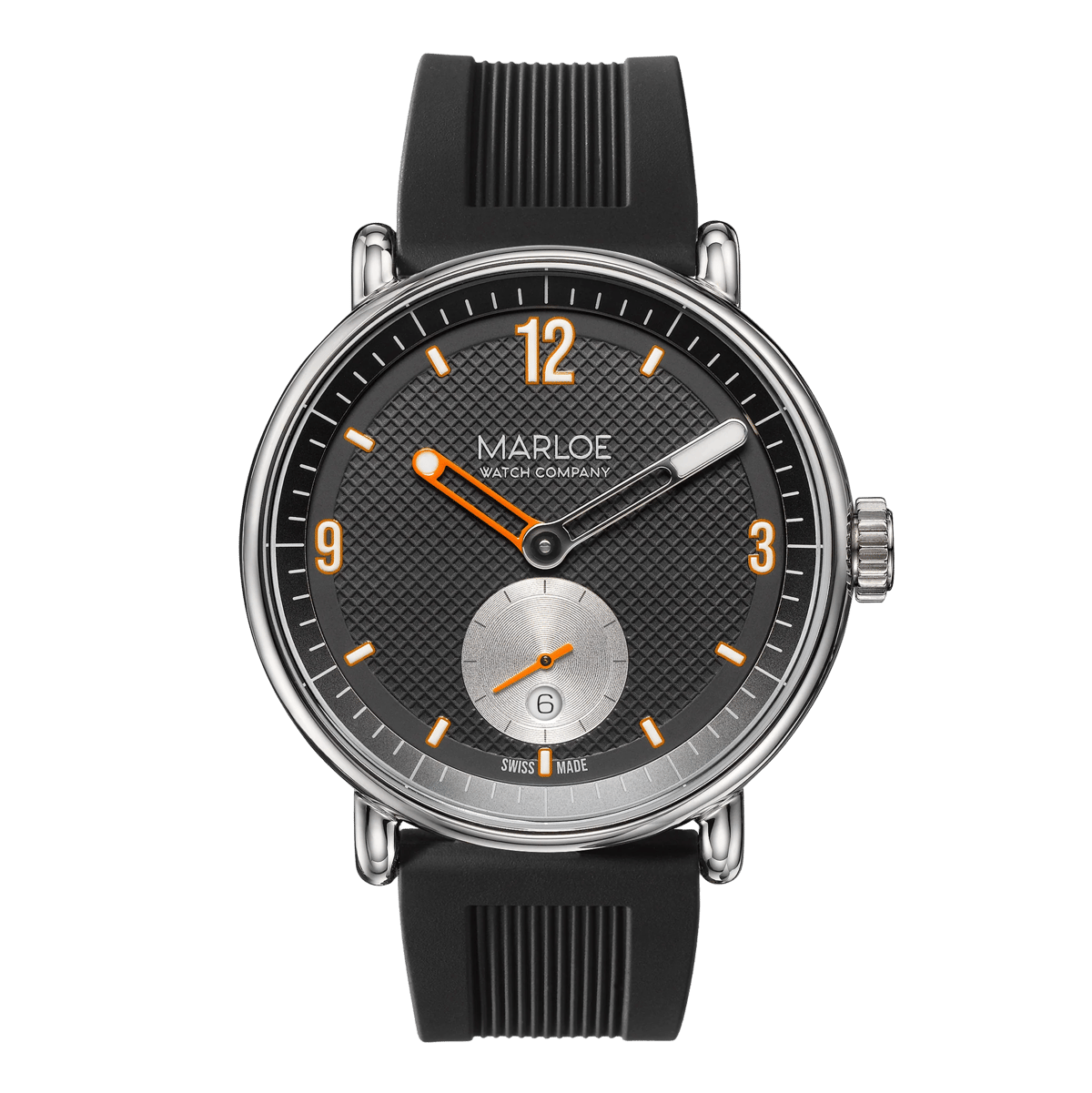
Marloe's dials have always leaned on deep, saturated colour and a certain retro-British calm, and the Gealach's night theme is a natural extension of that house style rather than a departure from it. The lunar display is the anchor — the thing your eye finds first and returns to — and everything around it is deliberately quiet. Applied markers, restrained typography, hands that are legible without being loud. It is a dial designed to be read over dinner, not decoded under a loupe.
What I like most is that Marloe didn't try to build a moonphase that punches above its weight. There is no faux-astronomical pretension here, no attempt to evoke a nineteenth-century pocket watch. The Gealach is a modern dress watch that happens to have a moon on it, and that's a harder brief to nail than it sounds. Plenty of affordable moonphases collapse into pastiche; this one stays composed.
The sapphire crystal is the right call at this price, and the stainless-steel case keeps the whole thing honest. It is not a watch trying to convince you it's something it isn't.
The movement
Here's where I have to be straight with you: Marloe publishes a deliberately lean technical sheet for the Daytimer line. The calibre designation, the power reserve, the beat rate — none of it is spelled out in the public materials, and I'm not going to invent figures to fill a table. If those details matter to you, and for some collectors they absolutely do, the correct move is to email Marloe directly and get them in writing before you order.
What we can say with confidence is what kind of object this is: a mechanical watch in the brand's house tradition, not a sealed quartz module with a printed moon on it. The lunar display is the headline complication, and it behaves the way mechanical moonphases behave — drifting gently against the real moon over months, needing the occasional reset, rewarding the owner who enjoys that small ritual. That drift is not a defect. It is the complication being honest about what it is.
The absence of COSC certification is not a surprise at this price point and shouldn't be treated as a black mark. What matters is that the watch is serviceable, that Marloe stands behind it, and that the movement is a known quantity rather than an anonymous novelty. Confirm the specifics, then judge on the wearing experience — which is where this watch actually earns its money.
On the wrist
Marloe has spent a decade refining a case language that errs toward the wearable side of the modern dress-watch spectrum, and the Daytimer Gealach continues that line faithfully. On the wrist it reads as a slim, unobtrusive watch — the kind that slides under a shirt cuff without a fight and doesn't announce itself across a dinner table. The proportions are the point. This is a watch designed to be lived with rather than photographed from one heroic angle.
The strap does most of the heavy lifting on comfort. Marloe ships the Daytimers on leather, and the pin buckle keeps the whole assembly light and traditional — no folding clasp bulk, no micro-adjust mechanism to fiddle with. If you're coming from a dive watch, you'll notice the absence immediately: no crown digging into the back of your hand, no slab-sided case fighting your sleeve.
It's a quiet wear, which is precisely what a moonphase should be. The complication reveals itself when you look down, not when you walk into the room. On a 3/5 wrist-presence scale, that's a deliberate design decision rather than a shortfall — but buyers who want their watch to be the loudest thing on the table should look at Marloe's Lomond instead.
Living with it
Day-to-day, the Gealach behaves like a good dress watch should: it disappears. You put it on in the morning, it slips under a cuff, and it does its job without demanding attention. There's no lume, so it's not an evening-in-the-dark watch, and it's not a tool watch by any stretch of the imagination — this is a piece for offices, dinners, weddings, gallery openings and the kind of long Sunday that doesn't involve a gym.
Because Marloe doesn't publish a rate specification, there's no factory tolerance to hold the watch to, and I won't pretend to have measured one over six weeks on a timegrapher. What I can tell you is that uncertified mechanical watches at this level typically run within a comfortable daily band — good enough that you won't be resetting it every morning, loose enough that you should treat the displayed time as a friendly suggestion. The lunar display needs a periodic reset regardless, which is as good an excuse as any to spend five minutes with your watch once a season.
Service goes through Marloe's UK operation. As with any microbrand, confirm turnaround times and pricing before you buy rather than after — it's the single most underrated piece of due diligence in this corner of the market.
What the spec sheet actually says
Marloe keeps its published specifications tight, so here's what is confirmed rather than inferred: a stainless-steel case, a sapphire crystal, a leather strap with a pin buckle, and a mechanical movement driving a moonphase display. Case diameter, thickness, lug-to-lug and water resistance are not published against this reference, so I've left them out rather than filling the gaps with industry averages. That's not a knock on the watch — it's a statement about how much information the brand puts in the public domain, and a reminder to get the numbers in writing if they matter to you.
What the lean sheet does tell you is something about priorities. Marloe is selling a design and a feeling, not a spreadsheet. For some buyers that's refreshing. For others it's a reason to email the brand before clicking buy. Both reactions are reasonable.
The rest of the family
The Daytimer Gealach doesn't exist in isolation. The base Daytimer gives you the same dress-watch brief without the lunar display, and it's the obvious starting point if you love the case but are indifferent to the moon. Beyond that, Marloe's catalogue is unusually coherent: the Cherwell is the minimalist flagship, the Lomond is the diver, the Derwent is the chronograph, and the Coniston, Morar and Haskell fill out the range for buyers who want Marloe's design language in a different register.
The practical effect is that most people considering a Gealach are deciding between it and one other Marloe — not between it and a Longines. That's a meaningful distinction. The brand's real competition is its own back catalogue, which is a healthy place for a small manufacturer to be.
Alternatives worth a look
If you want the moonphase experience with a bigger budget, Christopher Ward's C1 Moonglow is the other great British direct-sales answer — sharper case architecture, a big-date moon, and a price that still undercuts the Swiss establishment. It's the natural step up.
If you want heritage and a service network you can find in any major city, the Longines Master Collection Moonphase is the benchmark. You'll pay considerably more, and you'll get a more formal dial and a brand with a century of history behind it. Whether that's worth the premium is a personal question, but it's the honest comparison.
Frederique Constant's Classics Moonphase sits between the two — Swiss, conventional, and considerably more expensive than the Marloe. At the budget end, Orient's Sun & Moon delivers a day-night disc rather than a true lunar complication, and Seagull proves that Chinese mechanical moonphases can be had cheaply. Neither has Marloe's design discipline, but both are legitimate ways to scratch the itch.
The money question
Let's be clear-eyed. This is not an investment. Microbrand moonphases trade on affection rather than scarcity, and outside a handful of genuinely cult references the secondary market is thin. There is no auction history to speak of, and there won't be. If you buy the Gealach expecting it to appreciate, you will be disappointed.
If you buy it to wear, the maths changes completely. At brand-direct pricing in the mid-hundreds, you're paying for design authorship and a mechanical complication at a price where most competitors offer a plain three-hander with a quartz heart. That's a genuinely good trade. The value is in the decade of wrist time, not the resale listing.
Verdict
The Daytimer Gealach is the rare microbrand watch where the romance is the engineering brief. It won't out-finish a Longines and it won't hold value like one either — but it puts a mechanical moon on your wrist for the price of a mid-tier fashion piece, and it does so with real conviction.
If you've been circling a moonphase for years and couldn't justify the jump, this is the honest on-ramp. Email Marloe, get the specifications in writing, and then buy it to wear. That's what it's for.