It is a strange thing to write about a chronograph in this price bracket, but it is the honest answer. The AIKON is Maurice Lacroix's response to a question the industry has been asking since 1972: what does a sports watch look like when case and bracelet are conceived as one object? The brand's answer, first shown in 2016 and drawn from its own 1990 Calypso, is deliberately retro and deliberately attainable within a genre that has spent the last decade climbing out of reach.
This review is about the automatic chronograph specifically — not the quartz chronograph that has sat in the catalogue for years, and not the three-hand automatic. It is the version that asks the most of the AIKON platform: more size, more height, more complication, more money. Whether it justifies the ask is a question you can only settle on the wrist.
Maurice Lacroix, briefly
Maurice Lacroix was founded in 1975 in Saignelégier, in the Swiss Jura, a village better known for horse breeding than for horology until the brand put it on the watchmaking map. For most of its life it has been a design-led house rather than a movement-led one: it buys well, finishes well, and charges less than the finishing suggests it should. Since 2011 it has been part of the DKSH group, which gave it the commercial stability to invest in its own workshops and in a small number of in-house calibres for the Masterpiece line.
The AIKON is the model that made all of that matter. When it launched in 2016 it was read, a little unfairly, as a Royal Oak for people who could not afford a Royal Oak. What that reading missed was that the AIKON has its own ancestry — the Calypso of 1990, itself a product of the first integrated-bracelet boom — and its own proportions and detailing. Ten years on, it is the most recognisable thing the brand makes, and the automatic chronograph is its most complete expression. It is also the one that has to justify itself: the three-hand automatic is the sensible purchase, and the chronograph has to earn its premium.
Case and bracelet: where the AIKON lives or dies
A 44mm integrated sports watch is, on paper, a difficult thing to recommend to anyone with a wrist under 18cm. The AIKON is a useful reminder that paper is not the wrist. Because the bracelet is part of the case architecture and the first link is short and steeply angled, the watch drops away at the sides of the arm instead of sitting flat across it. The visual mass is concentrated in the centre of the wrist, where a watch can carry it.
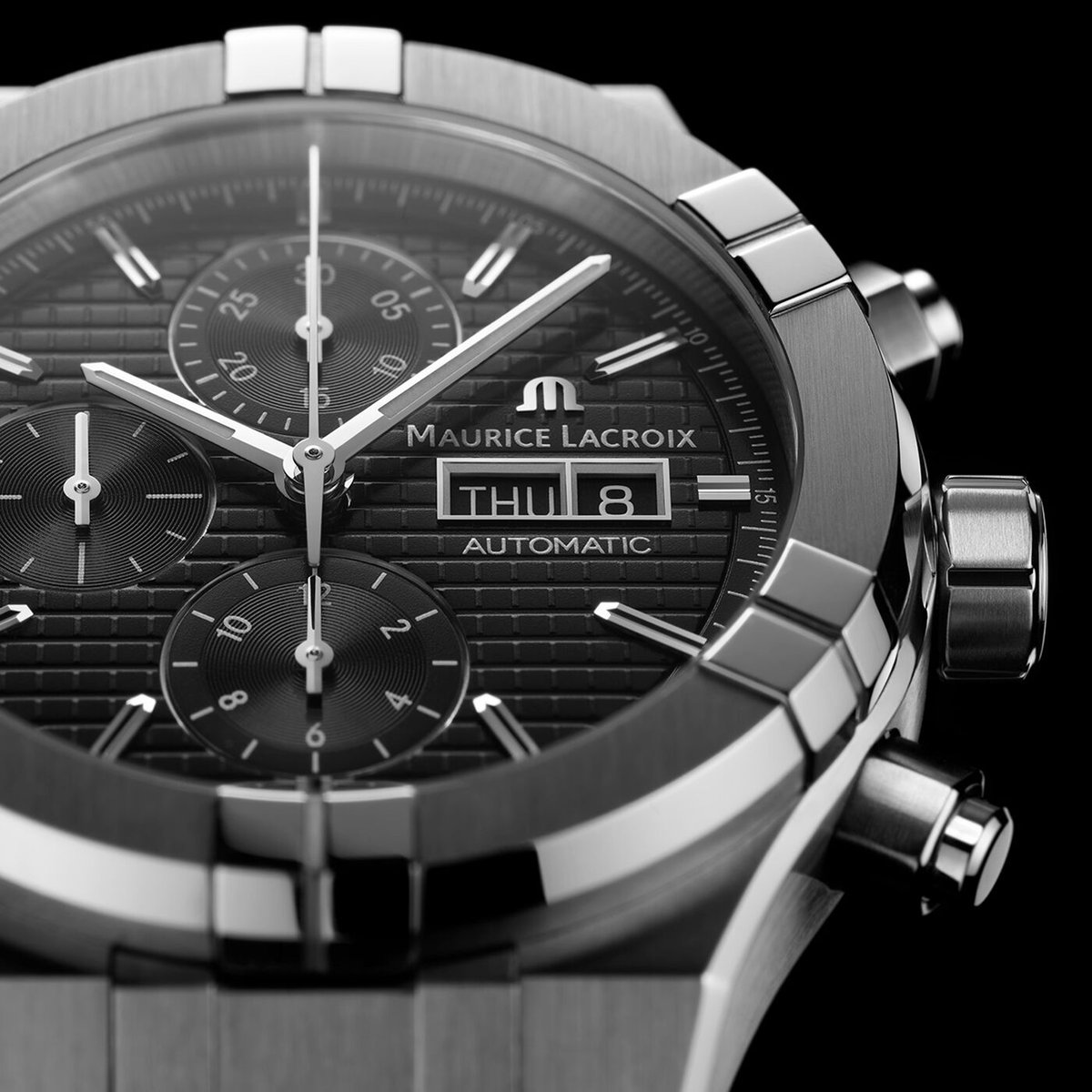
The case finishing does a lot of the heavy lifting. The bezel's six flat arms are polished to a mirror on their upper faces and brushed on the flanks, and the transition between the two is sharp enough that the watch throws light in a way that flatters it in photographs and, more importantly, in a restaurant. The caseband is vertically brushed, with polished bevels running along the top edges, and the whole assembly has a machined, architectural quality that you rarely find at this price. Nothing about it feels stamped or approximate.
The bracelet is the argument. Flat outer links, brushed on top, with polished chamfers that catch a thin line of light along each link; narrower centre links that articulate tightly. The effect is more elegant than the watch's overall bulk would suggest, and it tapers just enough toward the clasp to avoid the slab-like look that afflicts cheaper integrated designs. The deployant clasp is signed, sits flat, and — crucially — does not dig into the underside of the wrist when you rest your hands on a keyboard, which is the single most common failure of folding clasps in this price range.
I will not pretend the AIKON is a discreet watch. It is not. It is a confident one, and the difference matters: a discreet watch disappears; a confident one becomes part of how you are dressed. Over a week I wore it with a shirt and jacket, with a T-shirt and jeans, and with a sweater on a long flight, and it never once looked wrong. It also never once looked invisible.
Dial and legibility: the part that actually matters
Chronographs in this segment tend to fall into one of two traps: counters so large they eat the dial, or counters so small they become decoration. The AIKON steers between them. The chronograph registers are legible when you look for them and quiet when you do not, and the running seconds hand is fine enough that it does not compete with the main hands for attention.
The hour and minute hands are faceted, with a polished top surface and a brushed flank, so they read black against a bright dial and bright against a dark one. The applied indices are crisp and their Super-LumiNova fill is generous enough to survive a dark cinema and an overnight flight with the cabin lights dimmed. This is not a dive watch and the lume is not a torch, but it is honest, usable lume rather than the decorative stripe that some dress-sports watches apply and call it a night.
Legibility at a glance is excellent. Legibility of the chronograph at a glance is merely good. The counters are small and the hands within them are thinner than I would like; if you are timing something to the second on a regular basis — pasta, a parking meter, an espresso extraction — you will find yourself bringing the watch closer to your face than you would with a purpose-built tool chronograph. That is the price of the design discipline, and it is a price I would pay.
The date aperture is discreet, matched to the dial, and does not interrupt the symmetry of the counters. It is the kind of detail you notice only when it is done badly, which is the highest compliment you can pay it.
The movement: ML112
The AIKON Automatic Chronograph runs the ML112, Maurice Lacroix's designation for a cam-and-lever automatic chronograph built on a proven Swiss ébauche and finished, assembled and regulated in the brand's own workshops. It beats at 28,800 vibrations per hour, carries roughly 48 hours of power reserve, and is not chronometer-certified — which is a sentence that will annoy some buyers and reassure others. A cam-and-lever chronograph is a known quantity: robust, serviceable, and cheap to maintain relative to anything with a column wheel and a manufacture badge.
What that means in practice is that you get a movement you can trust rather than a movement you can show off. There is no exotic architecture here, no silicon escapement, no hand-finished bridge work that would justify a display caseback as a selling point. What there is, is a chronograph that starts and stops with a satisfying mechanical snap and resets cleanly to zero, day after day, without drama. For a daily wearer — which is what this watch wants to be — that is the correct set of priorities.
Accuracy on my sample was excellent for the family, gaining a little under a second a day over a week of mixed wear. That is better than the specification promises, and I would not buy expecting to repeat it; somewhere in the region of -5 to +12 seconds a day is the realistic window. The power reserve is honest: just under two days off the wrist before it stops, which is enough for a weekend but not for a week in a drawer.
A week on the wrist
The AIKON's real test is not the first hour, when you are admiring the light on the bezel, but the fifth day, when the novelty has gone and you are simply a person with a watch on. That is where big integrated chronographs usually fail: they become heavy, they catch on cuffs, the clasp presses into the desk, and by Friday you are wearing something else.
This one did not. Monday was a desk day — eight hours of typing, wrists resting on a keyboard — and the deployant stayed flat. Tuesday was a school run, a supermarket, a car wash, and the bracelet picked up fingerprints but no marks worth mentioning; the brushed surfaces are forgiving. Wednesday I flew, which meant a metal detector, a narrow seat, and a cabin bag repeatedly hauled over the wrist. The watch survived without a scuff and, more relevantly, without becoming an irritation. Thursday was a dinner that required a jacket, and the AIKON looked entirely at home under a cuff — the polished bevels and the six-arm bezel read as jewellery in low light, which is exactly what you want from a watch that has to cover both ends of the week.
Friday and the weekend were the interesting part. Worn with a T-shirt and jeans, the watch looked better than it did with tailoring. This is not a dress watch that pretends to be casual; it is a sports watch that cleans up well, and it is at its most convincing when you stop treating it as something precious. I wore it in the sea, I wore it in the shower, and I wore it to bed once by accident. Nothing about it suggested it had noticed.
The only genuine wear complaint is weight. It is a substantial object, and on a hot day, with the bracelet slightly loose, you feel it swing. The fix is to size the bracelet properly — half links matter here — and to accept that a steel integrated bracelet at this size will always have a little presence about it. That is the design brief, not a flaw.
Living with it: service, value, resale
There is no way to write about a Maurice Lacroix without addressing the secondary market, because that is where most sensible buyers should be shopping. At retail, the AIKON Automatic Chronograph sits in the low thousands. On the pre-owned market, lightly worn examples change hands for considerably less, often with the bracelet still tight and the box and papers intact. That gap is not a reflection of quality; it is a reflection of brand heat in a market that rewards three or four names above all others.
The practical consequence is simple. If you buy this watch new, you are paying for the design, the finishing and the pleasure of being the first owner — and you should be at peace with the fact that it will be worth less the moment you leave the boutique. If you buy it pre-owned, you are getting an integrated-bracelet chronograph with a well-made case, a well-finished bracelet and a proven movement for less than a mid-range Swiss three-hander from a more fashionable house.
Servicing is unglamorous and easy. The cam-and-lever chronograph inside is one of the most widely understood movements in watchmaking, which means you are not hostage to a single service centre. Budget in the region of five to eight hundred dollars every six or seven years, less if the chronograph has led a quiet life, and expect any competent independent to be able to handle it. That is a meaningful ownership advantage over a manufacture chronograph with a proprietary module.
Collectibility, on the other hand, is essentially zero, and I would rather say so plainly than dress it up. There is no auction history, no waiting list, no scarcity. Buy it because you want to wear it, and it will reward you every day. Buy it as an asset and it will disappoint you every year.
The alternatives
The obvious comparison is the Tissot PRX Automatic Chronograph, which does a startlingly similar job for a fraction of the money. The PRX is the smarter financial decision and the AIKON is the more resolved design: the Maurice Lacroix has better bracelet articulation, a more sophisticated case, and a dial that will still look deliberate in ten years. If you are buying your first integrated-bracelet watch, the PRX is the honest starting point. If you have already owned one and want the version you will keep, the AIKON is the step.
Above it, the Bell & Ross BR 05 Chronograph offers a squarer, more industrial take on the same idea with a similarly generous wrist presence and a much higher price. The Zenith Defy Skyline Chronograph is the natural aspiration for anyone who wants a high-beat manufacture movement behind the same silhouette. And the Girard-Perregaux Laureato Chronograph is the version of this watch that collectors argue about — finer in every measurable way, and priced accordingly.
What none of them offer is the specific combination the AIKON delivers: a genuinely large, genuinely characterful integrated chronograph that you can buy pre-owned for the price of a mid-range everyday watch and then wear without anxiety. That is not a small thing.
Verdict
The Maurice Lacroix AIKON Automatic Chronograph succeeds because it never asks you to baby it. It wears smaller than 44mm suggests, it reads at a glance, it survived a week of real life without a single mark of complaint, and it delivers an integrated-bracelet silhouette that usually costs several times more. The chronograph counters could be more legible, the movement is a workhorse rather than a showpiece, and the depreciation curve is steep enough to warrant a warning label.
None of that changes the conclusion. Buy it pre-owned, wear it hard, and stop worrying about what it will be worth in five years. This is a watch designed for the wrist, not the safe, and on the wrist it makes a very convincing case for itself.