Brand Context: MB&F and the Horological Machine Philosophy
MB&F was founded in Geneva in 2005 by Maximilian Büsser, with a mission to create radical horological machines rather than conventional watches. The brand works with independent designers, engineers and movement specialists, and its Horological Machines are produced in small series for collectors who value sculpture and mechanical storytelling over classicism. The HM12 Medusa sits at the outer edge of that philosophy, combining a flying tourbillon with an organic, limited-edition case design.
What makes MB&F relevant here is not just the rarity or the price. It is the fact that the brand treats a watch as a three-dimensional object. The HM12 is not a round case with a decorative dial; it is a construction. The movement, the displays and the case are designed as one visual system. That matters on the wrist because it changes how you read the watch and how you wear it. You do not glance at an MB&F the way you glance at a Datejust. You look into it.
Movement: Flying Tourbillon and Dual Time
The HM12 Medusa is powered by a hand-wound MB&F calibre built around a central flying tourbillon. MB&F quotes a 96-hour power reserve and a slow 18,000 vph beat rate, which fits the brand’s preference for mechanical drama over high-frequency convention. The movement is in-house and openworked, with twin time displays that make the watch as much a travel companion as a collector’s object.
The flying tourbillon is the centrepiece. It is not hidden behind a solid dial or treated as a discreet technical flourish. It is part of the architecture, visible and central, which is exactly what an MB&F buyer wants. The dual time function adds a practical layer that many high-horology pieces lack. In real use, that means the HM12 can be set to home time and a second zone, which is useful for travel and gives the watch a reason to be worn beyond the dinner table.
This is not a chronometer-certified movement, and MB&F does not position it as one. The hand-wound calibre should be expected to perform like a high-end mechanical piece rather than a quartz-adjacent tool watch: a few seconds to tens of seconds per day depending on position, winding consistency and temperature. The tourbillon is there for horological theatre and visual pleasure. Owners should wind it deliberately, keep it away from hard shocks and expect a watchmaker to regulate it during service if needed.
Specs and Wear-Focused Details
The HM12 Medusa uses a titanium case and a sapphire crystal, with a leather strap and pin buckle. Those choices matter. Titanium keeps the watch from feeling unnecessarily heavy for its scale, while sapphire gives the domed display a clean, glassy presence. The leather strap is the right call for a piece like this: it softens the transition from the sculptural case to the wrist and keeps the watch from feeling like a bracelet-bound machine.
I have deliberately not quoted case diameter, thickness, lug-to-lug or water resistance here because those figures are not the point of this review, and MB&F’s design language makes conventional dimensional comparisons less useful than they are for a sports watch. What matters is the experience: the HM12 sits high, reads as a dome of movement and casework, and feels more like a wearable object than a conventional wristwatch. The lume is present on the indications, but this is not a watch built around night-time tactical legibility. It is built around the pleasure of looking at it.
On the Wrist: Comfort, Balance and Presence
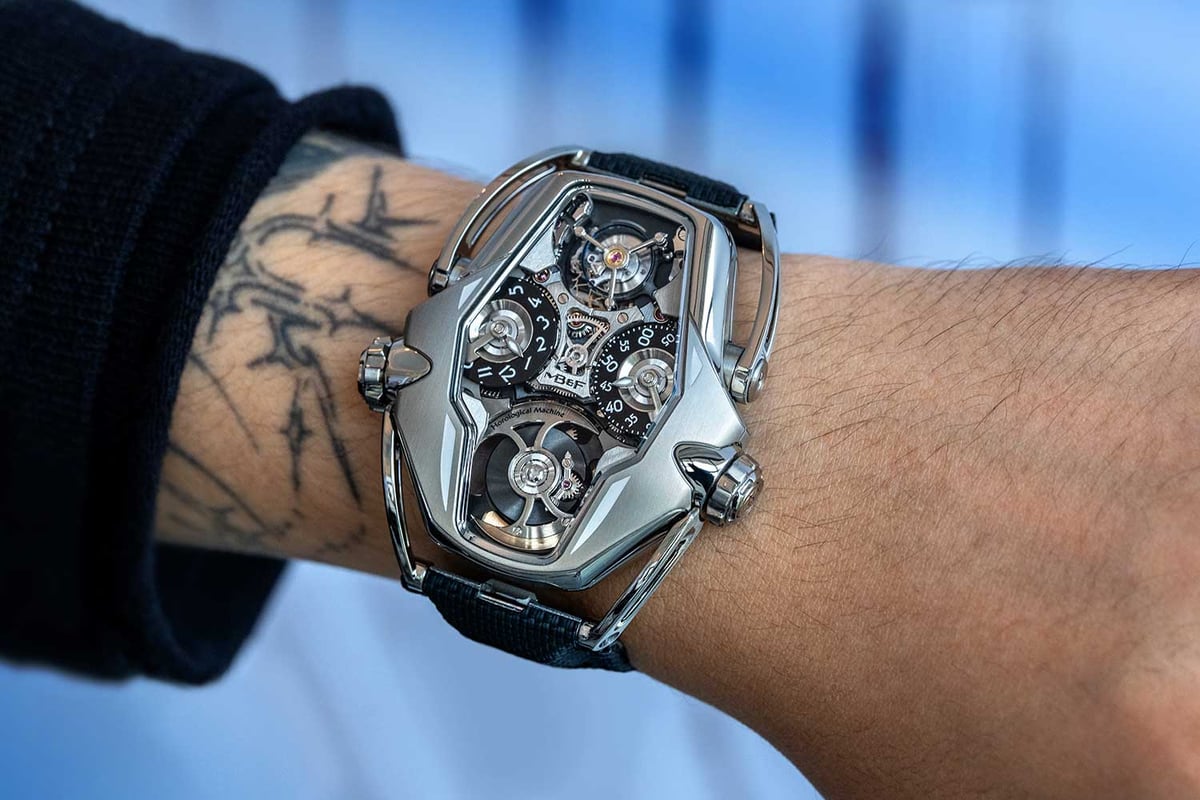
The HM12 Medusa wears like a piece of architecture rather than a conventional watch. It sits high and sculptural on the wrist, with a domed sapphire presence that makes the movement feel like an exhibit under glass. The titanium case keeps the weight from becoming oppressive, and the leather strap integrates into the lugs in a way that softens the transition from case to wrist. It is not a watch that disappears under a cuff, but it is more balanced than its visual mass suggests.
Comfort is best described as purposeful rather than invisible. The strap is supple enough for a full evening, and the caseback does not dig into the wrist in normal wear, but the HM12 is not the piece you choose for a tight-shirt day. It rewards a relaxed fit and a wearer who enjoys the sensation of a watch that occupies space. For collectors used to large, sculptural pieces, the balance is credible; for someone coming from a slim dress watch, it will feel like a commitment.
The crown and display layout take some getting used to. This is not a watch you read with a quick flick of the eye. The dual time displays and the openworked centre mean that legibility is secondary to spectacle. In daylight, the indications are clear enough once you know where to look. At night, the lume helps, but the HM12 is never going to be as immediate as a classic three-hander. That is part of the deal. You wear it because the act of reading the time is part of the experience.
Accuracy and Daily Ownership
Real-world accuracy should be judged like a high-horology mechanical watch, not a certified chronometer. Expect a few seconds to tens of seconds per day depending on how consistently you wear and wind it. The 96-hour power reserve means you can take it off for a weekend without it stopping, which is a genuine practicality for a watch in this price bracket. It also means the winding routine is less frantic than with a short-reserve manual piece.
The HM12 is not a daily beater in the traditional sense. It is not designed for gym sessions, swimming or rough handling, and the openworked movement deserves respect. But for a collector’s rotation, it is more usable than many extreme high-horology pieces because the strap is comfortable, the titanium case is not overly heavy and the dual time function has real-world value. It is a special-occasion watch that can travel, provided you treat it like the mechanical object it is.
Occasions and Wrist Presence
The HM12 Medusa is at its best in formal and dress settings, where its sculpture can be appreciated without competing with a cuff or a glove. It is also a natural travel watch for collectors who like to have a second time zone and do not mind answering questions about their wrist at the airport. It is not a sport watch, and it is not a discreet daily wearer. It is a collector’s piece for evenings, dinners, gallery openings and the kind of travel where the watch is part of the experience.
Wrist presence is a five out of five. This is a room-stopping watch. It makes most conventional luxury watches look invisible, and it invites conversation whether you want it or not. If you prefer anonymity, this is not your watch. If you enjoy wearing something that feels like a piece of contemporary art with a movement inside, the HM12 delivers in a way that few pieces can.
Reference Variants and Family Context
The HM12 Medusa is a limited edition of 50 pieces, with an openworked blue dial and luminous indications on a leather strap. That scarcity is central to its appeal. MB&F does not produce Horological Machines in large numbers, and the HM12 sits alongside family references such as the HM11 Architect, HM10 Bulldog, HM9 Flow, HM8 Can-Am and HM7 Aquapod. Each of those pieces takes a different architectural or mechanical idea and turns it into a wrist object. The HM12 continues that lineage with an aquatic, organic theme and a central flying tourbillon.
Other notable MB&F models include the Legacy Machine Perpetual, the LM Split Escapement and the HM10 Bulldog. The Legacy Machines are more traditional in layout, while the Horological Machines are more radical. The HM12 is firmly in the radical camp. That matters for buyers who are comparing it with a Greubel Forsey Tourbillon 24 Secondes, an Urwerk UR-220 or a Richard Mille RM 27-05. Those are different expressions of high-end mechanical sculpture, but they share the same collector mindset: the watch is chosen for its design and mechanical story, not for its ability to be a single do-everything daily watch.
Investment and Value
The HM12 Medusa sits in the roughly $250,000 to $300,000 range, with an MSRP around $275,000. That is a serious sum, and it should be treated as a collector purchase rather than a speculative trade. Limited MB&F pieces can hold value well, especially when they are complete with box and papers and have a strong design story. The HM12 has both: it is scarce, visually distinctive and mechanically interesting. The trend is best described as stable rather than rapidly appreciating, because the market for six-figure independent horology is narrow and buyer-specific.
My hold recommendation is simple: buy it because you want to wear it. A limited MB&F Horological Machine is a collector object first and an asset second. If you need liquidity, there are better places to put your money. If you want a watch that feels like a personal museum piece and can still be worn for an evening, the HM12 makes sense. There is no major auction history yet because the model is still a modern limited edition, so buyers should rely on dealer pricing and private-market comparables rather than auction records.
Service and Long-Term Ownership
Service should be arranged through MB&F or an authorized partner. The openworked tourbillon movement is not a candidate for independent generalists, and the limited production means that factory support is part of the ownership proposition. I have left the service interval and approximate cost open here because those figures should be confirmed directly with MB&F for the specific piece. The important point is that this is not a watch you hand to a local mall watchmaker. It is a specialized mechanical object that deserves specialized care.
Final Verdict
The MB&F HM12 Medusa is a triumph of watch-as-sculpture, and it is more wearable than its theatrical silhouette suggests. It will never be the quiet daily companion, but for a collector who wants a limited-edition flying tourbillon with genuine wrist presence, it is a compelling and deeply memorable piece. Buy it for the experience, the design and the mechanical theatre; treat its value as a bonus rather than the reason.
Pros: exceptional wrist presence, limited production, flying tourbillon and dual time, comfortable strap integration relative to the case size. Cons: not a subtle daily wearer, legibility is secondary to spectacle, service is specialized and potentially costly, and it is not designed as a sports or water watch. For the right wrist, the HM12 is not just a watch. It is a small, mechanical event.