The Aerodynamic Fever Dream: Introduction to the HM9
In the high-stakes world of luxury watch collecting, there is a point where the traditional circles of gold and steel no longer suffice. For the collector who has already conquered the 'Holy Trinity' and finds the latest hype-beast collaboration a bit too pedestrian, there is MB&F. Specifically, there is the HM9 'Flow.' This isn't just a watch; it’s a cultural artifact that captures the mid-century obsession with the future. When Max Büsser released the HM9, he wasn't looking at what his competitors were doing in 2018; he was looking at the 1948 Buick Streamliner and the de Havilland Venom jet.
The HM9 is the physical manifestation of movement. Even when sitting still on a velvet tray, it looks like it's breaking the sound barrier. As a trend spotter at Vivir, I see a lot of 'experimental' watches, but most are just traditional movements in funky cases. The HM9 is different. The movement is the case, and the case is the movement. They are inseparable, a singular vision of three-dimensional horology that challenges the wearer to rethink their relationship with time.
Design Language: Streamlining the Future
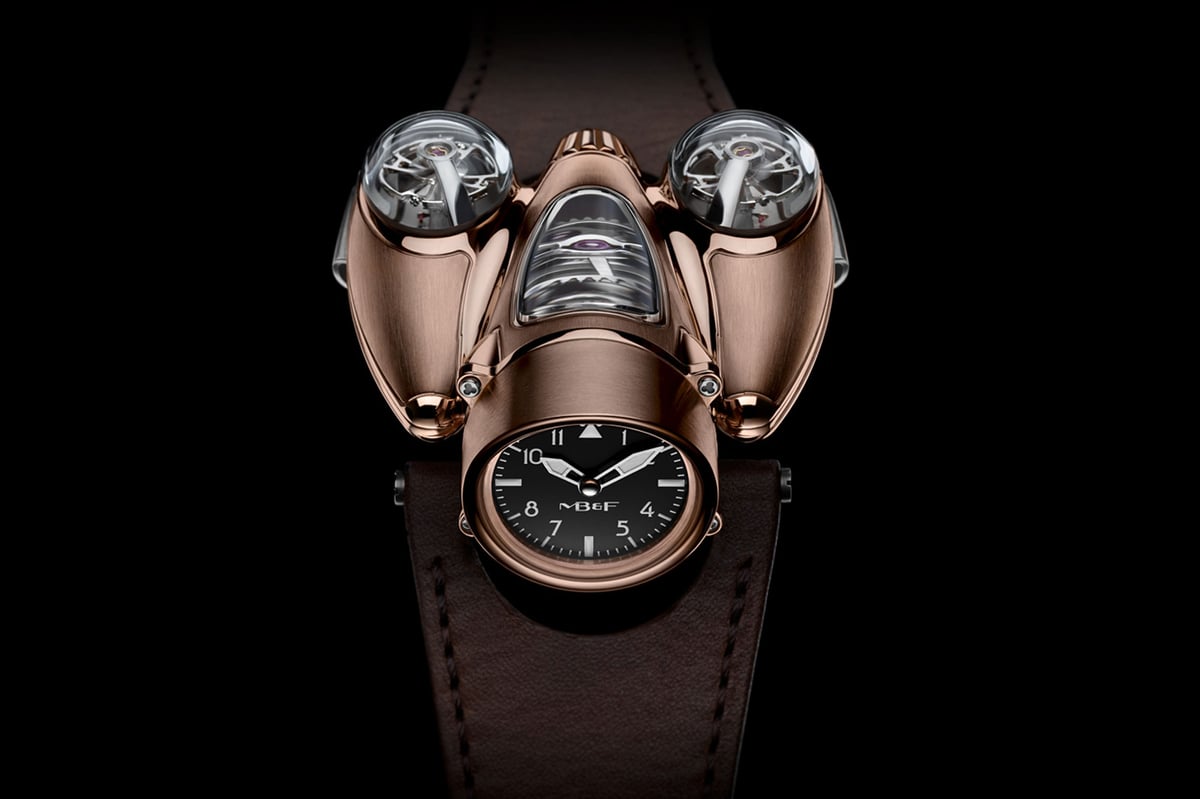
The silhouette of the HM9 is its most defining characteristic. It features a highly complex, Grade 5 titanium case that consists of three distinct pods. The central pod houses the 'brain' and the differential, while the two flanking pods house the twin balance wheels under sapphire domes. It is a layout that mimics the engine nacelles of a vintage aircraft or the fender flares of a classic salt-flat racer.
What makes the HM9 truly remarkable is the finishing of the case. The juxtaposition of polished and satin-brushed surfaces on such a complex, curvilinear geometry is a nightmare for polishers but a dream for the enthusiast. There are no straight lines here. Every angle is a curve, every surface a transition. This is 'Flow' in the literal sense. The dial is positioned vertically at the front of the machine, allowing the wearer to check the time without rotating their wrist—a nod to the 'driver’s watches' of the past, but executed with a futuristic, cockpit-inspired aesthetic.
The Engine: A Symphony of Two Hearts
Inside the HM9 beats a movement that took three years to develop. While most watches settle for one balance wheel, the HM9 uses two. Why? Because in the world of MB&F, 'too much' is just enough. These two independent balance wheels beat at their own cadence, and their individual rates are averaged out by a planetary differential located in the central chamber. This isn't just for show; it’s a mechanical solution to the problem of rate stability, though let’s be honest—the visual drama of seeing those two wheels oscillating under their own sapphire canopies is the real reason this watch exists.
The movement finishing is top-tier. Depending on the version—'Road' or 'Air'—the movement is treated with either a dark NAC or a rose gold plating. The bridges are hand-beveled, the sinks are polished, and the overall architecture is so deep you feel like you could fall into it. It’s a manual-wind caliber, and winding it via the fluted crown at the rear of the case is a tactile experience that connects the wearer to the mechanical soul of the machine. It feels industrial yet refined, like operating a piece of high-end lab equipment from a 1960s sci-fi film.
Wrist Presence and Cultural Impact
Let’s address the elephant in the room: the size. At 57mm wide, the HM9 is massive. But on the wrist, it defies logic. Because it lacks traditional lugs and tapers so aggressively toward the strap, it fits more comfortably than many 44mm divers. It’s a watch that demands a certain level of confidence. You don't wear the HM9 to blend in; you wear it to signal that you are part of a specific tribe—the 'Friends' of Max Büsser.
In the current cultural climate, where 'quiet luxury' is often synonymous with 'boring,' the HM9 is a loud, proud celebration of creativity. We’ve seen MB&F on the wrists of everyone from creative polymaths to elite athletes who are tired of the same three watches everyone else is wearing. It has become a symbol of the 'New Guard' of collecting—a group that values independent spirit and mechanical audacity over brand recognition among the masses.
Investment and the Secondary Market
From an investment standpoint, MB&F has transitioned from a niche independent to a powerhouse. A few years ago, you could find these at a slight discount on the secondary market. Those days are gone. With production capped at very low numbers—often just 33 pieces per edition—the scarcity is real. The HM9 'Flow' has shown incredible resilience in value, with 'Sapphire Vision' models often trading for significant premiums over their already eye-watering retail prices.
The verdict is simple: the HM9 is a safe place to park capital if you want something you can actually enjoy. Unlike a piece of art hanging on a wall, this is a piece of art you can wear to a dinner in Tokyo or a meeting in Silicon Valley. It signals taste, intelligence, and a willingness to take risks.
Final Thoughts: Is the HM9 for You?
The MB&F HM9 Flow is not a 'first watch.' It is a 'tenth watch.' It is what you buy when you have seen everything else and you want to be surprised again. It is a reminder that horology can be fun, daring, and completely unnecessary. In an age of smartwatches and digital everything, the HM9 is a defiant mechanical heart, beating twice as fast and looking twice as good as anything else on the road. If you have the wrist, the wallet, and the stones to pull it off, there is simply nothing else like it.