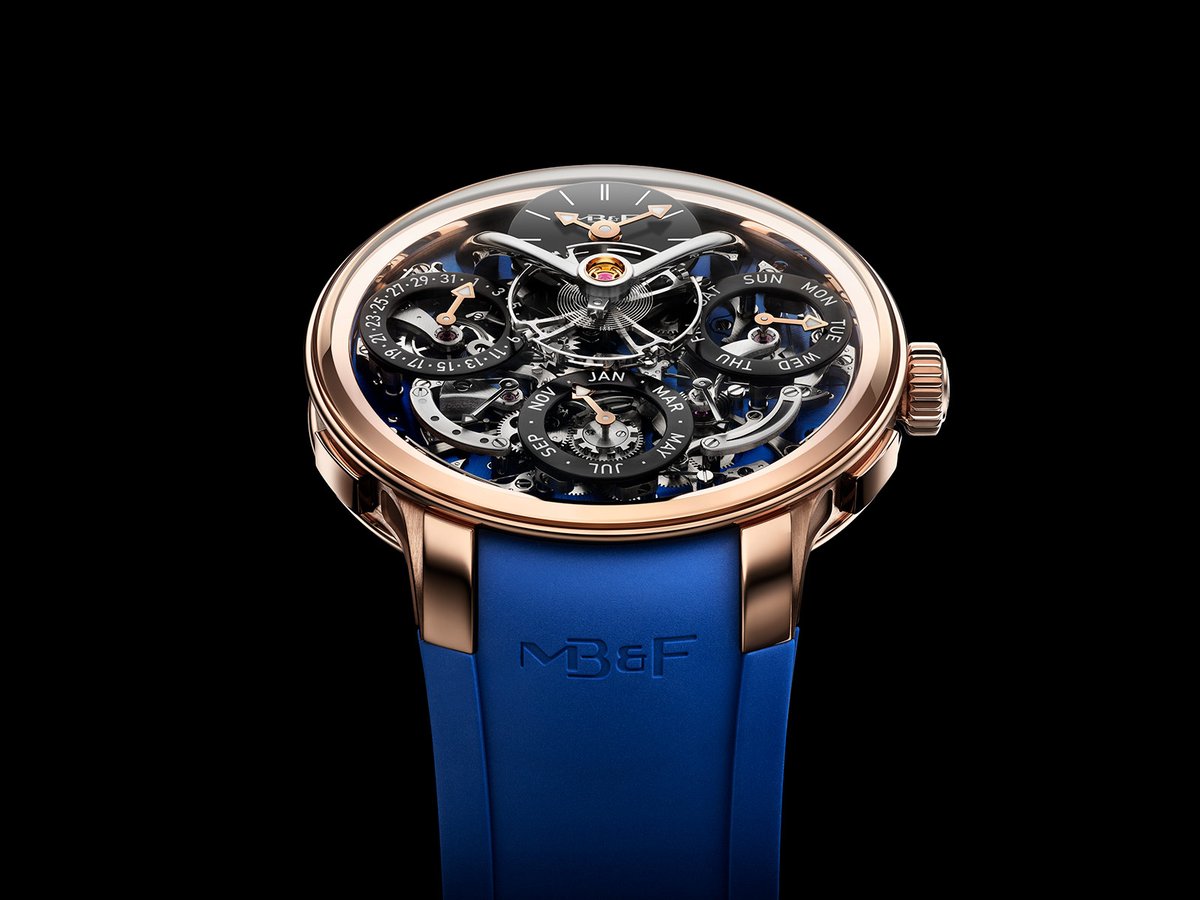
The Evolution of the Legacy Machine
To understand the MB&F LM Perpetual, one must first understand the ethos of the Legacy Machine. While the Horological Machines (HM) series explores the fringes of science fiction and automotive design, the Legacy Machine (LM) series is a reimagining of traditional watchmaking. It asks: 'What would have happened if I was born in 1867 instead of 1967?' The result is a series of watches that utilize high-domed crystals, suspended balance wheels, and exquisite 19th-century finishing. However, the LM Perpetual is more than just an aesthetic exercise; it is a fundamental re-engineering of the perpetual calendar complication.
For decades, the perpetual calendar was a fragile mechanism. Built on a 'grand levier' (grand lever) system, it relied on a 31-day month as the default. The lever would jump over the unnecessary days at the end of shorter months. This system is notoriously easy to break if the user attempts to set the date while the mechanism is engaged. Stephen McDonnell, the watchmaker behind the LM Perpetual, threw this concept out the window. He designed a 'mechanical processor' that uses a 28-day month as the default and adds days as needed. This means there is no 'skipping' of days, and the push-pieces are automatically deactivated when the calendar is changing, making it essentially fool-proof. For the daily wearer, this is a game-changer. You no longer need to live in fear of your own watch.
The Architecture of the Wrist
Let’s talk about the 'wear.' On paper, a 44mm watch that stands 17.5mm tall should be a clunky, top-heavy disaster. Yet, on the wrist, the LM Perpetual is a masterclass in ergonomics. The lugs are the unsung heroes here. They don't just extend from the case; they dive toward the wrist. This creates a silhouette that hugs the arm, centering the mass of the watch perfectly. During my week with the platinum version, I found that the weight—while significant—did not lead to wrist fatigue. Instead, it provided a sense of gravity and presence that reminded me I was wearing something truly special.
The legibility is another area where the LM Perpetual surprises. Often, skeletonized or open-worked watches sacrifice readability for the sake of 'the show.' Here, the sub-dials for the day, date, month, and power reserve are floating above the movement, anchored by transparent studs. Because they are white lacquer (in most versions), the contrast against the darkened movement plates or the blue/salmon base dials is exceptional. Even the leap year indicator, a retrograde hand at 7 o'clock, is intuitive. The only downside to the daily wear experience is the height. This is not a watch that slides under a buttoned shirt cuff. It is a watch that demands its own space, often requiring you to leave your cuff unbuttoned or wear it with knitwear and casual tailoring.
A Week on the Wrist: The Real World
On Monday, I wore the LM Perpetual to a formal lunch. Under the harsh fluorescent lights of a midtown restaurant, the movement finishing sparkled. The oversized 14mm balance wheel, oscillating at a slow, hypnotic 2.5Hz, is a conversation starter. It is positioned front and center, suspended by a double-arched bridge. Watching it beat is like watching the heart of the machine. It brings a sense of calm to a busy day.
By Wednesday, I was testing its durability. While the standard LM Perpetual is rated to 30 meters of water resistance (essentially 'splash-proof'), it feels sturdier than its dress-watch peers. The pushers for the calendar are large and tactile, and because of the mechanical processor, I didn't have to worry about the time of day I was adjusting them. This 'set it and forget it' nature is rare in high horology. On Friday, I switched to a more casual outfit—a cashmere sweater and denim. The LM Perpetual transitioned seamlessly. It has a 'steampunk' elegance that works just as well with a blazer as it does with a suit.
The McDonnell Processor: A Technical Marvel
The movement is comprised of 581 components, but it doesn't feel cluttered. The layout is symmetrical and purposeful. The power reserve indicator at 4 o'clock is a vital addition, as this is a manual-wind piece. With 72 hours of reserve, you can leave it off for a weekend, but the visual reminder ensures you never let the 'brain' of the perpetual calendar stop. If you do let it stop, the correction is simple and safe, thanks to those dedicated side-case pushers.
The finishing is, as expected from MB&F, top-tier. Internal angles are hand-polished, gold chatons are present, and the Geneva waves (Côtes de Genève) are applied with precision. But the real beauty is the depth. The distance between the top of the balance wheel and the bottom of the base plate creates a three-dimensional landscape that you can get lost in for hours. It’s a watch that rewards the use of a loupe, yet remains impressive from three feet away.
The Vivir Verdict
The MB&F LM Perpetual is not just a watch; it is a statement of intent. It proves that the most complex complications can be made user-friendly without losing their soul. For the young collector who values engineering as much as aesthetics, there is no better choice. It is a piece that survives the 'real week' because it was designed with the user's mistakes in mind. It is robust, it is beautiful, and most importantly, it is a joy to wear.
If you are considering the LM Perpetual, my advice is to look closely at the material choices. Platinum offers the classic 'blue dial' look but comes with weight. Titanium is the choice for the true daily wearer who wants to forget the watch is there until they need to check the date. And for those with an active lifestyle, the EVO version, with its screw-down crown and shock protection, is the ultimate expression of this movement's potential. Whichever you choose, you are acquiring a piece of horological history.