What the LM Sequential EVO is
The Legacy Machine Sequential EVO is MB&F's first chronograph. It is not a conventional chronograph with a single seconds hand and a couple of subdials. It has two independent chronographs, each with its own column wheel and vertical clutch, plus a control called Twinverter. The two chronographs can be started and stopped independently, or linked so that one button can start one and stop the other. That sounds like watchmaking cleverness for its own sake, but in use it creates real timing modes: split timing, lap timing, cumulative timing, and simultaneous timing. The point is not to show off. The point is to make a dual chronograph useful without a split-seconds mechanism that is delicate and limited in modes.
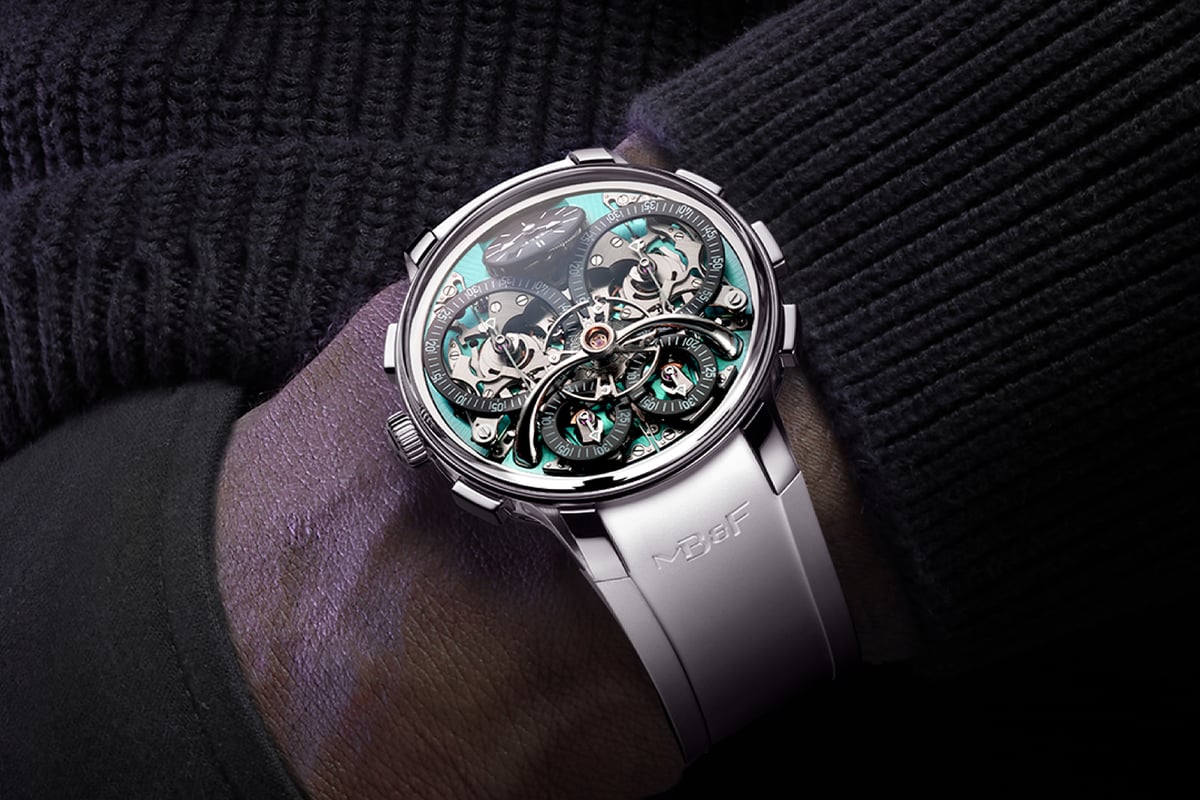
The movement is manual winding, with 592 components, 59 jewels, a frequency of 21,600 vph, and a power reserve of 72 hours. The case is zirconium, 44mm across and 18.2mm thick, with sapphire crystal front and back and water resistance to 30m. There is no lume. This is not a dive watch or a field watch. It is a high-horology daily wearer for someone who values function over rough use.
Brand context
MB&F was founded in 2005 by Maximilian Büsser in Switzerland. The brand built its reputation on radical Horological Machines and then, from 2011, on the more classical Legacy Machine line. The LM Sequential EVO sits at the intersection of those two impulses: the movement is experimental, but the case and dial follow the round, wearable Legacy Machine template. It was developed with Stephen McDonnell, whose work on the LM Perpetual and other MB&F projects has a reputation for architectural thinking. The result won the Aiguille d'Or at the 2022 GPHG, which matters less for daily wear than for collector context, but it explains why the watch has stayed in demand.
Movement and Twinverter logic
The Twinverter is the heart of the experience. On a normal dual chronograph, you need separate pushers for each counter, and the interaction between them can be confusing. Here, the pushers and the Twinverter let you choose the relationship between the two chronographs. You can run them independently, or you can configure them so that starting one stops the other. For lap timing, that is intuitive. For split timing, it is a different mental model from a rattrapante, but it works. The two column wheels and two vertical clutches are visible through the back, and the movement finishing is at the level you expect from MB&F: broad bridges, polished bevels, and a sense of depth rather than flat decoration.
The manual-winding format suits the watch. A dual chronograph with this much going on does not need an automatic rotor obscuring the view, and the 72-hour reserve means you can take it off for a weekend and pick it up again without resetting. Winding is part of the ritual. The crown is easy to grip, and the pushers have a crisp, mechanical action. This is not a soft or vague chronograph. You feel the mechanism working, which is part of the appeal.
Case, dial, and legibility
The 44mm zirconium case is the first thing you notice. Zirconium is lighter than steel, and that matters at this thickness. The watch is 18.2mm tall, so it is not slim. It will not slide under a tight shirt cuff without complaint. But the case is well shaped, with a rounded profile and a wide opening that keeps the dial readable. The bezel is modest, and the lugs curve down enough that the watch sits on the wrist rather than perching on top of it. The practical point is that the case wears like a large round watch, not like a rectangular brick.
The dial is openworked but not chaotic. The two chronograph registers are the organising feature. The hours and minutes are legible enough for daily use, and the chronograph hands are distinct. In low light, the lack of lume is obvious. This is a watch for restaurants, offices, trains, and collectors' dinners, not for a night hike. The sapphire crystal is clear, and the anti-reflective treatment does its job. The caseback view is excellent, and the movement is worth the transparency.
On the wrist for a week
Comfort is better than the dimensions suggest. The zirconium case keeps the weight down, and the rubber strap holds the watch in place without the need for a tight fit. The strap is not an afterthought. It suits the sporty side of the watch and makes the 44mm case feel less formal than a leather strap would. The pin buckle is simple and secure. Over a week, I found the watch balanced on the wrist, with no tendency to rotate. The thickness is the main compromise. It sits high, and you will notice it when you button a cuff or put on a jacket. If you are used to a 12mm dress watch, this will feel like an instrument. If you are used to modern sports chronographs, it will feel familiar.
The wrist presence is strong but not ridiculous. The open dial and twin registers draw the eye, and the zirconium case has a subdued grey tone that keeps it from looking flashy. It reads as a serious mechanical object rather than jewellery. On a smaller wrist, the 44mm diameter will be the limit. On a larger wrist, it will feel substantial without being oversized. The key is that the case is comfortable enough to wear for a full day, which is not always true of high-horology chronographs.
Accuracy and daily use
This is not a COSC-certified movement, and a dual chronograph is best judged over time rather than on a timing machine alone. In normal wear, expect a few seconds per day, with some variation when one or both chronographs are running. The vertical clutches help avoid the amplitude loss you can get with horizontal-clutch chronographs, but running two chronographs still asks more of the movement than simple timekeeping. My expectation for a watch at this level is stable, predictable timekeeping rather than quartz precision. The 72-hour power reserve is useful, and the manual wind means you are never fighting a rotor to keep it alive.
Daily use is where the Twinverter earns its keep. I timed coffee, a train delay, and a parking meter. I used one chronograph for elapsed time and the other for a second task. The controls became intuitive faster than I expected. The pushers are not hidden or fussy, and the layout makes sense once you stop thinking of it as a traditional chronograph. The lack of date is not a problem. The lack of lume is a deliberate choice. The 30m water resistance is enough for hand washing and rain, but not for swimming. This is a watch to wear with care, not to treat as a tool watch.
Occasions and ownership
The LM Sequential EVO works for formal settings because the case is round and the dial is open but not loud. It works for weekends because the rubber strap and zirconium case are casual enough. It works for travel because the two chronographs can track different time intervals, though it is not a GMT. It does not work for dressy occasions that demand a thin watch under a tight cuff. It does not work for sport in the sense of swimming or contact sports. It is a daily wearer for someone who wants a mechanical companion with a party trick that is actually useful.
Ownership is not casual. This is a limited edition of 100 pieces, and service should go through MB&F authorized partners. The movement is complex, and a generalist watchmaker should not touch it. The rubber strap is comfortable and practical, but you should expect to replace it over time. The pin buckle is simple and robust. The watch is not cheap to own, but it is not fragile in normal use. It is the kind of object that rewards attention and punishes carelessness.
Value, alternatives, and verdict
The LM Sequential EVO was priced around $170,000 at launch, and it sold out quickly. Current retail is effectively closed. Pre-owned examples trade above retail when they appear, which is typical for a limited MB&F with a GPHG win and a genuinely novel movement. There is no major public auction history yet, so the secondary market is driven by private dealers and collector demand rather than auction records. If you can buy at retail, the value is in the watch itself. At speculative secondary prices, you are paying for scarcity as much as horology.
Alternatives are few. The A. Lange & Söhne Double Split is a different kind of dual chronograph, with a more classical case and a split-seconds mechanism. The Patek Philippe Ref. 5370P is a split-seconds chronograph with classical finishing and a very different ownership experience. The F.P. Journe Chronographe Monopoussoir is a single-pusher chronograph that prioritises feel and purity. None of them offers the Twinverter logic. That is the LM Sequential EVO's real advantage. It is not just another high-end chronograph. It is a new way to use two chronographs.
The verdict is positive, with caveats. The case is thick, the price is high, and the watch is not for every wrist. But the Twinverter system is not a gimmick, the legibility is good for an openworked dial, and the zirconium case makes the size manageable. If you want a collector-grade daily wearer that rewards use rather than safe storage, the LM Sequential EVO is one of the most convincing MB&F watches yet. If you want a thin dress watch or a robust sports chronograph, look elsewhere.