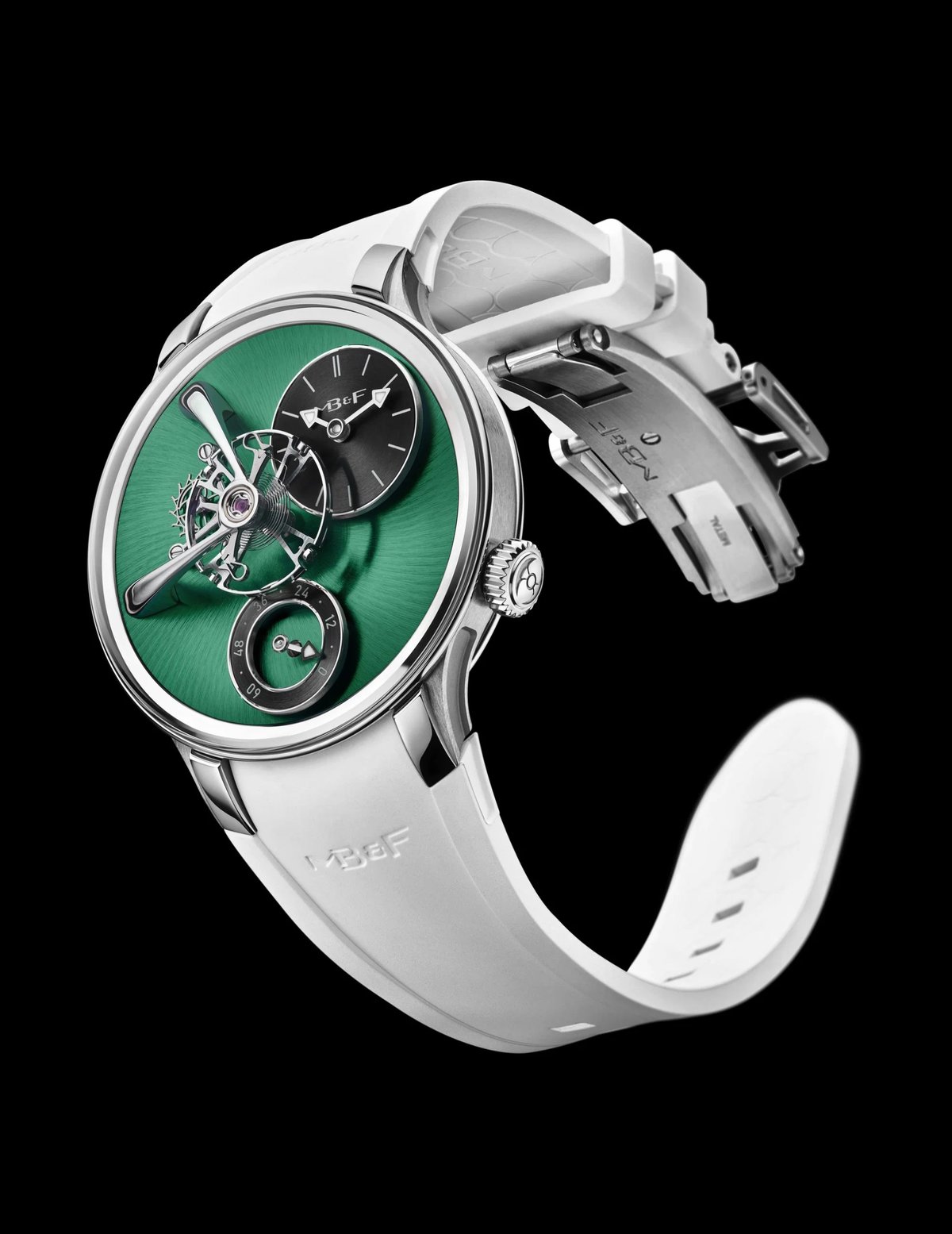
MB&F LM101 EVO: The Collector’s Sculpture
The MB&F LM101 EVO is not a watch that asks for permission. It is the quieter, more wearable branch of the Legacy Machine family, but it still arrives with the kind of theatrical movement architecture that made Maximilian Büsser’s independent label a collector obsession. Where many high horology pieces hide their drama under a conventional dial, the LM101 EVO puts the balance and the movement itself on display.
The original Legacy Machine 101 distilled MB&F’s radical language into something closer to a classical wristwatch: a single time display, a power-reserve indicator and an elevated balance that turns the dial into a small stage. The EVO treatment updates that formula for people who actually want to wear the watch, not just archive it. The result is a piece that feels less like a safe dress watch and more like a wearable sculpture with a very serious engine underneath.
This review looks at the LM101 EVO as a collector’s object and as a real wrist companion: what the EVO changes, how the movement reads on the wrist, where it fits among independent alternatives, and whether the price makes sense for a discerning buyer who cares about craft, character and long-term ownership.
The Brand and the Legacy Machine Context
MB&F was founded in 2005 by Maximilian Büsser, a former watch-industry executive who wanted to build a different kind of horological company. Instead of chasing traditional maison history, MB&F built a collaborative studio model: work with brilliant independent watchmakers, designers and engineers, then produce small-series watches that feel like mechanical art objects. That model produced the Horological Machines, a family of radical three-dimensional watches that looked unlike anything else in luxury horology.
The Legacy Machine line, launched in 2011, was a pivot toward a more classical silhouette without abandoning the brand’s love of visible mechanics. The LM101 arrived as a distilled version of that idea. It took the Legacy Machine language — exposed balance, hand-finished movement, a focus on architecture — and reduced it to a single time display and a power-reserve indicator. For many collectors, it became the most wearable entry point into MB&F’s world.
The LM101 EVO continues that story. It keeps the LM101’s essential character while pushing it toward daily wear. The EVO name signals a more casual, more robust attitude, but it does not turn the watch into a sports watch. It simply removes some of the preciousness that can make independent high horology feel like a safe-queen object. The result is a watch that still feels special, but less fragile in the way it is used.
What the EVO Changes
The EVO treatment is not a cosmetic refresh. It is a rethinking of how the watch sits in real life. The LM101 EVO is built around the idea that a collector might want to wear a suspended-balance MB&F with a T-shirt and jeans, not only with a suit. The case and strap package reflect that: the titanium version is lighter and more casual, the rubber strap gives it a more relaxed posture, and the overall look is less formal than the original LM101.
That does not mean MB&F softened the design. The LM101 EVO still has the brand’s signature sense of theatre. The balance is elevated above the dial, the movement is visible and the dial layout is deliberately unconventional. The EVO is simply more comfortable with being worn hard. It is the rare independent high-horology watch that feels like it could be a regular part of a rotation rather than a special-occasion-only object.
The most important change is psychological. The original LM101 could feel like a watch you kept in a safe. The LM101 EVO feels like a watch you take to dinner, to a gallery opening, to a weekend away. It is still precious, but it is no longer precious in a way that stops you from enjoying it.
Movement and Architecture
The LM101 EVO is powered by a proprietary MB&F manual-wind calibre with an elevated balance, hand-finished bridges and a power-reserve display. The movement is not hidden behind a conventional dial. It is the reason to buy the watch. The large balance is the visual anchor, and the architecture makes the watch feel like a small mechanical theatre on the wrist.
The manual-wind format is part of the appeal. This is not a watch for someone who wants to pick it up and go without thinking. It asks for a ritual: wind it, set it, wear it. That interaction is a feature, not a bug. In a market full of automatic luxury watches that disappear into the background, the LM101 EVO keeps the owner connected to the act of keeping time.
The calibre is built around an 18,000 vph frequency and a 60-hour power reserve, which gives it a generous window between windings while keeping the movement’s character visible. The lower beat rate suits the large balance and the old-school independent feel. Finishing is a major part of the experience: bridges, anglage and the kind of hand-work that collectors look for in small-series independent watchmaking. This is not a movement designed to be efficient above all else; it is designed to be looked at.
The power-reserve display is integrated into the dial rather than treated as an afterthought. It reinforces the manual-wind relationship between owner and watch. You can see how much energy is left, and you can decide when to wind. That simple interaction makes the watch feel more mechanical and more personal than an automatic piece with no visible energy indicator.
Wearing the LM101 EVO
At 40mm, the LM101 EVO sits in a wearable zone that makes it feel more approachable than MB&F’s larger Horological Machines. The case is sculptural and deliberate, with a profile that reads as an object rather than a slab. The domed sapphire gives the dial a magnified, almost vitrine-like quality, and the suspended balance dominates the view in a way that is impossible to ignore.
On the wrist, the watch is balanced and surprisingly easy to live with for a piece with this much visual architecture. The rubber strap and more casual overall attitude make the LM101 EVO feel less precious than the original LM101, while the suspended balance keeps it from becoming just another independent dress watch. It is comfortable enough for a long dinner or a gallery day, but it still demands a certain amount of wrist awareness. This is not a watch you forget you are wearing; it is one you notice, and so does everyone else.
The EVO’s wrist presence is strong without being loud. It does not rely on a huge case or a flashy bezel. Instead, it uses depth, reflection and mechanical motion. The balance moves, the light catches the domed crystal, and the dial has a layered quality that rewards close looking. It is the kind of watch that starts conversations with people who know watches, and curious questions from people who do not.
Comfort is helped by the lighter titanium case and the rubber strap. The watch feels more secure on the wrist than a formal leather-strap piece, and it is less likely to feel overly precious in warm weather or at a casual event. It is not a sports watch, but it is a watch that can handle more of life than its architecture might suggest.
Accuracy and Ownership
The LM101 EVO is not a chronometer-certified watch, and that is not really the point. With its large balance and manual-wind architecture, real-world accuracy should be judged over weeks rather than single days. Expect a stable rate that can drift into the low tens of seconds per day depending on winding habits, temperature and position. Owners should wind consistently and have the watch regulated by MB&F or a qualified specialist if the rate moves outside their comfort zone.
The manual-wind routine is part of ownership. The 60-hour power reserve gives you room to skip a day, but the watch is happiest when it is kept running and wound regularly. The power-reserve indicator makes that relationship visible, which is one of the small pleasures of the LM101 EVO. It turns maintenance into a tactile ritual rather than a chore.
Service and parts should be handled through MB&F’s authorized network or a recognized specialist familiar with high-complication manual-wind movements. This is not a watch for a local mall repair shop. The finishing, the suspended balance and the small-series architecture all demand proper care. Buyers should factor that into the total cost of ownership rather than treating service as an afterthought.
Dial, Case and Strap in Detail
The dial is where the LM101 EVO’s personality is most obvious. It is not a conventional three-hand layout. The time display is deliberately separated from the balance and power-reserve elements, creating a sense of depth and asymmetry. The result is a dial that feels architectural rather than decorative. It is designed to be read as a composition, not just as a time-telling surface.
The case is equally deliberate. The 40mm titanium case gives the watch a lighter, more modern feel, while the red gold variant pushes it toward a warmer, dressier register. The EVO treatment adds a more casual strap setup, which changes the watch’s personality significantly. On rubber, it feels like an independent high-horology piece with a weekend attitude. On leather, it becomes more formal and more traditional.
The sapphire crystal is domed and highly transparent, which is important because the movement is the star. The crystal magnifies the balance and the dial details without distorting them. The case finishing is clean and sculptural, with the kind of alternating surfaces that catch light and emphasize the watch’s three-dimensional quality. The pin buckle keeps the strap package simple and focused on the watch itself.
There is no lume, and that is consistent with the watch’s purpose. The LM101 EVO is not a tool watch. It is a mechanical object for people who appreciate architecture, finishing and the theatre of a suspended balance. If you need nighttime legibility or water-sport utility, this is the wrong watch. If you want a watch that feels alive in daylight and under restaurant lighting, it is exactly right.
Variants and Family
The LM101 EVO is offered in more than one personality. The titanium version is the more casual, more modern choice. It is lighter on the wrist, pairs naturally with the rubber strap and feels like the EVO concept in its purest form. The red gold version is warmer and more traditional, with a dressier presence that appeals to collectors who want the LM101 architecture in a more formal package.
Within the MB&F family, the LM101 EVO sits alongside the Legacy Machine Perpetual EVO and the Legacy Machine Split Escapement EVO as part of the brand’s more wearable Legacy Machine line. It is also a direct descendant of the original LM101, which remains the reference point for collectors who want the purest version of the single-display Legacy Machine idea. The EVO is not a replacement for the original; it is a different attitude toward the same architecture.
The LM101 EVO also belongs to the broader MB&F universe, which includes the Horological Machines. Those pieces are more radical and more sculptural, while the Legacy Machine line is more classical in silhouette. The LM101 EVO is the bridge between those worlds: it has the wearability of a traditional watch and the mechanical drama of an MB&F.
Alternatives and Homages
Buyers considering the LM101 EVO are usually looking at independent high horology rather than mainstream luxury. The F.P. Journe Chronomètre Souverain is a natural alternative for collectors who want a manual-wind dress watch with a power-reserve display and a cult following. It is more classical and less theatrical, but it has a similar appeal for people who care about movement culture.
The Greubel Forsey Signature 1 is another independent alternative, with a more artisanal and sculptural approach to hand-finishing. The Voutilainen Vingt-8 appeals to collectors who prioritize movement finishing and a large, expressive balance in a classical case. The Romain Gauthier Logical One offers a different kind of visible mechanism drama, with a power-reserve architecture that is very much its own thing.
There is no credible direct homage to the LM101 EVO. The suspended balance, case architecture and movement layout are too distinctive to have spawned a budget clone. That is part of the appeal. This is not a watch that can be copied easily, and it is not a watch that fits into the usual luxury-watch value equation. It is a small-series independent object with a very specific point of view.
Investment and Service
The LM101 EVO is a collector’s watch, but it is not a mainstream asset. Pricing is dealer-dependent and varies by case metal, configuration and market timing. Buyers should expect to pay a meaningful premium for the independent label, the small-series production and the movement architecture. The value proposition is not about quick flipping; it is about owning a piece of MB&F’s mechanical theatre in a wearable form.
Resale is narrower than it is for mainstream steel sports watches. That is true of most independent high horology. The LM101 EVO should hold attention and value better than fashion-driven luxury, but it is not a liquid asset. The right buyer is someone who wants the watch for its design, finishing and movement, not someone who needs to sell it quickly.
Service should be handled through MB&F’s authorized network or a recognized specialist. The watch’s architecture and finishing demand proper care, and owners should budget for that over the long term. This is part of the deal with independent high horology: you are not just buying a watch, you are entering a relationship with a small-scale maker and its specialist network.
Pros and Cons
The LM101 EVO’s greatest strength is its emotional pull. The suspended balance and the visible movement architecture make it feel alive in a way that most luxury watches do not. The manual-wind format adds ritual, the finishing adds depth, and the EVO treatment makes it easier to wear regularly. It is a watch that rewards close looking and long ownership.
The weaknesses are equally clear. It is not a daily beater, it has no lume, and it is not designed for water sports. Service requires a specialist network, and resale is less liquid than mainstream alternatives. These are not flaws in the watch; they are part of its character. The LM101 EVO is not trying to be everything to everyone. It is trying to be a specific kind of independent high-horology object for a specific kind of collector.
Final Verdict
The MB&F LM101 EVO is a rare thing: an independent high-horology watch that feels alive on the wrist without becoming a caricature. It rewards collectors who care about movement architecture, finishing and the sheer pleasure of a suspended balance, and it is wearable enough to justify the EVO name. Buy it because you want a piece of MB&F’s mechanical theatre in a more composed form — not because you expect it to behave like a mainstream asset.
For the sophisticated young collector, the LM101 EVO is a serious statement. It says you know the difference between a luxury product and a mechanical object with a point of view. It is not the obvious choice, and that is exactly why it works.