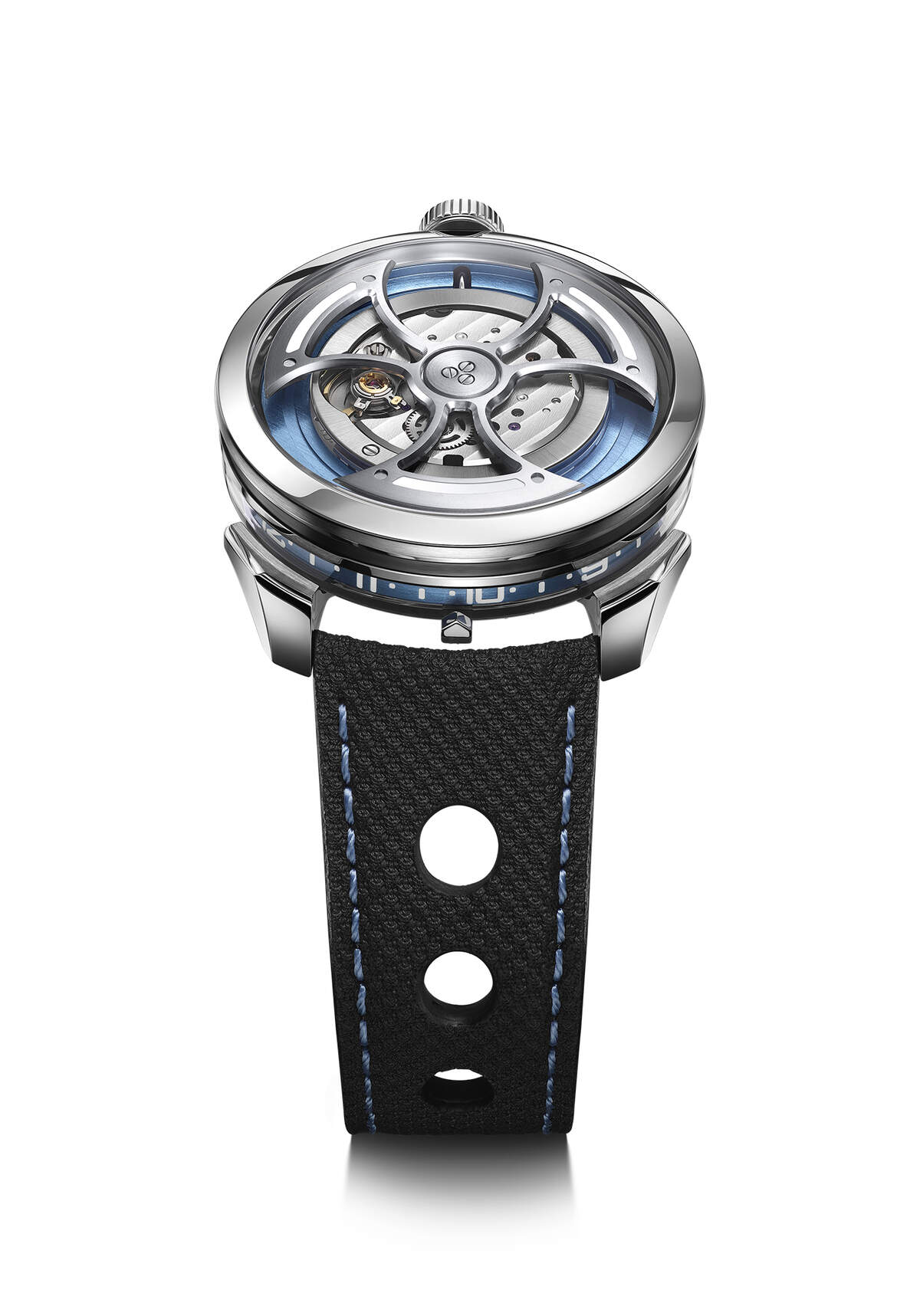
A thank-you that became a watch
Every serious brand has a piece that exists for reasons other than commerce, and MB&F's is the M.A.D.1. When Maximilian Büsser's Geneva atelier put it together in 2021, it was not a product launch in any conventional sense. It was a gesture — an object made for the collectors who had followed a small, strange, stubbornly three-dimensional watchmaker for a decade and a half, offered at a price that had more to do with gratitude than with margin, and allocated by draw rather than through a dealer network.
The name came from the M.A.D. Gallery, Büsser's side venture in kinetic mechanical art, which has outposts in Geneva and Asia. That lineage matters, because the M.A.D.1 is not really a wristwatch in the Horological Machine tradition. It is a small piece of mechanical sculpture that happens to tell the time, built to a budget, and the budget is the whole point. MB&F's core collections begin where most collectors' ceilings sit; the M.A.D. line begins at the floor of what a considered buyer can justify.
What nobody at the brand anticipated was the reaction. The M.A.D.1 became the most discussed release of its year, and the second-hand market did what second-hand markets do when a desirable object is deliberately under-supplied. The M.A.D.1S, the compact reinterpretation reviewed here, is the considered response: not a reissue, not a colourway, but the same thesis with the proportions corrected.
What the architecture actually is
Strip the M.A.D.1S down conceptually and there are two ideas in it, both taken directly from Büsser's larger machines.
The first is the rotor. In a conventional automatic, the oscillating weight lives on the back of the movement, hidden beneath a solid caseback and appreciated only by the person who takes the watch off. In the M.A.D.1S the winding train has been inverted, so the weight sits above the movement on the dial side, beneath the sapphire, and the rotor becomes the face of the watch. It is a three-blade affair in anodised aluminium — a turbine, not a semicircle — and its rotation is the object's principal source of motion and delight. Nothing about it is disguised. You can see the thing wind.
The second idea is the time display. There are no hands. The hours and the minutes are printed on two aluminium cylinders set laterally into the flanks of the case, turning continuously and read against small fixed indices cut into the case band. Head-on, the watch appears to be an abstract composition of rotor and plate. Tilt the wrist, and the time appears in profile on either side. It is a deliberate refusal to make the reading of the time easy, and it is why the M.A.D.1S feels like a piece of the brand's language rather than a watered-down version of it.
The S designation signals what has changed: the case has been brought down and the profile compressed, so the architecture no longer sits on the wrist like an architectural model. Everything else is intact. The trade-off — and it is a real one — is that the M.A.D.1S is less of a statement from across a room than the original. It has traded some of its aggression for something closer to wearability, and it is a better watch for it.
The movement, and the honesty of it
Inside is a Miyota-based automatic, re-engineered by M.A.D. Editions around an inverted winding train. The industrial base is the reason the watch exists at its price, and it is worth being plain about what that means: this is not a hand-finished, hand-bevelled, Geneva-sealed caliber. The plates are brushed, the finishing is functional, and the pleasure comes from the geometry of the winding mechanism rather than from the decoration of a bridge.
MB&F does not pretend otherwise, and that lack of pretension is precisely what makes the watch credible. A brand that has built its reputation on eight-figure-complexity machines choosing a Japanese workhorse for its accessible line is not a compromise; it is an editorial decision about where the money should go. Here, the money goes into the case architecture, the rotor, and the cylinder display — the parts you actually look at.
Running at 28,800 vibrations per hour with roughly forty-two hours of autonomy, the caliber is entirely adequate to its task. It is not COSC-certified, it does not claim to be, and the absence of a seconds hand removes the daily tyranny of rate-checking that afflicts owners of chronometer-certified pieces. That is either a limitation or a liberation, depending on your temperament.
Case, finishing and the question of size
MB&F has not published the full dimensional set for this reference in the way it does for its Horological Machines, and I have left those figures out of this review rather than fill them with numbers borrowed from a sibling. What can be said with confidence is relational: the M.A.D.1S is meaningfully more compact and noticeably flatter than the original M.A.D.1, and that single fact changes the ownership experience more than any other element of the design.
The case is stainless steel, with the mix of brushing and polishing that MB&F applies well even at this level. The flanks, where the cylinder apertures are cut, carry the most interesting surfaces: the chamfers around those openings catch light in a way that makes the watch look more expensive than it is. The crystal is sapphire, domed over the rotor, and it is the correct choice — an acrylic dome would have softened the rotor's edges, and the rotor's edges are the point.
There is no luminous treatment anywhere, which is worth stating plainly. This is not a watch to read in the dark, and the lateral apertures make lume impractical in any case. It comes on a leather strap with a pin buckle, a deliberately ordinary pairing that keeps attention where it belongs.
On the wrist
The original M.A.D.1 was a watch you admired and then took off. The S is a watch you forget you are wearing until someone asks about it — and they will ask, because the rotor is visible through the crystal from arm's length and it moves.
The weight distribution is the quiet achievement here. With the oscillating weight on the dial side, the mass sits higher in the case than in a conventional automatic, and in the original that produced a faint lurch on the arm. In the S, the reduced overall volume and flatter profile mean the rotor's inertia registers as a gentle rotation rather than a wobble. It is perceptible; it is not intrusive.
Reading the time takes a fortnight to become automatic. New owners tend to rotate the wrist outward, catch the minute cylinder, then rotate further for the hour — two movements where one used to do. Once the habit forms, it becomes part of the ritual, and ritual is a large part of why anyone buys a watch like this in the first place. The one genuine frustration is the absence of any seconds indication: you cannot use the M.A.D.1S to time anything, and you cannot easily verify its rate.
Accuracy in the real world
Expect something in the region of ten seconds slow to twenty seconds fast per day, with well-regulated examples routinely doing better. Because there is no seconds hand, rate must be assessed differently: note the minute cylinder against a reference clock, wait twenty-four or forty-eight hours, note again, and divide. It is a mildly absurd process that produces a mildly useful number, and it suits the watch.
What matters more day to day is that the Miyota base is robust and undemanding. It tolerates being worn irregularly, it does not resent being left in a drawer, and it starts without ceremony. Owners of industrial-base automatics know this already; it is the least glamorous and most reassuring part of the ownership proposition.
The draw, the market and what the money buys
M.A.D. Editions does not sell through retailers. Pieces are allocated by draw to members of the brand's community, which means the retail price — set in Swiss francs and landing in the high three thousands of US dollars — is not the price most buyers will pay. The secondary market clears above it, as it has for every M.A.D. release, and the size of that premium is a function of scarcity rather than of horological content.
That distinction should govern any buying decision. The M.A.D.1S is a genuinely good object at its draw price and a speculative one above roughly six and a half thousand dollars. Nothing about the movement, the finishing or the materials justifies a large multiple; what justifies it is that the supply is capped, the community is deep, and the brand has never discounted a piece in its life. Capital tends to be preserved. It is not, however, enhanced.
There is no meaningful auction history to cite — these watches move privately, between collectors, in the way that small-series independents always have. Anyone quoting you a hammer price is quoting you an anecdote.
What else to consider
Buyers drawn to the M.A.D.1S are usually drawn to mechanical theatre at a sane price, and there are three honest alternatives. Christopher Ward's Bel Canto delivers a chiming complication with real design conviction for similar money and rather more conventional wearability. Trilobe's Les Matinaux reads the time through rotating rings — the same intellectual proposition, executed with a French independent's sensibility. And Ressence's Type 1 shows where the disc-reading idea goes when money is no object. None of them is an MB&F, and that is the point: the M.A.D.1S is the cheapest entry into a specific design language, not into a category.
For those who simply want the look, the homage market has answers — Xeric's Halograph II and CIGA Design's skeleton series both offer exposed mechanics and unconventional displays at a fraction of the price. They are not substitutes. They are reminders of how much of the M.A.D.'s effect comes from proportion and restraint rather than from the idea alone.
Verdict
The M.A.D.1S is the most honest watch MB&F makes. It takes a genuinely radical three-dimensional idea, executes it in ordinary stainless steel around an industrial movement, and does not pretend that the money went anywhere other than the architecture. It wears better than its predecessor, it loses nothing of the theatre, and it asks its owner to learn a small new habit in exchange for the pleasure of watching a turbine spin.
Judged as a machine, it is close to irresistible. Judged as an asset, it is merely sound. Buy it for the former reason, and the latter will take care of itself.