The short version
The M.A.D.2 REDemption is the red-accented variant of the second generation of MB&F's M.A.D. Editions — the project that began in 2021 as Maximilian Büsser's thank-you to the suppliers and friends who kept his independent studio afloat, and which has since become one of the most reliably oversubscribed watches in horology. It is not a Horological Machine and it is not a Legacy Machine. It sits in its own lane: a mechanical object built around an oscillating weight rather than around a dial, priced close to a mid-tier Swiss chronograph, and distributed through a draw rather than a shop floor.
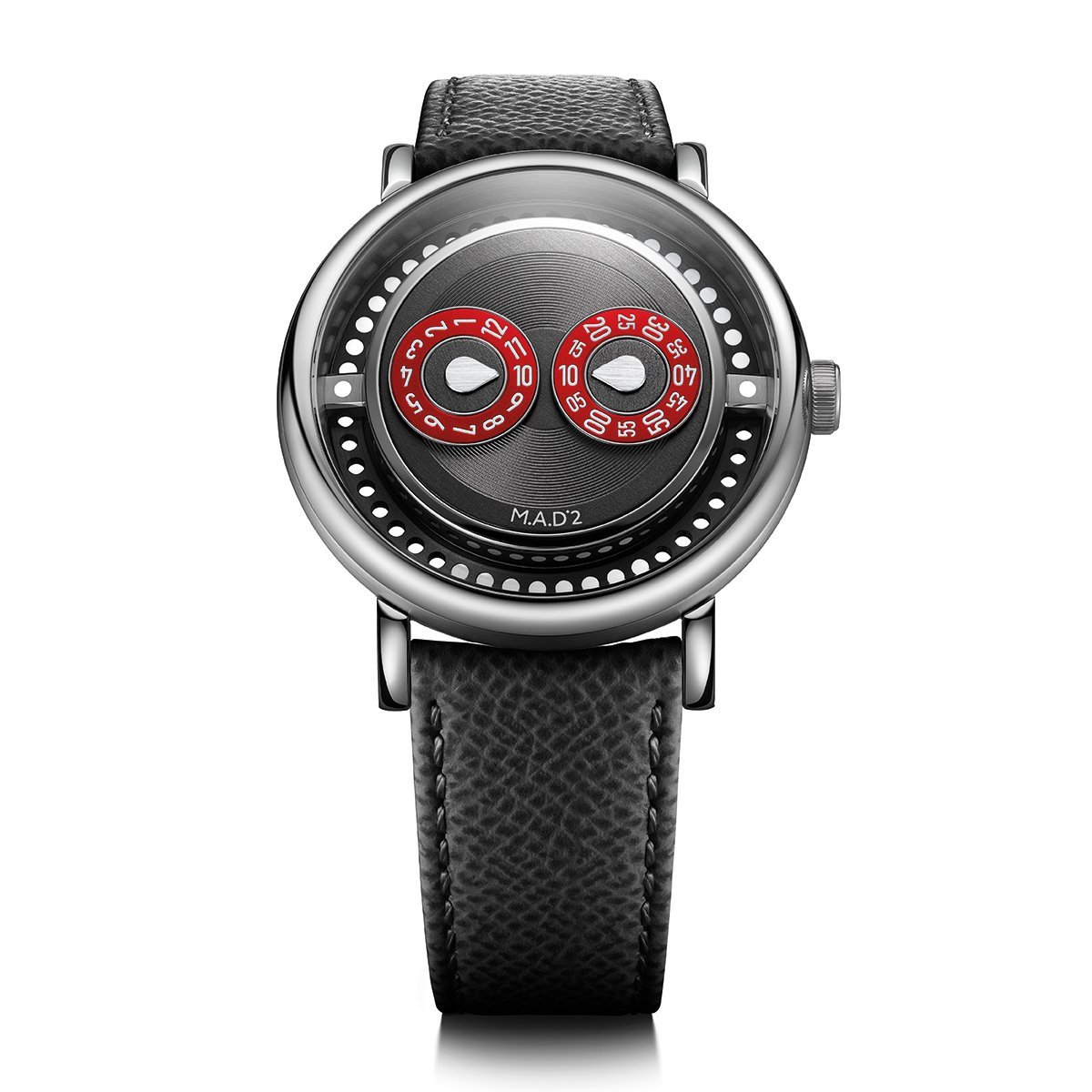
REDemption takes that formula and turns the volume up. Red on a watch like this is a statement, not a colour choice. In the metal it reads as an object rather than an instrument, which is precisely the M.A.D. brief: something genuinely unserious for people who already own serious watches.
Here is what matters for a buyer rather than a browser: what the REDemption is, how it actually wears, what it costs to service, what the secondary market is doing now that the initial scramble has cooled, and whether the premium above issue price is a position worth holding or simply the cost of getting in.
What M.A.D. Editions actually is
MB&F was founded in Geneva in 2005, after Büsser had spent years at Jaeger-LeCoultre and Harry Winston learning how the traditional side of the industry worked and, more usefully, how it failed. The brand's core output is radical three-dimensional watchmaking — the Horological Machines and the more classically inclined Legacy Machines — sold in tiny numbers at six-figure prices.
M.A.D. Editions was something else entirely. Launched in 2021, it was conceived as a gift rather than a product: a lower-cost, high-personality watch for the network of suppliers, partners and friends who had supported the studio. The first M.A.D.1 was built around a supplied Miyota automatic whose oscillating weight had been re-engineered into an oversized, dial-side 'battle axe' rotor, with the time read laterally off rotating drums on the flank of the case rather than under a hand.
It became a phenomenon. The M.A.D.1 Red and Green followed, the draw system replaced the friends-and-family list, and the watches began trading at multiples of their issue price almost immediately. The M.A.D.2 is the second chapter — same conceptual architecture, a Swiss automatic in place of the Japanese unit, and a more refined execution. REDemption is its red interpretation.
None of this is marketing gloss. The M.A.D. line exists because the brand's founder wanted to give something back, and the resale behaviour of the first generation is a direct consequence of that being genuine rather than cynical.
Design: red as a statement, not a gimmick
The REDemption inherits the family's defining gesture: a domed sapphire crystal over an oversized, sculpted oscillating weight that dominates the front of the watch. The rotor is the dial. Everything else — the time display, the branding, the case furniture — is arranged around it. From arm's length the effect is slightly hypnotic; up close, the dome distorts the rotor's edge and the red accents bleed into the distortion in a way that photographs badly and looks excellent in person.
The lateral time read is the other signature. Hours and minutes appear on the flank of the case rather than under a conventional handset, which means the watch is legible when you tilt your wrist and unreadable when you do not. This is a deliberate inconvenience and it is worth being honest about: if you need to read the time in a meeting without drawing attention, this is the wrong watch.
The case is stainless steel, the crystal is sapphire, and there is no lume anywhere on the piece — a small but telling omission. MB&F is not pretending this is a tool. The strap is leather with a pin buckle, which is the correct decision on a watch this visually heavy: a bracelet would turn the whole thing into jewellery, and a deployant would add a layer of formality the design does not want.
Finishing is consistent and industrial. The case surfaces are crisp and evenly brushed, the red elements are applied rather than printed, and the whole thing has the slightly engineered, prototype-adjacent quality that the M.A.D. line has always traded on. It does not feel like a $4,900 watch in the way a Tudor feels like a $4,900 watch. It feels like something that was made in a smaller room by people who cared more about the idea than the margins — which, in this case, is accurate.
The movement and the rotor
MB&F does not publish a full technical data sheet for the M.A.D. line, and that is a deliberate choice rather than an oversight. What the brand will tell you is that the M.A.D.2 runs a Swiss automatic, and that the oscillating weight has been re-engineered so that it becomes the visual centre of the composition rather than a component hidden behind a caseback. Beyond that — calibre designation, jewels, frequency, power reserve, rate tolerance — nothing is officially confirmed.
For a collector this is a genuine frustration and a genuine part of the appeal. On one hand, at this price you would ordinarily expect a spec sheet you can argue with. On the other, the M.A.D. line has never been sold on specifications; it is sold on an idea, and the lack of a data sheet is consistent with a product designed to be experienced rather than compared.
What can be said with confidence is that the movement is a supplied Swiss automatic rather than an in-house calibre, that it is not chronometer certified, and that the finishing is machine-consistent rather than hand-bevelled. That is the correct expectation at this price and there is no point pretending otherwise. If you want in-house architecture and hand-finished bridges, MB&F will happily sell you a Legacy Machine for roughly twenty times the money.
The reworked rotor does have a practical consequence worth flagging: because the weight is a large, sculpted mass sitting on the dial side, the assembly is more exposed than a conventional automatic and less tolerant of careless handling. It is not fragile, but it is not a watch to throw in a gym bag either.
On the wrist
The M.A.D.2 wears like an object, not a watch. The case is broad, the crystal is the dominant surface, and the visual mass sits high on the wrist while the strap does the actual work of securing it. The leather is soft from the first wear and the pin buckle keeps the whole package light — this is not a piece that announces itself through the density of precious metal the way a solid gold dress watch does. What it does instead is catch light. The domed sapphire distorts the rotor underneath, and the effect from across a table is what people actually react to.
Balance is the thing to test before you commit. Because the design pushes mass outward, the head can rotate slightly on smaller wrists during the first hour of wear until the leather takes a set. Once it does, the watch settles into genuinely comfortable daily-wear territory — the kind of thing you put on Saturday morning and forget about until someone asks what it is.
I would not call it discreet. I would call it easy. Those are different problems, and only one of them is yours to solve.
Accuracy and daily ownership
There is no chronometer certification and no published rate tolerance. What you should expect from a well-regulated Swiss automatic in this class is stable running in the region of a few seconds to low double digits per day, with the usual positional variation that shows up when a watch spends eight hours on a nightstand.
The saving grace is the display. Because the time is read laterally rather than under a hand sweeping across a marked track, minor rate deviation is far less irritating in daily use than it would be on a conventional dial. You check the M.A.D.2 for the shape of the day, not for a train timetable. If precision timekeeping is a core part of why you own watches, this is not the piece you reach for — and MB&F would be the first to agree.
Power reserve is not published, so the practical advice is simply to wear it regularly or wind it deliberately. There is no date to reset and no complicated setting sequence, which makes it an unusually low-friction mechanical watch to live with.
Service reality
MB&F does not publish a service schedule for the M.A.D. line, and you should not assume a five-year interval just because that is industry convention. Because the rotor assembly has been reworked and the watch is distributed through the brand rather than through a dealer network, service should go back to MB&F or an authorised partner rather than to a competent generalist.
Budget for a quote rather than a fixed price. The upside is that the movement is a supplied Swiss automatic rather than a proprietary calibre, which historically keeps parts availability and labour hours in a more reasonable range than an in-house independent would. The downside is that you will not get a published number before you send it in, and you should factor that uncertainty into what you are willing to pay on the secondary market.
Price, resale and the hold question
At issue price — roughly $4,900 — the REDemption is honestly priced for what it is: an independent-brand object with genuinely original industrial design, built in small numbers, distributed by draw. The M.A.D.1 Red traded at multiples of its original price in the years after launch, and that memory is what drives most of the demand for the second generation.
The M.A.D.2 market is calmer. Pre-owned examples are changing hands in the mid-four to high-seven-thousand-dollar range depending on colourway, condition and, more than anything, whether the seller has the box and the original allocation paperwork. REDemption sits at the top of that band because red is the variant collectors ask for first, which makes it the most liquid and the easiest to exit. The trend is best described as stable: the initial premium has compressed as volume has grown, and there is no structural reason to expect a return to the launch-window multiples.
There is no meaningful auction history to point to. M.A.D. Editions trade almost entirely peer-to-peer through collector groups and a handful of specialist dealers, which means liquidity depends on the community rather than on saleroom demand. That is fine while the community is engaged and worth remembering if it ever is not.
My hold recommendation is straightforward. If you were drawn for the watch and you wanted it, hold it — the REDemption is a long-term keeper and the red dial is the version most likely to stay desirable. If you bought it specifically to flip into a spike, sell into strength, because the premium you are holding is access rather than scarcity.
What else to consider
The obvious alternative is inside the family: the standard-colour M.A.D.2 carries the same architecture and movement with a quieter palette and a smaller secondary premium, which is the rational purchase if you want the idea rather than the colour.
Outside the brand, the closest philosophical match is Ressence's Type 8 — the same refusal to read time conventionally, executed with more restraint and a flatter profile. Konstantin Chaykin's Joker Classic offers comparable cult-independent energy and allocation theatre at a higher entry point. And if what you actually want is mechanical theatre at a fraction of the money, Christopher Ward's Bel Canto delivers a chiming complication for less than the premium on a grey-market REDemption.
Verdict
The M.A.D.2 REDemption is the right watch bought for the wrong reasons by roughly half the people who chase it. As an object it is superb: a genuinely original piece of industrial design that happens to tell the time, made by the only independent with the self-awareness to sell it as a joke and the discipline to price it honestly. Nothing at this money looks remotely like it, and nothing at this money generates the same reaction across a dinner table.
But the investment case is thinner than the design case. The premium above issue price is a function of allocation scarcity rather than of the watch itself, and allocation scarcity has a habit of easing. Buy the REDemption because you want the thing on your wrist, not because you want the number to go up. If you do that, you will own one of the few modern watches that still feels like a secret — and you will not care what it is worth next year.