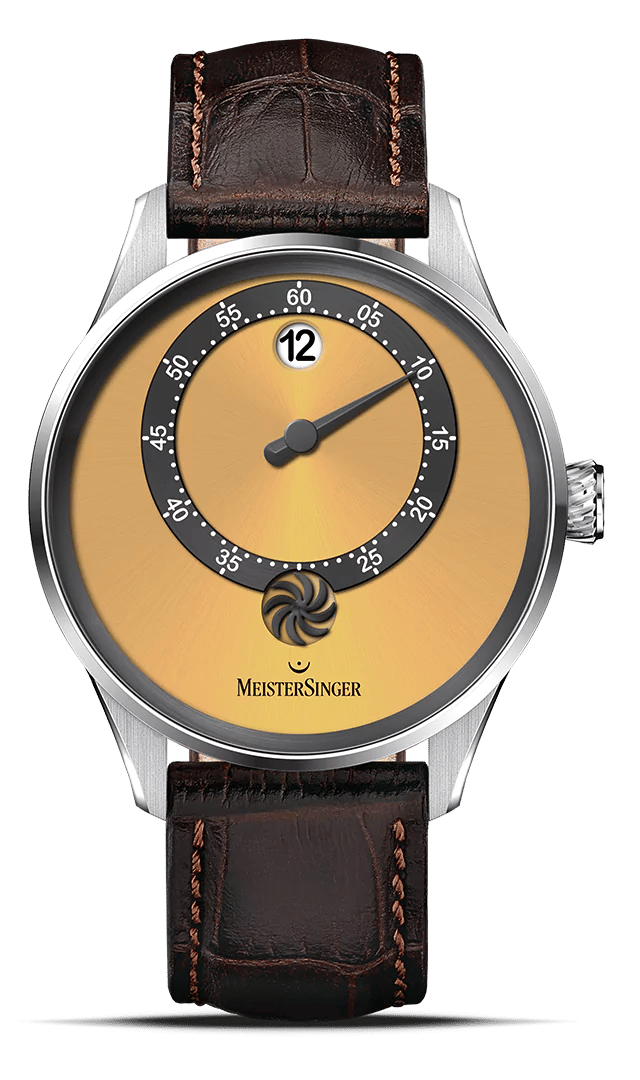
Meistersinger Panthero: The Case for One Hand
There is a moment, somewhere in the first week of wearing a Meistersinger, when you stop looking at your wrist to find out what time it is and start looking at it because you like looking at it. That moment is the entire product. The Panthero is a single-hand watch from a Münster brand that has spent more than two decades insisting the third hand was never the point, and in a market where every other release is a spec-sheet arms race, that stubbornness has curdled into something close to luxury.
The idea is simple and slightly absurd: one hand, a twelve-hour scale, and time read to the nearest five minutes. You will not be late because of it. You will, however, stop checking your wrist every ninety seconds, and that behavioural shift is what owners are actually buying. The Panthero is a watch that refuses to be a productivity tool.
The Münster School
Meistersinger was founded in Münster in 2001 by Manfred Brassler, and the brand's founding reference point was not a dive watch or a racing chronograph but the single-hand clocks that hung from medieval German town halls. Those clocks gave a whole square the time without pretending anyone needed it to the second. Brassler took that logic, wrapped it in clean typography, and has held the line ever since — through quartz crises, through the oversized-watch years, through the current enthusiasm for anything with a bracelet and a ceramic bezel.
The brand name itself refers to the Meistersinger guilds, the singer-poets of the German late Middle Ages. It is a romantic frame around a very pragmatic product, and the Panthero sits at the purest end of the catalogue: no power reserve indicator, no moonphase, no openworked dial, just a steel case, a leather strap and one hand doing all the work.
Dial and Design Logic
A single-hand dial creates an obvious compositional problem. One long hand sweeping across a wide, mostly empty field is inherently asymmetric, and most brands that attempt it solve the problem by adding hardware — a bezel ring, an aperture, a sub-dial. Meistersinger solves it with typography instead. The Panthero relies on a graduated minute scale printed in increments of five, a clean set of applied markers, and a restrained typeface that makes the whole layout feel intentional rather than under-furnished.
This is design doing the work of engineering. Because there is no seconds hand and no lume plot interrupting the markers, the dial reads as a single graphic object, and the effect is closer to a Bauhaus poster than to a piece of instrumentation. It also means the watch photographs beautifully — a non-trivial consideration in 2024, when half of a watch's life happens on a wrist shot posted to a group chat.
The learning curve is real but short. First day, you will find yourself squinting at the five-minute gaps. By the end of the second week, you will read the dial at a glance the way you read an analogue clock face in a train station. What you give up is precision. What you get back is a small, daily reminder that nobody has ever needed to know it was 4:47 rather than 4:45.
Case, Crystal and Strap
The Panthero is a stainless steel watch with a sapphire crystal, which is the correct spec sheet for a piece at this price in this decade. The case finish is restrained — polished surfaces where they catch light, brushed where they do not — and the whole geometry is designed to sit flat rather than to advertise itself. It is not a watch that announces arrival at a table.
The leather strap is the right decision and the right default. It softens the object, drops the visual weight, and lets the case hug the wrist instead of perching above it. The pin buckle is period-correct and honestly preferable here to a deployant, which would add mechanical ceremony to a watch whose entire argument is that ceremony is unnecessary.
What you should understand going in is that this is not a robust do-everything object. There is no lume, and the water resistance rating is not something to test in open water or even under a shower you are not standing next to. The Panthero is a desk watch, a dinner watch, a travel watch in the sense that it looks good in an airport lounge — not in the sense that it will survive a swim in a hotel pool.
The Movement
Inside, Meistersinger uses its MS 1.01 automatic, which is a Swiss Sellita SW 200-1 base reworked so that the single hand completes one revolution every twelve hours instead of driving a conventional hour-and-minute pair. That rework is the whole mechanical story, and it is a legitimate piece of engineering rather than a dial-side gimmick — the gear train is genuinely re-geared to make the one-hand display honest.
The power reserve sits around the thirty-eight-hour mark and the beat rate is a familiar 28,800 vibrations per hour. Finishing is industrial-clean, which is entirely appropriate at this price and largely academic anyway, since a solid caseback means you will never see it. There is no COSC certification and no pretension of certification. What you get instead is a movement with a global service footprint: any competent independent watchmaker has serviced a Sellita hundreds of times, which means you are never held hostage by a single service centre in a single country.
On the Wrist
The Panthero wears light, flat and unobtrusive. It slips under a shirt cuff without a fight and never catches on a jacket sleeve, which sounds like a small thing until you spend a day with a chunky chronograph and remember what friction feels like. Because there is no lume and no bezel furniture, the visual weight is all in the dial, and the watch ends up reading as jewellery-adjacent in a way that a tool watch never can.
Comfort is the quiet achievement. There is no crown digging into the back of the hand, no bracelet tugging at arm hair, no sense that the watch is a piece of equipment you are carrying around. It disappears. And that disappearance is cumulative — wear it for a fortnight and a three-hand watch starts to feel like a notification you cannot dismiss.
Presence is where you have to be honest with yourself. On a scale of one to five this is a three: nobody in a restaurant will notice it, and that is the point. But anyone who knows watches will notice it, and will ask about it, and you will get to explain medieval town hall clocks to a stranger at a bar. Which is a better evening than explaining why your bezel is ceramic.
Accuracy and Daily Ownership
The Panthero is not chronometer-certified, and given the format that is philosophically irrelevant. A regulated Sellita-derived automatic in this class typically settles somewhere between a few seconds and around fifteen seconds a day depending on how it is worn, and any competent watchmaker can tighten that during a routine service. But you are reading the time to the nearest five minutes. A ten-second daily variance is invisible in daily use.
Owners who track their watches with an app will find the number unremarkable. Owners who actually live with it will find they stopped caring within a week, which is a healthier relationship with a mechanical object than most of us currently have.
What It Costs to Own
Retail sits in the region of the high four figures in US dollars, and street pricing moves around with currency and dealer discounting. The second-hand market is soft — independent German brands in this bracket typically lose a third or so of retail on the secondary market, and the Panthero is no exception. The absolute loss is small, but the percentage is not flattering.
That is the correct lens through which to view it. This is not a steel sports watch with a waitlist; it is not going to appreciate while you sleep. It is a design-led object with a proper Swiss automatic inside, a serviceable movement, and a price that reflects an independent rather than a marketing department. Buy it to wear. The daily rate of return is excellent; the financial one is not.
Alternatives Worth Trying On
If you want German minimalism with three hands, the Nomos Tangente is the obvious comparison and a genuinely great watch at a similar price. If you want the Bauhaus look for less, the Junghans Max Bill Automatic delivers a softer, warmer version of the same idea. If you want German steel and legibility with actual water resistance, the Sinn 556 I is the tool-watch answer to the same question.
And if you want to test the one-hand concept before committing, Botta Design's UNO has been making the case for decades, and Slow Jo sells a 24-hour single-hand watch for a couple of hundred dollars. Spend a month with one of those and you will know within days whether this is a philosophy you can live inside.
Verdict
The Meistersinger Panthero is not trying to win a specification fight, which is exactly why it works. It is a well-made, quietly confident German automatic with a Swiss heart, a design argument strong enough to justify the entire object, and a price that respects the buyer. If your collection already covers dive, chronograph and travel categories, this is the watch that makes the rest of them feel loud. If you only own one watch, it is a more honest daily companion than most of what sits beside it in the case — provided you are ready to give up the seconds hand and, with it, a small piece of your need to know exactly.