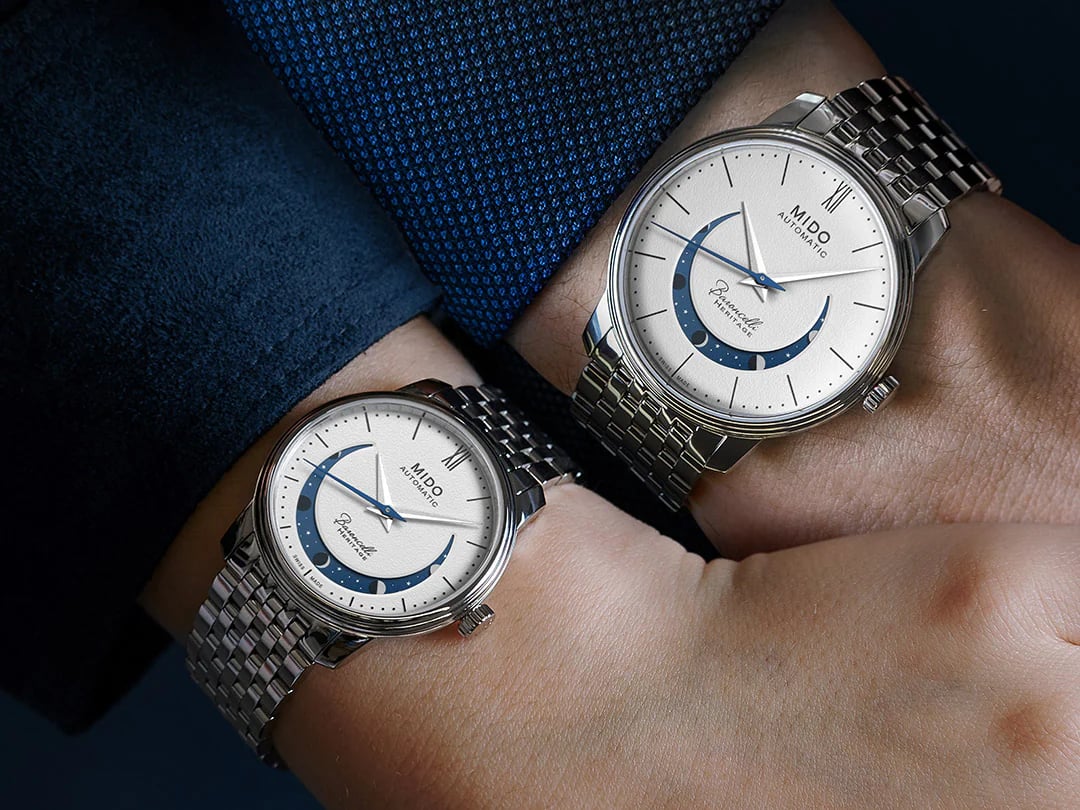
Romance without the premium
There is a specific kind of collector who shows up to a Wednesday dinner in a steel sports watch, and another who has quietly stopped caring what the group chat thinks. The Mido Baroncelli Heritage Smiling Moon is built for the second person. It is a moonphase — the least useful, most irresistible complication in horology — wrapped in the kind of restrained, mid-century dress-watch styling that the market spent a decade ignoring and has spent the last three years rediscovering.
Mido does not get a lot of oxygen in the luxury press. It sits inside the Swatch Group alongside Longines, Tissot and Omega, making honest Swiss automatics at prices that make comment sections go quiet. That is the brand's whole pitch, and the Smiling Moon is the pitch at its most charming: a proper moonphase, a proper automatic, a proper leather-strapped dress watch, without the deposit slip that usually arrives with the words moon and phase in the same sentence.
That matters more than it sounds. The last few years have taught collectors to be suspicious of hype — the MoonSwatch drop culture, the stainless steel waiting lists, the endless resale math. A watch like this one asks a different question: what if you just bought something beautiful, wore it, and stopped checking the market?
Mido: measuring instruments since 1918
Mido was founded in 1918 by Franz Schöpf in Biel, Switzerland — the town that still supplies half the Swiss industry with movements and the other half with people who will argue about them. The name comes from the Spanish Yo mido: I measure. It is a functional origin story for a brand that has always sold engineering rather than mythology.
The 1934 Multifort was one of the first watches to combine automatic winding, water resistance and antimagnetic protection in a single case — a combination that sounds mundane now and was genuinely radical then. That instinct, practical Swiss engineering at a fair price, is still the brand's spine.
What matters for this watch is the Baroncelli family, Mido's classical line. Where the Multifort and Ocean Star lean sporty and architectural, the Baroncelli is the brand's tuxedo: applied indices, slim leaf-style hands, a clean dial, a case designed to disappear under a shirt cuff. The Heritage sub-line strips it back further, dropping clutter and pushing the elegance. The Smiling Moon takes that canvas and adds the one complication that justifies a little theatre.
The dial: a moon with a sense of humour
The moonphase sits at six o'clock, and it is the reason anyone remembers this watch's name. Mido did not simply cut a crescent into a disc — the Smiling Moon leans into the whimsy, rendering the moon as a smiling face and letting it track the lunar cycle across a dark, star-flecked aperture. It is a small, warm joke embedded in an otherwise sober dial, and it lands precisely because everything around it is disciplined.
The rest of the dial is clean: tight printing, applied markers that catch light without shouting, leaf hands, a slim minute track, and no text doing battle with itself. There is also a date, which keeps the watch useful without crowding the composition. The moonphase would be enough on its own for a collector, but a daily-worn watch still has to answer the boring questions.
This is the hardest thing to do at Mido's price point, and the thing most microbrands fail. Anyone can make a moonphase look expensive by adding guilloché, gold and drama. Making one look calm is the trick. The Smiling Moon looks calm.
Sapphire crystal up front, and the Baroncelli Heritage line has historically been generous with an exhibition caseback — which matters here. You want to see a rotor moving when you have paid for a mechanical moonphase rather than a printed disc behind a quartz movement.
The movement: Caliber 80 and the lost weekend
The Smiling Moon runs on a Mido automatic from the Caliber 80 family, the Swatch Group's ETA-derived high-reserve architecture, here carrying a moonphase module. The headline number is the 80-hour power reserve, which is the single most useful specification in modern watchmaking and the one collectors chronically underrate. Take the watch off on Friday night, put it back on Monday morning, and it is still telling the right time and the right moon. No winder, no ritual, no resetting the calendar on a Tuesday because you forgot.
The architecture is deliberately unflashy: a 3 Hz beat, industrial-grade finishing, and a design brief that prioritises durability and service over decoration. That is fine. You are not buying a Mido for the anglage. You are buying it because a Swatch Group automatic is the most serviceable, most parts-available, least dramatic mechanical platform on earth, and because that reserve is a genuine quality-of-life feature rather than a spec-sheet flex.
It is not COSC-certified, and Mido does not submit this line for chronometer testing. What you get instead is a well-regulated modern Swiss automatic that holds a steady rate in normal wear — a watch that will be predictable rather than breathtaking, which is exactly what a daily dress watch should be.
On the wrist
Dress watches live or die on how they sit — whether they slide under a cuff, whether the caseback rests flush, whether the whole thing feels like jewellery or like a tool wearing a suit. The Smiling Moon is firmly in the first camp. The case is slim and compact, with a restrained profile that disappears under a shirt cuff the way a proper dress watch should. If you have spent the last five years in a chunky steel diver, the first ten minutes will feel like you forgot to put your watch on. That is the point.
The leather strap is the right call. A bracelet would make the watch heavier and more ordinary; slim leather keeps the proportions honest and lets the case read as a case rather than a lump of metal. Weight is modest, balance is neutral, and there is no rotation on the wrist. It is the kind of watch you forget you are wearing until somebody at dinner notices the moon and asks what it is.
The caveat is wrist presence. This is not a watch that announces itself across a table. It does not photograph like a hype piece and it will not win a wrist-shot contest. If that is what you want, look elsewhere. If you want something that reads as taste rather than money, this is the brief.
Accuracy and day-to-day life
Expect a modern, non-certified Swatch Group automatic to run within roughly ten seconds a day either way, with the usual positional variation — a few seconds fast on the wrist, slower dial-up overnight. It will settle after the first few weeks and then stay boringly dependable. Hacking makes setting it easy; the moonphase, like all moonphases, should be adjusted away from the changeover window so the disc and its finger are not fighting the crown.
Day to day, this is a desk watch, a dinner watch, a wedding watch. It has no lume and no business near water beyond a hand wash, and it will not survive being treated like a field watch. What it will do is make a Tuesday afternoon feel slightly more deliberate, which is a strange thing to pay for and a very good reason to own a mechanical watch.
What it costs, and what it is worth
At retail the Smiling Moon sits in the mid-four figures in most markets, which puts it in direct competition with the entry dress watches from Longines, Raymond Weil and Frederique Constant. On the secondary market it trades for roughly half — sometimes less — which is where the argument becomes genuinely compelling. Mido depreciates; that is simply how the brand's resale works. The flip side is that a moonphase with a Swiss automatic and a Swatch Group service network is available for less than plenty of people spend on a quartz fashion watch with a moon printed on the dial.
There is no auction history to speak of, and there never will be. Nobody is buying a Mido as a store of value. If you want the romance of a moonphase and the discipline of a sensible purchase, buy it used and never look at the resale page again. It will hold up far better than the money you would have spent on a hype watch that stopped being interesting in a year.
The competition
The Longines Master Collection Moonphase is the obvious step up: same group, more elaborate dial work, more money. The Frederique Constant Slimline Moonphase is the closest true rival, with in-house automatic movements and comparable restraint. Raymond Weil's Maestro Moonphase offers a more conventional moon and a similarly classical case. Below them, Tissot's Tradition Moonphase does the same job with fewer refinements.
Above them, everything gets expensive fast, and most of it is not meaningfully better at telling you what phase the moon is in. That is the strange, lovely truth of this category: the complication is democratic. The moon looks the same on a five-figure watch as it does on this one.
Verdict
The Smiling Moon is the rare affordable complication that does not feel like a compromise. It is a real moonphase in a properly elegant case, with a movement that will still be serviceable in twenty years and a dial that rewards a second look. It will not appreciate, it will not impress a room, and it will not survive a swim — none of which are the brief.
Buy it because you want to look at the moon on a Tuesday afternoon, and because spending five figures to do that is a choice rather than a requirement.