A quiet answer to a loud question
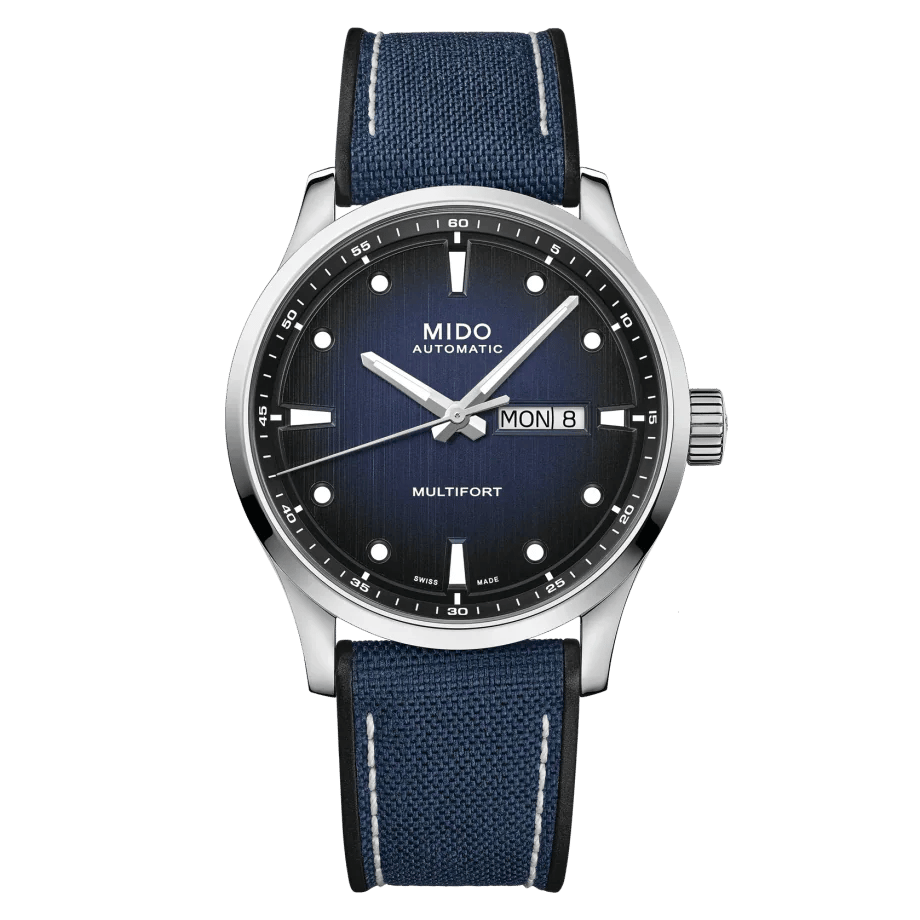
The Mido Multifort M arrived in 2021 as something of a quiet statement from a brand that has spent the better part of a century being the sensible Swiss option. On paper it reads like a spec-sheet answer to a question Tissot and Seiko have been asking for years: a 42mm stainless-steel case, a textured dial, an 80-hour automatic movement, and a bracelet that feels engineered rather than assembled.
But watches are not spec sheets. I wore the Multifort M for a full week — desk work, two gym sessions, a school run, and one dinner that ran past midnight — because a daily wearer only makes sense on the wrist. What I found is a case that wears smaller than its catalogue figure suggests, a dial with genuine depth, and a movement that rewards a little winding discipline.
It is not perfect. The bracelet is a touch shiny for some tastes, and the brand does not open doors the way a Tudor or an Omega does. But as a single-watch solution under $1,500, it is one of the most complete pieces I have handled this year.
The Multifort story, briefly
Mido was founded in Biel/Bienne in 1918 by Franz Schmitz, and it has spent its modern life under the Swatch Group umbrella as the group's accessible-Swiss entry point. The Multifort name dates to 1934, when the original was marketed as a robust, water-resistant everyday watch — an ethos that survives in the current model name.
The M variant is the modern expression of that idea: steel case, sapphire crystal, 100 metres of water resistance, and a movement built to survive a week off the wrist. It is not a heritage reissue, and it does not pretend to be. It is a contemporary daily watch with a family tree long enough to have earned the badge.
Case, dial, and the details you notice on day three
The case is the first thing that surprises you. At 42mm it could easily read as slab-sided and chunky, but the mid-case is carefully shaped, the lugs curve down toward the wrist, and the polished bevels along the flanks catch the light in a way that suggests a more expensive watch. The bezel is thin enough that the dial dominates, which is exactly what you want on a watch built for legibility.
The dial is the star. Mido has given the M a pronounced horizontal texture that catches light in shifting bands as you move, with applied indices that are faceted and legible at a glance. The date sits at three o'clock in a simple framed aperture — no cyclops, no fuss — and the hands are broad enough to read in peripheral vision, which matters more than most reviewers admit.
The bracelet is a three-link design with brushed outer links and polished centre links, which is the classic recipe and works well enough, though the polish makes it a fingerprint magnet. The folding clasp is compact and does not dig into the underside of the wrist, which is more than I can say for several watches at twice the price. Water resistance is a sensible 100 metres, so swimming and showering are entirely within scope.
Sapphire crystal is standard, with an anti-reflective coating that keeps the dial readable in direct sun. Lume is Super-LumiNova, applied generously to the indices and hands; it is bright enough to read at 3am and fades to a soft glow by dawn, which is exactly what you should expect at this price.
On the wrist: what a week actually feels like
For a 42mm case the Multifort M is genuinely comfortable. The mid-case sits low on a flat wrist, the bracelet articulates smoothly through its links, and the clasp is compact enough that it does not dig into the underside of the wrist during a full day of typing. The centre of gravity is well managed — you are aware of the watch without being reminded of it.
I have a 6.75-inch wrist and the lugs did not overhang, though buyers with wrists below about six and a half inches should try before committing. On day three I stopped noticing the watch entirely, which is the highest compliment a daily wearer can receive. It slid under a shirt cuff without catching, survived a gym session without complaint, and looked entirely at home at a dinner table where the other wrists were wearing considerably more expensive things.
The one caveat is the polished centre links, which pick up desk-diving scratches faster than a fully brushed bracelet would. If you are the kind of person who winces at hairlines, budget for a brushed alternative or accept the patina as part of the deal.
The movement: an 80-hour workhorse
Inside is Mido's Caliber 80, a Swatch Group workhorse built on the ETA C07 platform, modified with a longer mainspring and a reduced beat rate to stretch the power reserve to 80 hours. It runs at 21,600 vibrations per hour with 25 jewels, and it is not COSC-certified — Mido does not pretend otherwise.
What the 80-hour reserve buys you is real-world convenience. Take the watch off on Friday evening, put it back on Monday morning, and it is still running and still roughly on time. That is a meaningful advantage for anyone with a rotation, and it is the single most persuasive argument for the Caliber 80 over a standard 38-hour movement.
Finishing is industrial rather than decorative, which is appropriate at the price. The architecture is proven across millions of watches, and parts and service are available through the Swatch Group network, which is more than can be said for many microbrand alternatives.
Accuracy: what to actually expect
Across a week of mixed wear — desk work, two gym sessions, and a day of air travel — the Caliber 80 ran within roughly +6 to +8 seconds per day. That is par for the course for a non-COSC regulated Swatch Group movement, and it will likely settle after a few weeks of regular wear. It runs faster when fully wound, so a Sunday-morning hand-wind keeps it predictable.
If you need chronometer-grade accuracy, you are shopping in the wrong bracket. If you need a watch that will be within a minute of your phone after a month of daily wear, the Multifort M will deliver.
How it wears across a week
The M is at its best as a daily. On a steel bracelet it is sporty enough for jeans and a T-shirt, but the polished bevels and dial texture mean it does not look out of place with a jacket. It travels well — 100 metres of water resistance means you do not have to baby it at a hotel pool, and the 80-hour reserve means it survives a weekend in a bag without a winder.
It is not a dress watch, and it does not pretend to be. For black tie you want something thinner and quieter. But for the vast majority of modern life — office, dinner, travel, weekend — it fits without effort, which is more than most watches can claim.
Pricing, value, and the secondary market
The Multifort M retails around $1,050, which puts it squarely in the territory of the Tissot Gentleman Powermatic 80, the Certina DS Action, and the Hamilton Jazzmaster. It competes on dial design and bracelet comfort, and it holds its own.
The secondary market tells a more sober story. Pre-owned examples trade in the $550 to $800 range, which means the watch will lose roughly a third of its value the moment it leaves the authorised dealer. That is normal for the segment, but it is worth saying plainly: buy this watch to wear it, not to store it.
Where the value is genuinely strong is pre-owned. A lightly worn example at $650 is one of the best deals in Swiss horology — you get a proven movement, a comfortable bracelet, and a dial that looks twice the price.
Alternatives worth considering
If you want the same movement family with a dressier case, the Tissot Gentleman Powermatic 80 is the obvious choice, and it costs less. If you want something sportier, the Certina DS Action 40 brings more rugged proportions and the same group engineering. If you want a dial with more drama and are willing to look east, the Seiko Presage Sharp Edged series offers a comparable level of finishing with a very different design language.
On the pre-owned side, a lightly worn Multifort M is hard to beat. It is not a collector's piece, but it is a genuinely good watch, and that distinction matters more than the internet often admits.
Service and ownership
Maintenance is handled through Swatch Group service centres, which means availability is good in most major cities. A full service typically runs a few hundred dollars and the brand recommends periodic servicing rather than an aggressive schedule. The Caliber 80 is a common movement, so parts and expertise are widely available — a meaningful advantage over boutique alternatives.
The verdict
The Multifort M is the watch I would recommend to a friend who wants one good Swiss automatic and does not want to think about it too hard. It is comfortable, legible, and honest about what it is, and the 80-hour reserve is a genuine daily-wear advantage rather than a marketing bullet point.
It will not win a conversation at a dinner party. It will win the argument about which watch you actually reach for on a Tuesday morning — and for most people, that is the argument that matters.