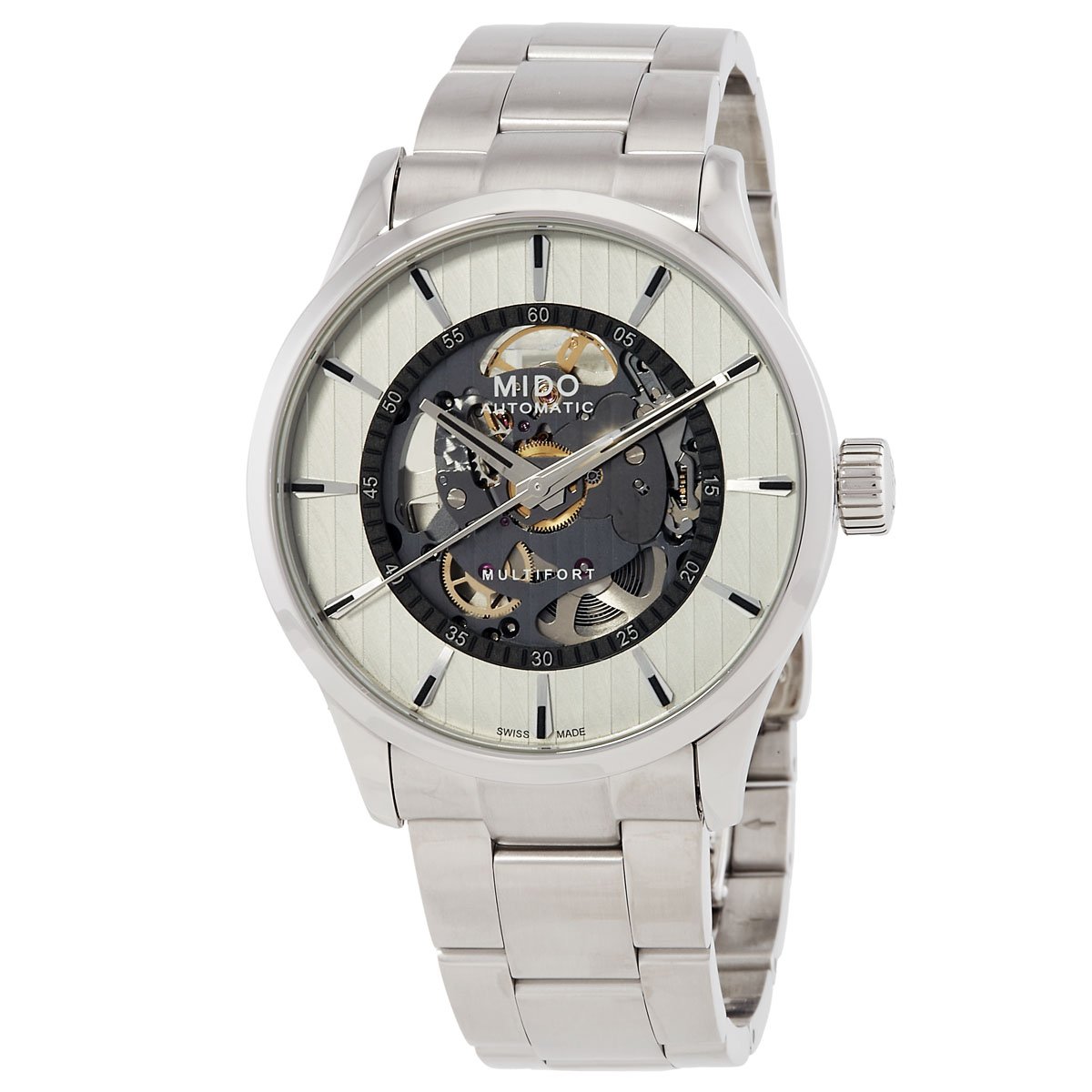
The Architecture of Time: A Week with the Mido Multifort Skeleton Vertigo
In the world of luxury horology, we often talk about 'transparency' in a metaphorical sense—brand heritage, pricing, and manufacturing ethics. But with the Mido Multifort Skeleton Vertigo (Ref. M038.436.11.031.00), transparency is the literal, physical mission statement. As a reviewer for Vivir, I am frequently asked if a skeletonized watch can truly serve as a 'one-watch collection.' Usually, the answer is a polite 'no'—most are too fragile, too illegible, or too ornate for the grocery store or a casual Friday. However, after seven days of continuous wear, the Skeleton Vertigo has forced me to reconsider my stance.
Mido has always occupied a fascinating space within the Swatch Group. While Tissot captures the high-volume entry-level and Longines dominates the heritage-chic market, Mido quietly produces watches that are arguably more robust and architecturally interesting. The Multifort line, inspired by the Sydney Harbour Bridge, has been the brand's backbone since the 1930s. In the Vertigo, those steel-girder vibes are translated into vertical Geneva stripes that run across the bridges of the skeletonized movement, creating a sense of depth that justifies the 'Vertigo' moniker.
Case Dimensions and Ergonomics: The 10.6mm Surprise
On paper, a 42mm watch can be daunting for those of us who prefer the classic 38-39mm range. However, the Skeleton Vertigo is a masterclass in how case geometry affects wearability. The lug-to-lug measurement is a sensible 48.5mm, but it’s the thickness—or lack thereof—that defines the experience. At 10.6mm, this watch is thinner than many dedicated dress watches. This slim profile allows the watch to hug the wrist, lowering the center of gravity and preventing the 'wobble' often associated with larger automatic timepieces.
During my week of testing, I wore the Vertigo with everything from a structured blazer to a heavy wool sweatshirt. The brushed finish on the case sides is resilient; it didn't pick up the 'desk diving' micro-scratches that polished surfaces usually attract within 48 hours. The screw-down crown is substantial and provides a tactile grip, reinforcing the 100-meter water resistance rating. This isn't just a watch for looking at; it’s a watch for living in.
The Dial and Legibility: Navigating the Steel Labyrinth
The primary critique of skeleton watches is that they are impossible to read at a glance. Mido combats this by using bold, faceted hands with a mix of sandblasted and polished finishes. The contrast against the silver-toned movement is surprisingly effective. The inner flange features a minute track with applied indices, providing the necessary reference points to tell time accurately within seconds.
The 'Vertigo' effect comes from the vertical Côtes de Genève that adorn the movement plates. Unlike traditional skeletonization, which removes as much material as possible to create thin webs of metal, Mido has left enough of the plate intact to serve as a canvas for these stripes. This provides a structured, industrial look that feels like looking down into the mechanical guts of a skyscraper. In low-light conditions, the Super-LumiNova on the hands and indices performs admirably, though, as with all skeletons, the lack of a solid dial background means the lume has to work a bit harder to stand out.
Movement: The Caliber 80 and Nivachron
At the heart of the Vertigo is the Mido Caliber 80, a modified version of the ETA C07.631. For the modern professional, the 80-hour power reserve is the ultimate luxury. I took the watch off on Friday evening and when I picked it up on Monday morning, it was still ticking accurately. This 'weekend-proof' nature is a significant advantage over the standard 38-42 hour reserves found in many competitors.
More importantly, the inclusion of a Nivachron balance spring is a major technical win. In our world of iPads, magnetic laptop clasps, and smartphones, magnetism is the silent killer of mechanical accuracy. The Nivachron alloy is significantly more resistant to magnetic fields than standard Nivarox springs, ensuring that the Vertigo remains a reliable chronometer-grade performer in a high-tech environment. The skeletonized rotor, decorated with Mido’s logo, spins with a satisfying smoothness, visible through both the front sapphire crystal and the exhibition case back.
The Bracelet: Solid, Secure, and Sophisticated
The three-link stainless steel bracelet is primarily brushed, with polished outer edges on the center links. This subtle play of light gives the watch a more premium feel than a standard all-brushed oyster-style bracelet. The butterfly clasp is secure and flush, though I would have appreciated a tool-less micro-adjustment system for those hot afternoons when the wrist swells. That said, the links are small enough that achieving a 'perfect' fit is relatively easy with the provided half-links.
The integration between the lugs is seamless. There is no rattle, no 'tinny' sound when you move your arm—just the solid, muted click of well-engineered Swiss steel. For those who want to change the look, the 22mm lug width is standard, making it easy to swap in a grey suede or black rubber strap, though the factory bracelet is so well-matched to the case that I rarely felt the urge to change it.
Final Thoughts: Who is the Vertigo For?
The Mido Multifort Skeleton Vertigo is not a watch for the traditionalist who wants a hidden movement and a sterile dial. It is a watch for the collector who appreciates the 'how' as much as the 'what.' It occupies a unique niche: it is more sophisticated than a fashion-brand skeleton, more robust than a classic dress squelette, and more affordable than the high-end architectural pieces from brands like Zenith or Girard-Perregaux.
After a week on the wrist, the Vertigo proved itself to be a versatile, reliable, and endlessly interesting companion. It captures the spirit of modern Swiss watchmaking—respect for the past, but with a clear, transparent view of the future. For just over $1,000, you are getting a movement that rivals watches three times its price, housed in a case that respects the ergonomics of daily life. If you’re ready to let the world see the gears turning, there is no better place to start than here.