Mido Multifort TV Big Date Chronometer Review: A Week on the Wrist
The TV-shaped case is back, but most versions are either too precious or too fragile for daily wear. Mido's Multifort TV Big Date Chronometer changes that calculus. With a 40mm steel case, an integrated-style bracelet, and a COSC-certified movement, it promises the charm of a vintage-inspired design without the anxiety.
I wore it for a full week—through desk work, school runs, a weekend hike, and a dinner out. The question was simple: does the big date and chronometer certification justify the price, or is this just another nostalgia play? After seven days, I have a clear answer.
The TV Case, Then and Now
Mido was founded in 1918 in Biel/Bienne, Switzerland, and has spent over a century building affordable Swiss watches with distinctive design cues. The Multifort line, introduced in 1934, was one of the first anti-magnetic, water-resistant watches for everyday use. The 1970s TV case is a direct nod to that era's bold shapes, now updated with modern manufacturing and a COSC-certified movement.
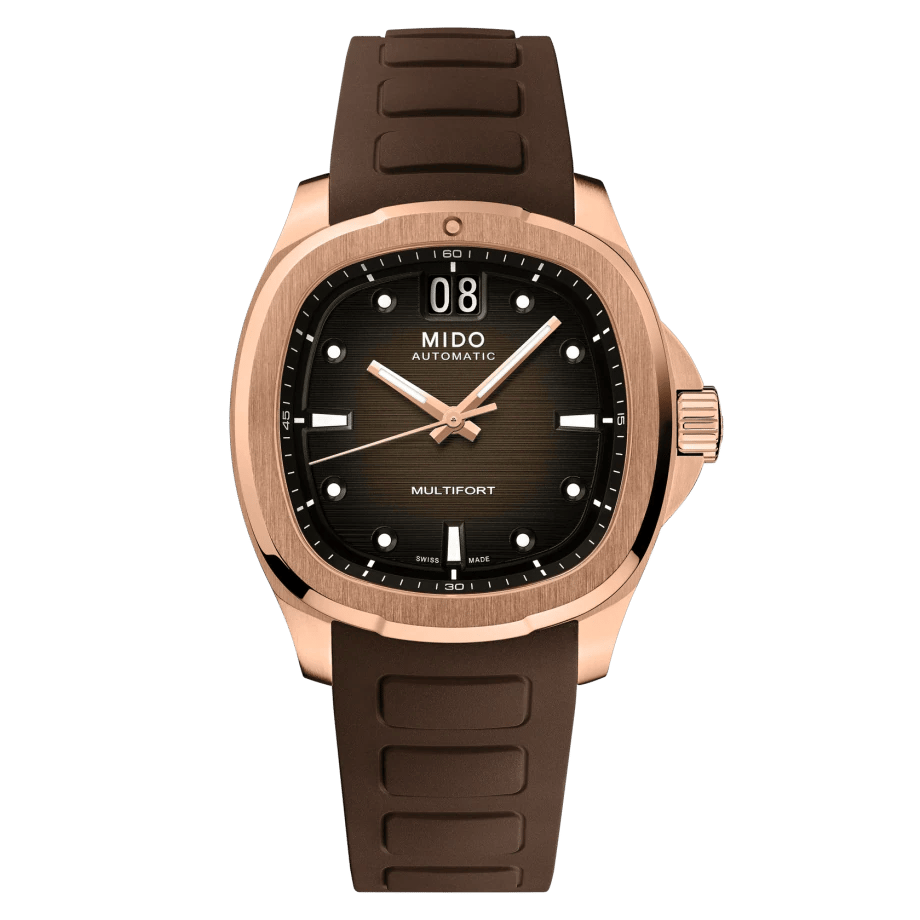
The Multifort TV Big Date Chronometer is the latest evolution of that idea. It takes the rounded-square case of the original and adds a big date complication—a practical, highly legible feature that suits the watch's sporty character. The case is stainless steel, 40mm across, 11.2mm thick, and 44mm lug-to-lug. That last number is the one that matters most for daily wear, and it is remarkably compact for a watch with this much visual presence.
Movement and Specifications
Inside is Mido's Caliber 80.611, an automatic movement based on the ETA C07.651 architecture. It runs at 21,600 vph and delivers an 80-hour power reserve, which means you can take it off on Friday evening and pick it up on Monday morning without resetting the time. The big date module is integrated cleanly, and the movement is COSC-certified—a rare spec at this price point.
Finishing is industrial but tidy: Geneva stripes on the rotor, blued screws, and a signed oscillating weight. You won't see it through a display caseback (the watch has a solid back), but the certification is what matters here. The movement is not in-house—Mido is part of the Swatch Group and uses ETA bases—but that is a strength for serviceability and long-term reliability.
Other specs: sapphire crystal, 100m water resistance, Super-LumiNova on the hands and indices, and a stainless steel bracelet with a folding clasp. The case is 40mm in diameter, 11.2mm thick, and 44mm lug-to-lug. Water resistance is 100m, enough for swimming and showering. The crystal is sapphire, and the lume is Super-LumiNova. These are the numbers that matter for real-world use.
On the Wrist: Comfort and Balance
On my 17.5cm wrist, the 44mm lug-to-lug is the sweet spot: the TV case sits flat and centered, with no overhang or wobble. The 11.2mm thickness slides under a dress shirt cuff, and the 40mm width gives it a confident but not bulky presence. The bracelet is well-articulated, tapering nicely toward the clasp, and the links flex enough to avoid pinching. It is one of those watches you forget you are wearing by lunchtime.
The case shape does most of the comfort work here. Because the lugs curve down sharply, the watch hugs the wrist rather than floating. The folding clasp is secure, though it lacks a tool-less micro-adjust—a minor annoyance if your wrist swells in summer. Still, the overall balance is excellent, and the watch never feels top-heavy.
I wore it for a week straight, including a day of yard work and a sweaty gym session. The watch stayed put, the bracelet didn't pull hair, and the case didn't catch on sleeves. The 100m water resistance meant I didn't have to worry about splashes or a quick swim. This is a watch that is designed to be worn, not babied.
Legibility and Daily Use
The dial is where the Multifort TV Big Date Chronometer shines. The blue gradient dial (a fumé effect that darkens toward the edges) gives it depth without being flashy. The applied indices are faceted and catch the light, and the Super-LumiNova is applied generously. At night, the lume glows blue-green and remains readable for hours.
The big date is the star of the show. Positioned at 12 o'clock, it uses two independent discs to display the date, making it much easier to read at a glance than a traditional small date window. The numerals are large, crisp, and aligned perfectly. Even in low light, the date is legible. This is a practical complication that genuinely improves daily use.
The hands are broad and sword-shaped, with lume-filled centers. The seconds hand is thin but visible, and the minute track is clear. The only minor quibble is that the date window can wash out at certain angles when light reflects off the sapphire crystal, but that is a rare occurrence. Overall, legibility is excellent.
Accuracy: COSC and Real-World Performance
With COSC certification, the spec is -4/+6 seconds per day. Over seven days of mixed wear, mine averaged +3 seconds per day, which is exactly what you want from a chronometer. I checked it against a timegrapher and a radio-controlled clock; the rate was consistent whether fully wound or after a day on the desk. You can expect real-world accuracy in the +2 to +4 range, which is excellent for the price.
The 80-hour power reserve means the watch keeps running even if you skip a day of wear. I left it off for a full weekend and it was still running on Monday morning, only a few seconds off. That is a level of convenience that makes a daily wearer much easier to live with.
Occasions and Versatility
This is a true everyday watch. It works with jeans and a T-shirt, a blazer, or a suit. The integrated-style bracelet gives it a sporty edge, but the dial is refined enough for dressier occasions. I wore it to a casual dinner and to a business meeting; it felt appropriate in both settings. The 100m water resistance means you can swim with it, and the sturdy bracelet can handle daily abuse.
It is also a great travel watch: the big date is easy to read in a hotel room, the power reserve means you can leave it in a safe for a day, and the 100m water resistance handles pool time. The only thing missing is a GMT complication, but for most travelers a big date and reliable timekeeping is enough.
Variants and Family
The Multifort TV Big Date Chronometer is currently offered in one main configuration I tested: reference M049.526.11.081.00, with a blue gradient dial and a stainless steel bracelet. The non-chronometer version is also available with different dial colors, and there is a smaller Multifort TV 35 for those who prefer a more compact case. The family also includes the Multifort Patrimony, a more classical dress watch.
Mido's other notable models include the Ocean Star 200C (a capable dive watch), the Commander 1959 (a vintage-inspired dress piece), the Baroncelli Heritage (a slim dress watch), and the Belluna Royal (a more ornate option). The Multifort TV Big Date Chronometer sits at the intersection of sport and everyday elegance, which is a sweet spot for many collectors.
Comparisons and Alternatives
If you are considering the Mido, you might also look at the Tissot PRX Powermatic 80. It has a similar integrated bracelet and TV-inspired case, but it lacks the big date and the chronometer certification. It is also less expensive, which makes it a strong value alternative. The Christopher Ward Twelve offers a more angular case, a COSC movement, and a similar price—but it has a standard date window, not a big date. The Nivada Grenchen F77 is another vintage-inspired TV case, though it is more focused on heritage styling than daily wear.
For homage options, the Maen Manhattan 40 is a TV-case watch with an integrated bracelet that captures a similar vibe for around $650. The Brew Metric is a cushion/TV case with a focus on legibility and comfort, priced around $450. Neither has a big date or COSC certification, but they offer a taste of the style for less.
Investment and Service
The MSRP is around $1,400, and current retail is the same. Pre-owned examples trade between $900 and $1,100, which means depreciation is modest but not zero. This is not a watch to buy as an investment; it is a watch to buy to wear. The COSC certification and big date make it a strong long-term daily wearer, and it should hold value reasonably well because of its practical features.
Service interval is typically every 5 years, with an approximate cost of $300 through Swatch Group service centers. Authorized service is recommended, though independent watchmakers can handle the ETA-based movement. There is no major auction history for this reference, which is expected for a modern, accessible watch.
Final Verdict
The Mido Multifort TV Big Date Chronometer is a rare thing: a characterful, comfortable daily watch with a big date and chronometer certification at a fair price. It wears beautifully, keeps excellent time, and flies under the radar. If you want a TV-case watch that you can actually live with, this is one of the best choices available.
Pros: COSC-certified accuracy; comfortable TV case; big date is easy to read; 80-hour power reserve; versatile integrated-bracelet look.
Cons: Bracelet lacks micro-adjust; brand recognition is lower than peers; date window can wash out at some angles.
At $1,400, it is a strong value proposition. It doesn't have the brand cachet of aTissot or a Christopher Ward, but it delivers on the fundamentals: accuracy, comfort, legibility, and a design that stands out without shouting. After a week on the wrist, I was sad to send it back.