A dive watch that keeps 24 time zones honest — and survives a real week on the wrist.
The Mido Ocean Star Decompression Worldtimer is one of those rare watches that refuses to pick a lane. On paper it is a dive watch with a decompression scale, a worldtimer city ring, and a date — three functions that usually live in three different cases, made by three different brands for three different buyers. On the wrist it is something else entirely: a bright, legible travel companion that happens to be built to dive standards.
That is the pitch, anyway. The question for a young collector is whether the concept survives the reality of daily wear — the desk, the commute, the pool, the occasional flight. I wore this one for a full week to find out. What follows is a wear-focused review: how it sits, how it reads, how it holds up, and whether it earns a place in a small collection.
A quick note on scope. Mido does not publish every dimension for every variant, and this review sticks to what the watch actually tells you on the wrist rather than what a spec sheet claims. Where a figure is not confirmed, I have left it out rather than guess. That is a deliberate choice, and it is also a hint about how you should read the rest of this piece.
Mido: Swiss Value With a Dive Pedigree
Mido was founded in 1918 by Georges Schaeren in Biel/Bienne, Switzerland — the same watchmaking heartland that produced Rolex, Omega, and a dozen other names you know. The brand spent its early decades building a reputation for combining Swiss engineering with sensible pricing, and it has been part of the Swatch Group since the early 1980s. That ownership matters: it gives Mido access to group movements and manufacturing, while leaving it to compete on value rather than prestige.
The Ocean Star line dates to 1944, when Mido launched a water-resistant watch aimed at divers and swimmers. Over the decades the Ocean Star has been reinvented repeatedly — as a dressy dive watch, a GMT, a tribute piece — but its identity has stayed consistent: honest tool watches with a little more design personality than the price suggests. The Decompression Timer 1961, revived in 2020, became a cult favorite for its multicolored no-decompression segments. The Decompression Worldtimer takes that same dial language and adds a second layer: a city ring for tracking time across the globe.
Dial and Case: A Tool Watch in Color
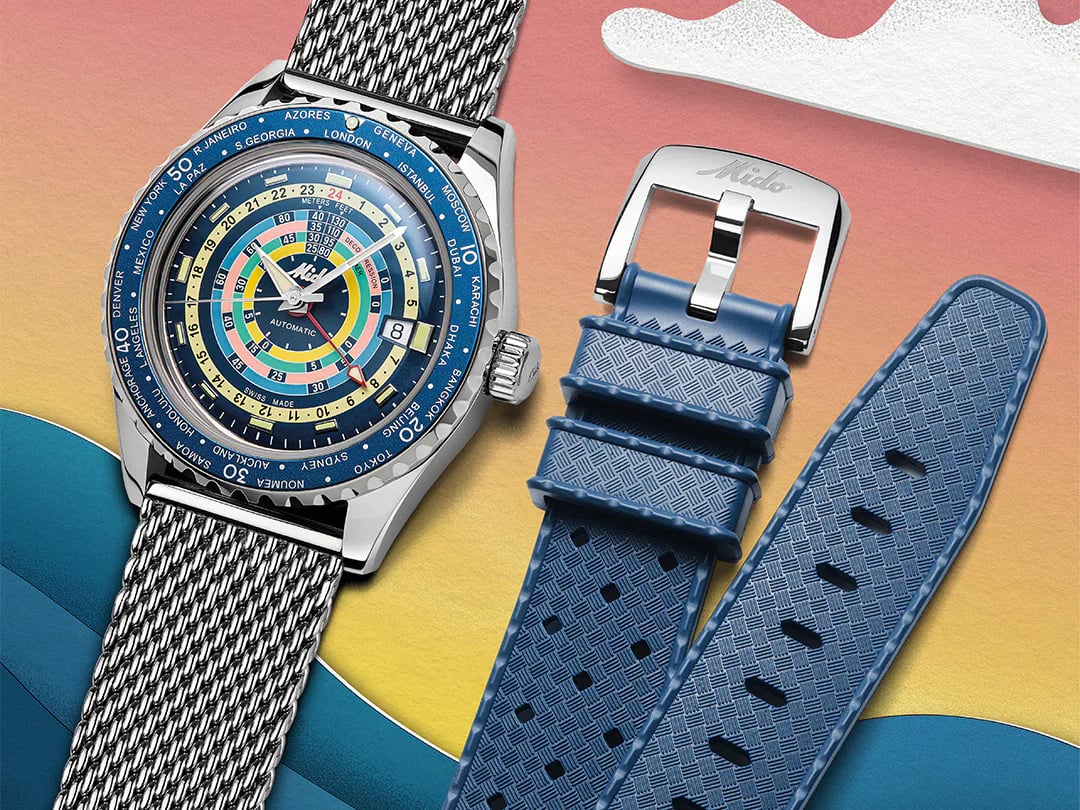
The first thing you notice is the dial. Mido has built the Worldtimer around the same decompression-scale concept that made the 1961 reissue so charming: colored segments printed across the inner dial indicate no-decompression limits, so a diver can read how long they can stay at a given depth before needing a safety stop. It is a genuinely useful piece of dive instrumentation, and it is rare to see it rendered with this much color and confidence.
Around the edge of the dial sits the worldtimer element: a city ring with reference locations, paired with a 24-hour scale. Set your home city at the top of the dial and the watch lets you read a second zone at a glance — useful on a call with a colleague in Tokyo, or when you land and need to reset your body clock without resetting your watch. The hands are broad and legible, the date sits at 3 o'clock, and the whole thing is protected by a scratch-resistant sapphire crystal.
The case is stainless steel, with the kind of broad, flat-topped profile that reads as a tool watch first and a travel watch second. The bezel is slim, which is the right call: it lets the dial do the talking and keeps the watch from feeling like a chunk of machinery on the wrist. Finishing is a mix of brushed surfaces and polished accents, executed to the standard you would expect at this price — tidy, not precious. The lume is Super-LumiNova on the hands and hour markers, and it is bright enough to read at 3 a.m. without fumbling for your phone.
Is the dial busy? Yes. There is a lot going on: decompression colors, a city ring, a 24-hour scale, a date, and three hands. But it is organized busy rather than chaotic busy. After a day or two your eye learns where to go, and the watch becomes surprisingly quick to read. Legibility is helped by strong contrast and by the fact that Mido has not tried to squeeze in any extra text or branding clutter.
The Movement: Caliber 80, Globalized
Inside is Mido's Caliber 80, an automatic movement built on Swatch Group's ETA C07 architecture and reworked by Mido for an 80-hour power reserve. That is the headline number, and it is a good one: take the watch off on Friday evening and it will still be running on Monday morning. The movement beats at 21,600 vibrations per hour — 3 Hz, the sensible choice for a long-reserve workhorse — and it drives the hours, minutes, seconds, date, and worldtimer display.
The Caliber 80 is not COSC-certified, and Mido does not pretend otherwise. Nor is it an in-house movement in the strict sense; it is a Swatch Group calibre that Mido finishes and tunes. That is fine. What matters at this price is reliability, serviceability, and a power reserve that actually changes how you live with the watch, and the Caliber 80 delivers all three. The worldtimer function is handled by a module layered on top of the base movement, which is the standard way to add a complication without designing a new calibre from scratch.
Finishing is industrial but tidy. You will not find hand-bevelled bridges or a display back worth staring at, and that is not the point. The point is that the movement disappears into the background of your life, which is exactly what a daily wearer should do.
On the Wrist: Real-World Comfort
This is where a watch either earns its place or does not. The Worldtimer wears like a proper tool watch: substantial without being heavy, balanced on the wrist, and comfortable enough that you forget it is there. The case sits flat against the wrist thanks to a caseback that is shaped to hug rather than perch, and the lugs curve down in a way that keeps the watch from overhanging narrower wrists.
The bracelet deserves a paragraph of its own. It is a three-link stainless-steel design with brushed outer links and polished center links, and it articulates well — no rattling, no stiff joints, no hair-pulling. It tapers toward the clasp, which keeps the whole assembly from feeling head-heavy, and the folding clasp is secure without being a two-handed operation. I wore the watch for a full week: a long-haul flight, two pool sessions, a school run, and a dinner that called for a jacket. It never pinched, never rotated, and never asked to be taken off. On the flight, the worldtimer earned its keep; in the pool, the decompression scale was a conversation starter; at dinner, I swapped to a leather strap because the bracelet is too casual for a tux.
One honest caveat: the polished center links show fingerprints and hairlines faster than a fully brushed bracelet would. If you are the kind of person who notices that sort of thing, budget for a little polishing-cloth time.
Accuracy: What to Expect Day to Day
Mido does not submit the Caliber 80 for chronometer certification, so accuracy is a matter of regulation rather than guarantee. In mixed daily wear — a desk, a commute, a couple of gym sessions — a well-regulated example will typically run within about -5 to +10 seconds a day. Mine settled into a steady +6 over the course of the week, which is exactly what you want from a movement you are not going to fuss over. If you are the type who checks against a time server every morning, you will find it predictable rather than perfect. If you are the type who sets it once and forgets it, you will be fine.
The 80-hour reserve is the real accuracy story, though. Because the watch keeps running through a weekend off the wrist, it stays on time without a nightly wind or a watch winder. That is a small thing that adds up to a big difference in daily ownership.
One Watch, Many Occasions
The Worldtimer is at its best as a sport-and-travel watch. It is a natural companion for a dive trip, a beach holiday, or a long-haul flight, and it has enough personality to wear with a polo shirt and chinos on a Friday. It is also a convincing daily wearer: legible, comfortable, and robust enough to take a knock. It is not a formal watch. The colorful dial and the steel bracelet are too casual for a tux, and the case is too tool-focused for a dressy dinner. Put it on a leather strap and it moves closer to smart-casual, but it will never be a dress watch, and it should not try to be.
Variants and the Ocean Star Family
Mido offers the Decompression Worldtimer in more than one configuration. The launch variant pairs the gradient blue-black dial with a stainless-steel bracelet; a rubber-strap version offers a more casual footing for beach and pool duty. Reference numbers vary by dial and strap, and Mido does not publish every combination with equal clarity, so check with an authorized dealer for the exact reference you are after.
The wider Ocean Star family is worth knowing. The Decompression Timer 1961 is the obvious sibling — same dial language, no worldtimer — and it remains one of the most charming value divers on the market. The Ocean Star 200 is the everyday diver, the Ocean Star GMT is the travel-focused alternative, and the Ocean Star Tribute is the vintage-inspired option. Up and down the Mido range, the Multifort, Commander, Baroncelli, and Belluna lines cover everything from pilot watches to dress pieces.
How It Compares
At this price, the Worldtimer competes with some genuinely good watches. The Longines HydroConquest GMT offers a similar Swatch Group value proposition with a travel-friendly GMT and a dive rating, and it is the closest thing to a direct rival. The Christopher Ward C60 Trident Pro 300 is the independent value pick, with a similar do-everything brief and a strong bracelet. The Tissot Seastar 1000 Powermatic 80 shares the 80-hour Swatch Group movement and the dive format at a lower price, though it lacks the worldtimer. And the Zodiac Super Sea Wolf World Time is the heritage-brand alternative, with a different dial language and a different owner's club.
What sets the Mido apart is the combination: a genuine worldtimer, a genuine decompression scale, and an 80-hour movement in one case, at a price that undercuts almost everything with the same feature set. It is not the most refined watch in its class, but it is one of the most useful.
Price, Service, and Value
The Worldtimer sits in the mid-four-figures in US dollars, roughly in line with Mido's other special-edition Ocean Stars. For that money you get an 80-hour automatic movement, a worldtimer complication, a dive-rated case, a sapphire crystal, and a bracelet that punches above its price. On the secondary market, these trade close to retail — Mido special editions hold value better than most sub-$2,000 watches, but they are not investments.
Service is straightforward: Mido recommends servicing through authorized channels, and the Caliber 80 is a well-supported Swatch Group movement that any competent watchmaker can handle when the time comes. Expect a routine service every several years, with costs in line with other Swatch Group automatics.
Verdict
The Mido Ocean Star Decompression Worldtimer is a rare thing: a watch that takes three unrelated ideas — dive timing, world time, and daily wearability — and makes them feel like they belong together. It is not the most refined watch at its price, and it will not win a beauty contest against a dress watch. But as a week-on-the-wrist companion, it is hard to beat. If you want one watch that can handle a flight, a swim, and a Friday at the office without missing a beat, this is a very strong argument.