Minase is the quietest flex in Japanese watchmaking
There is a specific kind of collector who has stopped buying watches to be recognized and started buying them to be understood. Minase builds for that person. The company has been machining components in Yuzawa, in Akita Prefecture, since 1963 — a snow-country town known for hot springs and machining tolerance in roughly equal measure — and its own-brand watches are a comparatively recent chapter. That origin story matters, because it means the 7 Windows arrives without a heritage film, a racing sponsorship, or an ambassador in a tailored suit. It arrives with a case that is machined, finished, and assembled by hand, and a price that sits below almost everything Swiss doing anything remotely comparable.
The 7 Windows is the model that made Minase's name outside Japan. The Steel 2.0 is the current steel expression of it, and if you spend ten minutes with one it becomes obvious that the whole watch is built around a single thesis: that the case is the most underrated piece of watchmaking there is, and that a small Japanese company can out-execute brands ten times its size in exactly one discipline.
This is a review for people who already own a dive watch and are now looking for something that rewards a closer look. It is a dress-adjacent everyday watch from a supplier that got tired of being anonymous.
The case is the entire argument
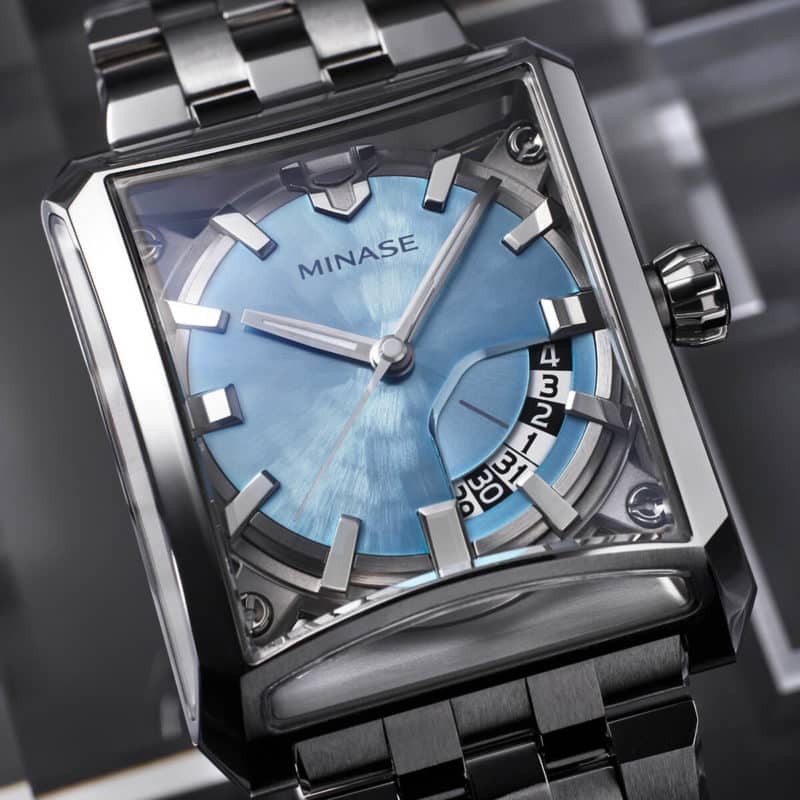
The name is not a dial gimmick and it is not a reference to sub-dials. The 7 Windows refers to the case, which is built from a stack of separately machined components rather than stamped from a single billet or pressed together as a mid-case-and-bezel sandwich. The 'windows' are the openings and facets that appear between those components — you see them from the side and around the lugs, and they are the reason the watch photographs poorly and looks extraordinary in person.
Because the lugs are discrete pieces rather than extensions of the case, Minase can finish each surface independently before assembly. That is where the money goes. The polished surfaces are mirror-grade, the brushed surfaces are grained with unusual consistency, and the transitions between them are cut rather than blended — a hard, architectural edge that Swiss brands at this price point typically round off because rounding is faster. Look at the top of a lug, then the side, then the underside. All three are finished to the same standard, including the one nobody sees.
Screwed construction is used at the lugs, and it is visible. Some collectors will read that as industrial; others will read it as honest. Either way, it tells you something true about the watch, which is that it was designed by people who assemble things for a living rather than people who style things for a living.
A dial that behaves like a Japanese interior
Minase dials are not loud. They are not trying to be. The Steel 2.0's dial is built around applied indices with faceted, polished edges that catch light in a very narrow band — the effect is closer to a shoji screen than to a sunburst. It reads matte at arm's length and then glints when you move, which is exactly the kind of restraint that makes Japanese design legible to a certain kind of eye and invisible to everyone else.
The hands follow the same logic: faceted, polished, precisely proportioned, with no lume and no pretence of being a tool. This is not a watch you read in a dark car park. It is a watch you read in a restaurant, and it is significantly better at that job than most of its competitors.
The date sits where it should and does not interrupt the composition. There is no cyclops, no framed aperture, no unnecessary framing device — just a clean cutout that confirms Minase understands that a dress watch's job is to disappear at the edges and hold your attention at the centre.
The movement: borrowed architecture, local discipline
Here is where the 7 Windows requires a small act of faith. The calibre inside is a thin Swiss-derived automatic — an ETA 2892-based architecture that Minase regulates and finishes in-house — rather than an in-house Japanese movement. Minase does not publish a full technical dossier, so anyone quoting a jewel count or an exact base designation with total confidence is guessing. What is stated is standard thin-automatic territory: roughly 28,800 vibrations per hour and around 42 hours of power reserve.
That is a deliberate trade, and a smart one. An in-house movement would have pushed the price up and the case thickness with it, and thickness is the enemy of a watch like this. The ETA architecture is slim, serviceable anywhere in the world with a competent watchmaker, and well understood — which matters for a brand with a limited authorised service footprint outside Japan. Minase's contribution is regulation and finishing, and the watch keeps time like a properly adjusted thin automatic should.
Where the movement disappoints is in theatre. There is no exhibition caseback drama worth the word, no micro-rotor to admire, no hand-finished bridges to photograph for the group chat. Minase has spent the entire budget on the outside of the watch, and it expects you to be fine with that. Given the case, you probably will be.
On the wrist
This is a watch that disappears under a cuff and then ambushes you at dinner. The multi-component case distributes its mass intelligently, so it sits flat and low rather than perched on top of the wrist, and the bracelet articulates in tight, small links that follow the arm instead of hovering over it. Because the lugs are separate machined pieces, the curve at the bracelet's end is unusually generous — no floating gap, no pinch on the underside of the wrist, which is the usual failure point of stiff steel bracelets on dress watches.
It does not feel heavy the way a sports chronograph feels heavy. The weight reads as density rather than heft, and the absence of lume plots and a rotating bezel keeps the whole thing visually quiet. Wear it with a shirt and jacket for a full working day and you will forget it is there; wear it with a T-shirt and it reads as intentional rather than overdressed.
The trade-off is presence. On a scale of wrist statement, this is a three out of five. People who know watches will notice it — usually with a pause, then a question. Everyone else will register 'nice watch' and move on. If you need the room to know what you spent, this is the wrong purchase, and that is precisely the point.
Accuracy and daily behaviour
Expect a well-regulated thin automatic running comfortably inside chronometer-adjacent territory in daily wear once it has been broken in. There is no COSC certificate and no master-chronometer claim here, so treat the number on your timegrapher as a courtesy rather than a contract. Positional variation is normal for this architecture; if you rotate it with other watches, expect a small daily drift that averages out across a week.
What matters more than the rate is the consistency. Minase regulates each watch before it leaves Akita, and owners report steady behaviour rather than wild swings — the sign of a movement that was adjusted by a person rather than calibrated by an algorithm. It is not a watch you will set every morning, and it is not a watch you will obsess over either.
Buying, owning, servicing
Pricing sits in the mid-four-figure range at retail, with limited dial editions commanding more. On the secondary market, steel 7 Windows trade meaningfully below retail — which is good news for a buyer and mildly sobering news for anyone who bought at full price expecting an investment. Minase is a small-volume brand; the watches hold value in the sense that they do not collapse, but they do not appreciate either, and liquidity outside Japan is thin.
Service runs through Minase's authorised network, which is limited outside Japan. Budget for shipping, plan ahead, and do not expect a local turnaround on a Tuesday afternoon. The compensating factor is that the movement is a known quantity — any competent independent watchmaker can work on a thin ETA-based automatic — but for warranty and case work, authorised is the only route.
The competition
The obvious benchmark is Grand Seiko, and specifically the hand-wound SBGW231. Both are Japanese, both are dress watches, and both are built by people who regard finishing as an engineering problem rather than a marketing one. Grand Seiko wins on movement prestige and dial variety; Minase wins on case architecture and, frankly, on being less expected. Nobody at a collector dinner has seen one before.
Nomos is the German comparison — the same instinct toward restraint, the same willingness to put the money where it will be felt rather than photographed. The Tangente 38 Datum is more overtly designed, more Bauhaus, more legible as a statement. The Minase is quieter and more intricate, and it will appeal to someone who has already owned a Nomos.
Below that, the Baltic MR01 and Seiko Presage Cocktail Time are the affordable routes into the same aesthetic. They are good watches. They are also a reminder of what the Minase case actually costs — hand-finished multi-component construction does not scale down to a few hundred dollars, and you can feel the difference in your fingers the moment you pick one up.
Verdict
The 7 Windows Steel 2.0 is not competing on specification sheets. It is competing on the thing you notice in year three, which is how the case catches a room's light and how the bracelet settles into the wrist after an hour. It asks you to trust a snow-country components shop over a marketing department, and it rewards that trust with the kind of finishing that Swiss brands charge two to three times as much for and often do not deliver.
Buy it if you want a dress watch with an argument behind it, and if you are comfortable with a brand your colleagues cannot pronounce. Skip it if you need your watches to be liquid, luminous, or loud. Minase has made its choice about which of those matters, and the watch is better for it.