The Butterfly That Refuses to Sit Still
There is a butterfly in Japan that behaves less like an insect and more like a long-haul pilot. The asagimadara — the chestnut tiger, Parantica sita — migrates in numbers, sometimes covering more than a thousand kilometres across open water, turning up on islands where it has no business being and generally refusing to respect the map. Its wings are a wash of asagi, the green-tinged blue that Japanese dyers have been pulling out of indigo vats for centuries, broken by dark veins and dappled markings.
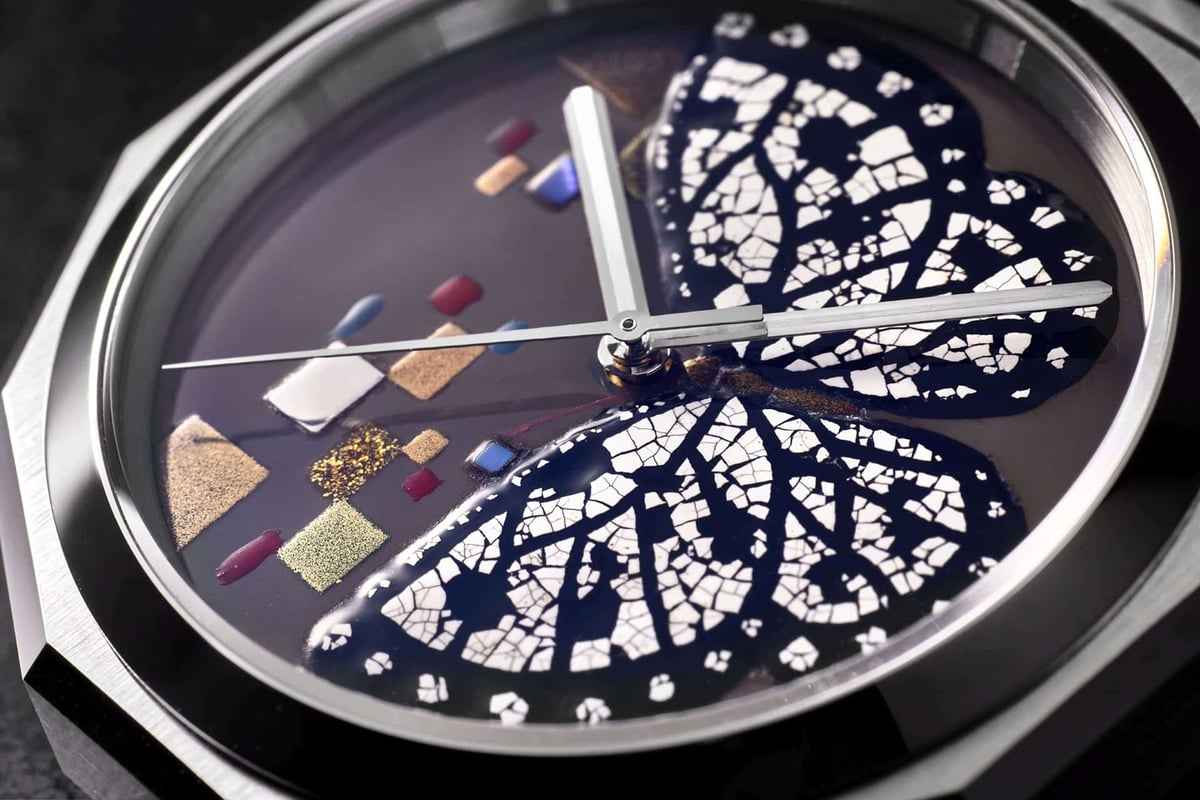
Minase, a small watchmaker working out of Akita Prefecture in Japan's north-west, has taken that insect and turned it into a dial. The Asagimadara is not a loud watch. It is the precise opposite of loud: a hand-finished object whose entire argument is made at conversational distance, in the way light slides across a mottled blue-green surface and the way a case edge catches a room.
If you already collect Japanese watches, you know why this matters. If you do not, here is the short version: some of the most interesting work in watchmaking right now is happening in workshops of five to fifty people, in Akita and Tokyo and Nagano, where the economics of scale do not apply and the only thing that matters is whether the person doing the polishing cares. Minase cares. The Asagimadara is the evidence.
Who Is Minase?
Minase was founded in 2005 in Yuzawa, a small city in Akita Prefecture in the far north-west of Honshu. The brand grew out of a regional case-making tradition rather than out of a marketing department, and that origin explains more about the Asagimadara than any spec sheet will. Minase is, at its core, a company that knows how to make a case.
That is a rarer skill than it sounds. Case finishing is where most watches quietly give themselves away. The difference between a case that has been machined and one that has been finished by hand is visible from across a table, even to someone who has never worn a watch. Minase's reputation rests on exactly that distinction: sharp, deliberate transitions between mirror-polished surfaces and brushed ones, edges that stay crisp instead of rounding off, and a consistency you normally associate with much larger houses.
The brand has never chased volume. Its catalogue is small, its production is deliberately limited, and it has built a following among collectors who want what Grand Seiko does — Japanese case craft at a serious level — in a package that does not announce itself to the room. The Asagimadara fits that brief exactly.
The Dial: Asagi, Madara, and a Great Deal of Patience
Everything about this watch is downstream of the dial. Minase has built the Asagimadara around a surface that reads pale blue-green from one angle and almost grey from another, with darker mottling that gives the whole thing depth rather than flatness. It is not a printed pattern and it is not a sunburst. It is closer to the way pigment behaves when it is laid down by hand and allowed to settle unevenly — which is the point, because the chestnut tiger's wings are not uniform either.
What makes it work is restraint. Nothing competes with the surface. The dial furniture is minimal, the hands are slim enough to let the background do the talking, and the typography stays out of the way. In a market where every second release is a collaboration with a cartoon or a colourway lifted from a sneaker, a dial that simply asks you to look at it is almost subversive.
The practical consequence is that the Asagimadara changes character depending on where you are. Under office lighting it reads cool and slightly formal. In direct sun the mottling opens up and the depth becomes obvious. Under the low tungsten glow of a bar it goes warm, almost bronze at the edges. That is the mark of a genuinely good dial: it does not have one best angle, it has several.
The Case: Where Minase Actually Earns Its Money
Minase does not publish case dimensions for this reference, and I am not going to invent them for you. What matters more is what the case does, because that is the part you actually live with.
The finishing is the story. Minase's reputation is built on hand-polishing, and it shows in the way the surfaces relate to each other. The transitions between polished and brushed areas are lines rather than gradients. On a mass-produced case those transitions are soft and slightly wavy; here they are crisp enough that you can feel the change of plane with a fingertip. The edges hold their definition, which is the hardest thing to achieve and the first thing to go when a brand starts cutting costs.
There is also a discipline to the design that is distinctly Japanese. Nothing is decorative for its own sake. There are no fake screw heads, no unnecessary bevels, no borrowed codes from dive watches or pilot watches. It is a dress watch that knows what it is, drawn by someone who has spent a long time looking at watches and deciding what to leave out.
The Movement: The Part Minase Will Not Talk About
Here is where I have to be straight with you. Minase does not publish a caliber designation for the Asagimadara. It does not publish a power reserve figure. It does not submit the watch for chronometric certification. There is no COSC certificate, no master-chronometer badge, and no in-house movement mythology to sell you.
What that means in practice is that the Asagimadara runs on an externally sourced automatic movement, and Minase treats that movement as a means to an end rather than a marketing asset. In an era when half the industry would rather you admired a bridge than a dial, that is an unfashionable position. It is also an honest one. Minase is a case company that happens to make watches, and it has decided to spend its money where you can see it.
Is that a problem? Only if you buy watches to talk about them. The movement is a known quantity, serviceable by any competent watchmaker, and entirely beside the point of what this watch is. If you want a movement story, buy something else. If you want a dial that stops conversations, keep reading.
On the Wrist
The Asagimadara is a watch you forget you are wearing, and I mean that as praise. The balance is right. The case sits close to the wrist, the strap breaks in quickly, and there is none of the top-heaviness that plagues dress watches built on thick cases with heavy dials. It slides under a shirt cuff without a fight, which is exactly what you want from a watch in this category.
The dial, however, does not disappear. That is the interesting tension here: physically the Asagimadara is discreet, visually it is not. You will catch yourself looking at it during meetings. Other people will catch you looking at it during meetings. That is the whole trick, and Minase has executed it cleanly.
Comfort over a long day is excellent, and the strap choice matters more than usual. A stiff, over-engineered leather fights the case and makes the whole thing feel heavier than it is; something softer and slightly matte lets the dial carry the watch. This is a piece that rewards being set up properly.
Accuracy
Without published chronometric certification, the honest answer is that accuracy depends on how the individual movement was regulated and how you wear it. Expect a well-made automatic to keep time within the range you would expect from a mid-tier ebauche — a handful of seconds a day, varying with position, temperature and how much of the night it spends on a bedside table.
What matters more than a number is stability. A movement that runs consistently fast is easy to live with; a movement that wanders is not. Buy from a dealer who will put the watch on a timing machine before it leaves the shop, and have it regulated if it needs it. That is a five-minute conversation that will save you a year of irritation.
When You Would Wear It
This is a dress watch first and a daily wearer second, and it is very good at both. It belongs with a suit, a jacket, or a plain oxford cloth shirt with the sleeves rolled. It is entirely at home at a wedding, a gallery opening, or a dinner where nobody is going to ask you what is on your wrist — which is, frankly, the best kind of dinner.
It is not a sports watch and it does not pretend to be. Do not take it swimming. Do not wear it to the gym. If you want one watch that does everything, this is not it, and Minase has never claimed otherwise. What the Asagimadara offers instead is a specific pleasure: a formal watch that is interesting enough to wear on a Tuesday when nothing formal is happening.
Limited by Design, Not by Marketing
Minase does not run limited editions the way Swiss brands do — a colourway, a numbered caseback, a press release timed to a trade fair. The brand's production is simply small, and the Asagimadara exists because someone in the workshop wanted to make it. That distinction matters when you are deciding whether a watch is genuinely scarce or merely marketed as such.
The consequence is that you will almost certainly never see another one on a wrist in the wild. In a hobby increasingly dominated by waiting lists and Instagram flexing, that is a strange and rather lovely thing: a watch whose appeal is almost entirely private, and which only reveals itself to the people who bother to look closely.
What It Is Up Against
Grand Seiko SBGW231. The obvious comparison, and the one most buyers will make. Grand Seiko brings its own movement manufacture, its own dial-making and a level of brand recognition Minase will never have. What Minase brings is scarcity and a dial Grand Seiko does not make. If you want the safe answer, buy the Grand Seiko. If you want the one nobody else at the table has, buy the Minase.
Kurono Tokyo. Hajime Asaoka's brand occupies similar territory: small-batch Japanese watches with art-directed dials and a cult following. Kurono leans more graphic and more obviously designed; Minase leans more classical and more focused on casework. Both are exercises in restraint, and Kurono's releases selling out in minutes tells you where the collector appetite currently sits.
Nomos Glashutte Orion. The German counterargument. Nomos gives you an in-house caliber, a clean Bauhaus dial and a strong value story. It does not give you hand-polished Japanese casework or a dial with this much depth. Different philosophies, similar money, and the right answer depends entirely on whether you want to admire a movement or a surface.
Seiko Presage enamel and urushi references. Seiko's craft-dial models deliver a genuine Japanese artisanal story for considerably less money. What they do not deliver is Minase's level of case finishing or the same sense of a small workshop behind the product. If the dial is all you care about, Presage is a smart buy. If the whole object matters, it is not a substitute.
Cheaper Ways Into the Look
Seiko Presage Cocktail Time SRPB41 (around $425). A blue sunburst dial with real presence under light. It is not the same craft, but it gets you most of the visual effect for a fraction of the money.
Orient Bambino (around $250). The default answer for anyone who wants a proper dress watch on a budget. Classic proportions, a reliable automatic, and a dial that behaves itself.
Tissot Le Locle Powermatic 80 (around $650). Swiss, well made and unapologetically conventional. It will not surprise anyone, but it will not disappoint anyone either.
The Money Question
Minase does not publish a US retail price for the Asagimadara, and the brand's automatic references generally sit in the low-to-mid four-figure band. That puts the Asagimadara in direct competition with Grand Seiko, Nomos and the upper end of Seiko's craft-dial range — a serious neighbourhood.
What you are paying for is finishing and scarcity, not horology. There is no in-house movement to justify the number, no precious metal, no complication. The value proposition is that a very small number of people in Akita made this dial and this case by hand, and you can see the difference every time you look down. That is either worth the money to you or it is not, and no review can decide that for you.
On resale: this is not a watch to buy as an investment. Minase does not have the secondary-market liquidity of the big Swiss names, and limited production does not automatically mean appreciating values. There is no meaningful auction track record to point to. Buy it because you want to wear it. If you are looking for an asset, look elsewhere.
Service and Ownership
The movement is serviceable by any competent independent watchmaker, which is a genuine advantage of not having an exotic in-house caliber. Case refinishing is a different matter: the whole point of this watch is its finishing, and you should not hand it to someone who has never worked on a Minase. Expect to send it back to the brand or to a specialist for anything cosmetic.
Ownership is otherwise straightforward. There is no proprietary strap system to lock you in, no app, no firmware, no subscription. It is a mechanical object that will outlive most of the things you own if you look after it.
The Verdict
The Minase Asagimadara is a watch for people who have already owned the obvious things. It does not have the movement story, the certification or the brand equity to win an argument on paper, and it is not trying to. What it has is a dial that rewards attention, case finishing that embarrasses watches costing considerably more, and the kind of scarcity that comes from a small workshop doing careful work rather than a marketing team manufacturing hype.
If you want a dress watch that nobody else at the table is wearing, and you are willing to pay for craft rather than for a name, this is one of the most satisfying ways to spend the money. If you need a certificate and a resale chart to feel good about a purchase, it is not for you — and that is fine, because Minase was never going to make enough of them anyway.