The Akita Aesthetic: Beyond the Surface
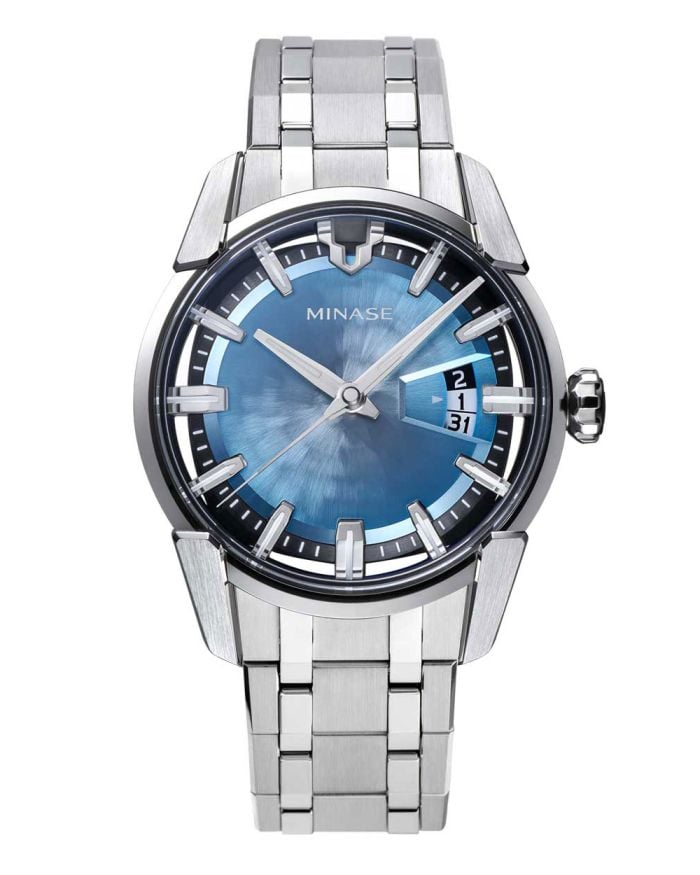
In the quiet town of Minase, within the Akita Prefecture of Japan, a small group of artisans is quietly redefining the boundaries of case construction. The Minase Divido, specifically the reference VM14-M01GGR-SSB, is the physical manifestation of a philosophy known as Monozukuri—the Japanese art of making things. While mainstream luxury brands often focus on the movement as the primary value proposition, Minase turns its attention outward, treating the case and dial as an integrated architectural site.
Minase is not a traditional watchmaker by origin. They are a subsidiary of Kyowa Co., Ltd., a specialist tool manufacturer. This lineage is vital to understanding the Divido. When you hold this watch, you are not just holding a timekeeper; you are holding the result of decades of expertise in precision metal cutting, drilling, and polishing. The Divido is named for the Italian word for 'divided,' a nod to the complex, multi-part construction of the case that allows for unparalleled finishing access.
The 'More' Structure: A Horological Puzzle
The core of the Divido’s appeal is the 'More' structure (Minase Original Rebuild Equation). Inspired by Kumi-ki wooden puzzles, this construction method involves a case-within-a-case design. The movement is housed in a central container, which is then surrounded by an outer frame of lugs and case walls. This is not merely an aesthetic choice; it is a functional one. By making the watch modular, Minase ensures that every single part can be disassembled and replaced or refinished independently.
For the collector, this offers a level of longevity that is rare in the modern era. If a lug is severely dented, it can be replaced without necessitating a whole new case. Furthermore, this 'divided' architecture allows the artisans to apply Sallaz polishing to surfaces that would be unreachable on a traditional monobloc case. The result is a series of sharp, intersecting planes that catch the light with a mirror-like clarity that rivals, and perhaps exceeds, the Zaratsu finishing found on Grand Seiko's finest offerings.
The Dial: A Floating Verdant Void
The reference VM14-M01GGR-SSB features a green gradient dial that is nothing short of hypnotic. The dial itself is part of the 'case-in-case' system. It is not a flat disc but a complex assembly where the indices are actually attached to a ring that sits between the inner movement box and the outer case. This creates a visual effect where the dial appears to float in space, suspended within the box-type sapphire crystal.
The green finish is applied with a subtle gradation—deeper at the edges and slightly more vibrant toward the center. This colorway, often associated with the lush forests of Akita, provides a perfect organic counterpoint to the cold, precise geometry of the steel case. The hands are hand-bent to follow the curve of the dial, a technical detail that prevents parallax error and demonstrates the brand's commitment to traditional watchmaking flourishes.
The KT7001/2 Movement: Precision and Finishing
Under the hood, Minase utilizes the Caliber KT7001/2. While the base architecture is derived from the Swiss ETA 2824 or Sellita SW200, it would be a mistake to dismiss it as a standard 'off-the-shelf' movement. Minase receives these movements as ébauches and subjects them to rigorous in-house modification. The bridges are decorated with circular perlage, and the screws are heat-blued to a deep cornflower shade.
The most striking modification is the rotor. Skeletonized to resemble a drill head—a tribute to Kyowa’s tool-making heritage—it allows for a clearer view of the movement's architecture. While the 38-hour power reserve is modest by contemporary standards, the movement's reliability and ease of service make it a practical choice for a daily wearer. The regulation is performed in-house, ensuring that the watch performs well within the expected tolerances for a high-end mechanical timepiece.
The Bracelet: A Masterclass in Steel
Often, boutique brands stumble when it comes to the bracelet, opting for third-party suppliers that lack the refinement of the watch head. Minase avoids this pitfall entirely. The Divido's steel bracelet is an extension of the case's design language. Each link is composed of multiple parts, allowing for full Sallaz polishing on every facet. There are no visible pins or screws on the side of the bracelet, giving it a monolithic, sculptural quality.
On the wrist, the bracelet is exceptionally supple. The tight tolerances between the links prevent any 'jingle' or play, and the folding clasp operates with a satisfying, tactile click. It is a design that feels integrated without the limitations of a proprietary lug system, though the Divido is at its best when kept on its intended steel 'armor.'
Technical Specifications and Wearability
With a diameter of 40.5mm and a lug-to-lug distance of 48.5mm, the Divido occupies the 'sweet spot' for the modern collector. It has enough presence to be noticed but remains slim enough at 12mm to slide under a double cuff. The water resistance is rated at 50 meters, which is sufficient for daily life, though this is clearly a watch designed for the boardroom or the gallery, not the pool.
The lack of luminous material on the dial and hands might be a deterrent for some, but in the context of the Divido’s design, it is a logical omission. Lume would disrupt the clean, polished surfaces of the indices and hands, which are designed to catch even the faintest ambient light. In practice, the watch remains legible in low-light conditions simply because of the way its facets reflect whatever light is available.
Final Thoughts: The Connoisseur’s Choice
The Minase Divido VM14-M01GGR-SSB is a testament to what can be achieved when a manufacturer prioritizes craft over volume. It is a watch that rewards close inspection, preferably with a 10x loupe. While it may lack the name recognition of the Swiss giants, it offers a level of soul and structural complexity that is increasingly rare in an era of mass-produced luxury.
For the sophisticated collector, the Divido is a statement of independence. It says that you value the 'how' and the 'where' of a watch's creation more than the logo on the dial. In the world of horology, where many watches are designed to look good in a press photo, the Minase Divido is a watch that is designed to be lived with, admired, and eventually passed down, thanks to its unique, repairable architecture.