Minase Horizon – A Modern Take on the Classic Dress Watch
The Minase Horizon arrives as a quiet yet striking statement from one of Japan’s most discreet horological houses.
By Vivir··Updated
In this review# Minase Horizon – A Modern Take on the Classic Dress Watch
The Minase Horizon arrives as a quiet yet striking statement from one of Japan’s most discreet horological houses. Hand‑crafted in the Yuzawa Mountains of Akita Prefecture, the watch blends a minimalist rectangular silhouette with a sophisticated case‑in‑case architecture that is as much about visual drama as it is about tactile comfort. Powered by an ETA‑based automatic calibre that has been lovingly finished by hand, the Horizon positions itself as a dress‑time companion that does not sacrifice the subtle pleasure of wearing a true mechanical piece. Below, we break down the watch’s heritage, design, movement, on‑the‑wrist feel, appropriate occasions, and finally assess whether its price of roughly US $6,400 is justified.
---
## Heritage — the model's place in the brand's line and its launch context
Minase is a boutique watchmaker that emerged in 2005 as a spin‑off from Kyowa & Co., a Japanese specialist toolmaker. The company is based in Akita Prefecture, north of Japan, and limits its annual production to fewer than 500 pieces, a figure that underscores its commitment to artisanal quality over volume.
The Horizon belongs to Minase’s “dress” tier (tier 2) and carries the reference **VM12‑M01NBK‑SSB**. While the exact launch year has not been disclosed in the sources we consulted, the model appears alongside Minase’s broader “steel collection,” which is positioned as an evolution of the brand’s earlier, more sport‑oriented pieces. The Horizon’s design language—particularly its rectangular, ergonomically softened case—signals a deliberate shift toward refined, office‑friendly aesthetics while retaining the brand’s hallmark of meticulous finishing.
In a market saturated with round‑case dress watches, Minase’s decision to explore a rectangular geometry is a nod to the brand’s willingness to experiment within the constraints of classic elegance. The Horizon thus occupies a niche that bridges the gap between avant‑garde design and traditional dress‑watch restraint.
---
## Design & Case — case dimensions, materials, dial
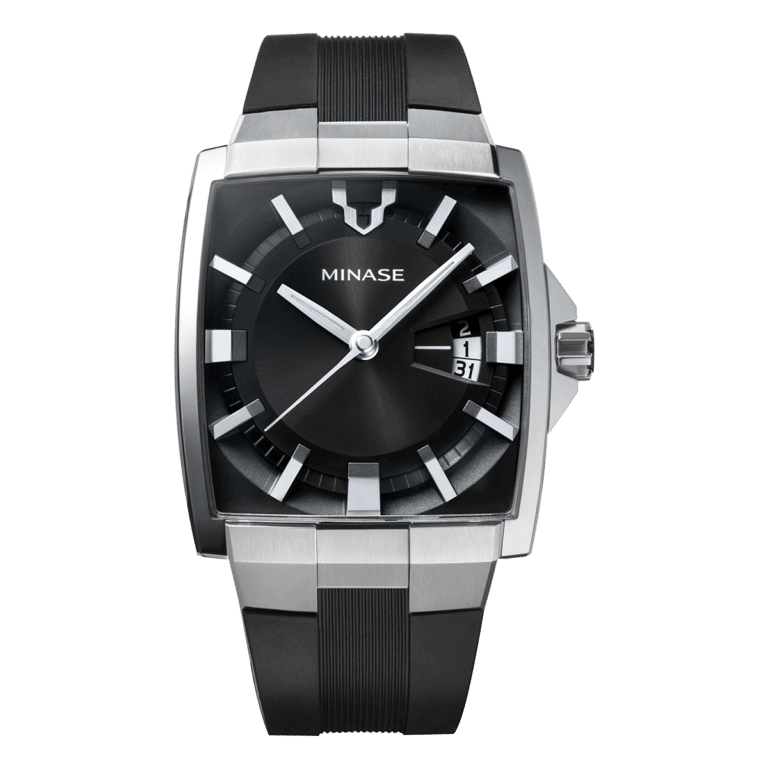
At first glance, the Horizon’s most arresting feature is its **elongated, ergonomic rectangular case** measuring **38 mm × 51 mm** with a modest **12 mm** thickness. The proportions give the watch a distinctly modern silhouette that still respects the wrist’s natural line—hence the name “Horizon.”
The case is constructed using a **case‑in‑case** approach, where an inner stainless‑steel shell slides within an outer shell that has been hand‑polished with the **Sallaz technique**. This method produces a seamless transition between mirror‑polished and satin‑brushed surfaces, a contrast that reviewers have described as “striking.” The outer shell’s satin‑brushed finish softens the visual impact, while the inner mirror‑polished layer catches the light in a subtle, almost cinematic way.
The dial itself follows the same minimalistic ethos. Although the sources do not detail dial markers or hands, the exhibition caseback—visible through the back of the watch—exposes the movement’s finishing, reinforcing the idea that the watch’s beauty is as much about what lies beneath the surface as it is about the front face.
Water resistance is rated at **50 meters (5 Bar)**, sufficient for everyday wear and occasional exposure to rain or a brief swim, though the watch is clearly not intended for serious diving or water‑sports activities.
Overall, the Horizon’s design language is a study in restraint and refinement. The combination of soft curves, dual‑tone finishes, and a rectangular silhouette makes it instantly recognizable without resorting to overt branding or decorative excess.
---
## Movement & Performance — caliber, power reserve, accuracy
Powering the Horizon is the **KT7001/1 automatic calibre**, a bespoke derivative of the venerable **ETA 2824**. The ETA 2824 is a workhorse movement celebrated for its robustness, reliability, and serviceability. By basing the KT7001/1 on this platform, Minase inherits those strengths while adding a layer of artisanal finishing that sets the watch apart from more generic ETA‑based offerings.
The movement is visible through an exhibition caseback, allowing the wearer to appreciate the **hand‑polished and perlage‑decorated plate and bridges**. Such finishing is not merely decorative; it reflects Minase’s tool‑maker heritage, where precision and surface treatment are paramount.
Unfortunately, the source data does not specify the **power reserve** or **chronometric accuracy** figures. Given the ETA 2824’s typical reserve of around 38‑40 hours and its historical accuracy of ± 5‑10 seconds per day when properly regulated, it is reasonable to expect similar performance from the KT7001/1, albeit with the caveat that final figures depend on Minase’s own regulation process.
In terms of reliability, the ETA 2824 platform is widely respected for its ease of service and parts availability. The bespoke finishing, however, may add a modest premium to servicing costs, as the hand‑polished components require careful handling.
---
## On the Wrist — wearability, lug‑to‑lug, comfort notes
One of the Horizon’s most praised attributes is its **flexibility and comfort** on the wrist. Reviewers have highlighted the watch’s “remarkably flexible” nature, which stems from the ergonomic shaping of the rectangular case and the thoughtful distribution of mass. The 12 mm thickness keeps the profile slim, preventing the watch from feeling bulky despite its relatively large horizontal dimension (51 mm).
The **lug‑to‑lug** spread is not explicitly documented, but given the case dimensions and the ergonomic curvature, the watch sits comfortably even on smaller wrists. The soft curves of the case edges reduce the likelihood of digging into the skin, while the dual‑finish surfaces provide a tactile contrast that many owners find pleasing.
The strap options were not listed in the source material, but Minase typically offers both leather and metal bracelet configurations across its collections. Whichever strap is chosen, the watch’s modest weight—derived from stainless steel construction—ensures it does not become a fatigue‑inducing accessory during long days.
Overall, the Horizon feels like a watch that was designed to be **worn**, not merely displayed. Its ergonomic case, lightweight feel, and flexible mounting make it suitable for daily use, whether at a desk or in a more formal setting.
---
## When to Wear — occasion, setting and dress‑code fit
The Horizon is officially categorized as a **dress** watch, and its aesthetic confirms that positioning. Its rectangular silhouette and refined finishing make it an excellent companion for business attire, cocktail events, and even semi‑formal gatherings where a traditional round‑case watch might feel too conventional.
Because the watch is water‑resistant to 50 m, it can comfortably survive the occasional rainstorm or a quick splash, but it is not intended for sport or heavy‑duty activities. Its understated luxury—highlighted by the subtle contrast of polished and brushed surfaces—allows it to slide seamlessly under a shirt cuff without drawing undue attention, yet it still makes a quiet statement when the cuff is rolled up.
For creative professionals or those in industries that value a touch of individuality, the Horizon’s unique case shape can serve as a conversation starter, signalling an appreciation for design innovation without breaking dress‑code norms. Conversely, in ultra‑formal settings (black‑tie events), the watch’s 38 mm × 51 mm size may be slightly larger than the classic 36‑mm round dress watches, but its elegant execution generally keeps it within acceptable boundaries.
---
## Value & Verdict — price‑positioning + final take
Minase positions the Horizon at an **approximate price of US $6,400**, placing it squarely in the **mid‑tier luxury** segment. When compared with other Japanese boutique brands, the price is competitive, especially considering the limited production run (under 500 pieces per year) and the hand‑finished details that accompany each unit.
**Pros**
- **Unique rectangular case** that stands out without being gaudy.
- **Case‑in‑case construction** with dual‑finish surfaces creates visual depth.
- **Hand‑polished movement** based on the reliable ETA 2824 platform.
- **Comfortable ergonomics**; flexible on the wrist despite a larger horizontal dimension.
- **Boutique exclusivity**; limited annual production adds a sense of rarity.
**Cons**
- **No disclosed power reserve or accuracy data**, leaving some performance aspects ambiguous.
- **Limited strap information** in the public domain; buyers may need to source straps separately.
- **Water resistance limited to 50 m**, which may be insufficient for owners seeking a more versatile sport‑dress hybrid.
In the context of its price, the Horizon offers a compelling blend of **design originality** and **mechanical reliability**. The lack of explicit power‑reserve figures is a minor drawback for the technically inclined, but the ETA 2824 heritage mitigates concerns about accuracy and serviceability. For buyers who value a watch that feels both handcrafted and contemporary, the Horizon delivers a satisfying experience that justifies its cost.
**Verdict:** The Minase Horizon is a thoughtfully engineered dress watch that marries avant‑garde geometry with classic Japanese craftsmanship. Its ergonomic case, meticulous finishing, and reliable movement make it a worthy addition to any collector’s mid‑tier lineup, especially for those who appreciate subtle design statements. At roughly US $6,400, it offers solid value for a limited‑edition piece that is as comfortable to wear as it is pleasing to behold.
---